



Use these calming tools to flip the switch on stress this season
The holiday season may be merry and bright, but it’s also frustrating… crowded… rushed… overwhelming… and stressful.
Your to-do list grows to five miles long, pulling you in 20 different directions at once. You’re expected to buy presents, decorations, and special foods no matter how tight your budget is. You may feel like you have to live up to perfect social media holiday photos (even though you know they aren’t real). Tricky family dynamics can add an extra layer of dread to the whole holiday stress casserole.
And all of this piles on top of your normal everyday stress. So it’s no wonder you feel a constant state of fight-or-flight.
But, you can take proactive steps to lower the effects of all that extra stress—even when you can’t avoid those stressors completely—so you can manage holiday cortisol chaos and the toll it can take on your body.
Cortisol Chaos Ramps Up the Pressure
When you feel stress, your body has a biological response.[1] That response involves a flood of hormones designed to save you from a dangerous situation. And the main hormone surge comes from cortisol.
Cortisol spikes can have a huge effect on your body. It makes you breathe faster so you can take in more oxygen. It makes you hyperaware by heightening your senses. It sends extra blood flow to your arms, legs, heart, and lungs so you can make a quick getaway or have more strength to fight. And it releases a lot of sugar to provide extra energy for all of that.
Once you’re out of danger, the cortisol faucet is supposed to shut off. Your body is supposed to release calm-down hormones to put your body into its rest-and-digest state.
But in the flurry of holiday stress, your body might not get that calm-down signal. And that can leave you feeling jumpy, edgy, and irritable… and with some super strong sugar cravings.
 Want to listen instead of read? CLICK HERE
Cortisol Regulation Is the Key to Calming Down
You don’t want to get trapped in a stress loop. Where your body never gets a chance to fully calm down. That’s why it’s so important to use your body’s own tools and systems for balancing cortisol levels.
Your gut microbiome plays a key role in cortisol management. Beneficial probiotic gut bacteria help soothe communication between the gut and the brain over the gut-brain axis. They also promote serotonin production, the feel-good neurotransmitter that acts as a natural counterbalance for cortisol.[2]
Vitamin D also plays a key role in cortisol management. This vitamin/hormone can block the enzyme that transforms cortisol into its active form when levels run too high.[3] Research shows that low vitamin D levels are linked to high cortisol levels… and healthy vitamin D levels promote lower cortisol.[4]
You can also use calming tools to help settle down your nervous system. Proven tools include things like meditation, deep breathing, and journaling.[5]
Without effective management, chronic stress can take hold, and that can lead to serious health consequences.
Chronic Stress Derails Your Health
Chronic stress locks your body in a near-constant state of fight-or-flight, with cortisol always on high.[6] In that state, many essential biological tasks get turned off. After all, when your body is focused on escaping extreme danger, it doesn’t have time for regular housekeeping and repairs.[7]
So when you’re stuck in a chronic stress cycle, you miss out on things like:[8,9]
- Restorative sleep
- Complete digestion
- Necessary cellular repairs
- Crucial hormone production and management
- Regular detoxification
All of those skipped processes disrupt important pillars of your health including your immune system and your emotional health.
Chronic stress can suppress regular immune function, leaving you more vulnerable to whatever happens to be going around. That takes a bigger toll during the holiday season when you’re more likely to be in crowds, in enclosed places like airplanes, and in close contact with people you don’t see regularly.[10]
Cortisol has direct effects on the brain as well, which can lead to emotional dysregulation. Research connects chronic stress with depression, anxiety, mood swings, crying jags, and feeling generally overwhelmed.[11,12] The stress hormone can ramp up already heightened emotions, making it even harder to enjoy the holidays.

Use This Holiday Stress Support Strategy for a Calmer Season
Keeping cortisol under control and balancing your body’s stress response can help you get through this holiday season more calmly.
Here are the best ways to turn down the temperature on your stress, balance cortisol, and give yourself a chance to fully relax. Use as many of these tools as you can every day to get ahead of stress and break out of a potential stress loop before you’re trapped in it.
- Listen to music. Research shows that listening to any kind of music you enjoy calms your nervous system and helps decrease cortisol. It can even slow your heart rate and lower blood pressure.[13]
- Practice self-soothing touch. Studies show that actions like putting your hands over your heart, stroking your arms gently, and hugging yourself reduce cortisol, lessen stress responses, and boost stress resilience.[14]
- Take a walk outdoors. Movement relieves stress, giving your fight-or-flight energy somewhere to go. Being outdoors enhances the calming effect, especially in areas with trees and plants. Exercising, especially outside, can help you feel rejuvenated and lower cortisol levels.[15]
- Introduce the “stress magician” probiotic B. longum 1714™ into your daily routine. This unique probiotic strain helps your body maintain balanced cortisol levels and calm stress signals, giving you the chance to deeply relax.[16] One clinical trial showed that B. longum 1714™ helps decrease nervous brain activity during times of social stress, a common holiday occurrence.[17] Another trial found that B. longum 1714™ helps promote healthy sleep quality during stressful times.[18]
- Bump up Vitamin D supplies. The holiday season happens to coincide with the shortest daylight hours, making it harder for your body to get a natural daily helping of vitamin D. Keeping your vitamin D levels in the healthy zone can support healthy cortisol from levels.[19] Research shows that vitamin D helps regulate cortisol release and support positive moods.[20,21] Get the most out of vitamin D by supplementing with the active form, vitamin D3, and pairing it with vitamin K2-7 (the most bioavailable form of K2) for maximum effectiveness.
Combining any or all of these techniques and tools will help your body manage stress more effectively, giving you a chance to fully relax and rejuvenate… and truly enjoy your holidays.
Just Thrive Stress Support Products

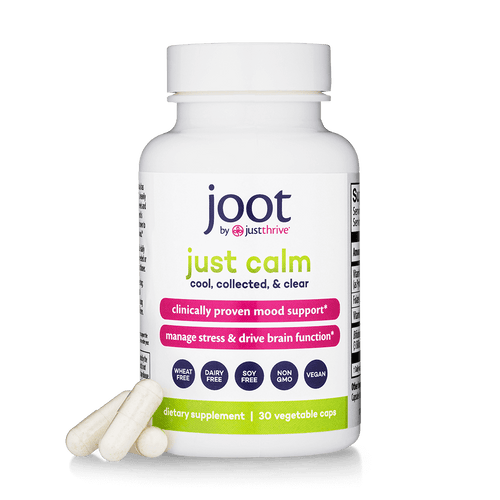

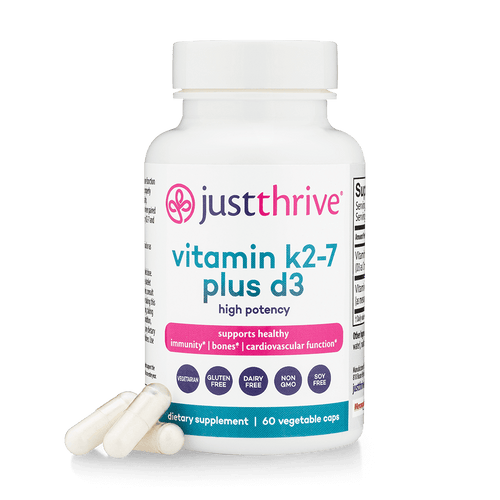
Keep Stress at Bay During the Holidays with Just Thrive
Your holiday anti-stress kit includes plenty of tools you can use safely every day. From journaling to calming walks outside to your favorite music. Adding Just Calm and Vitamin K2-7 Plus D3 into your support plan will keep your holiday season calm and peaceful.
Just Calm contains the clinically studied “stress magician” B. longum 1714™ along with a stress-soothing blend of vitamins B6, B9, and B12 to smooth out your holiday mood.
Vitamin K2-7 Plus D3 can support optimal vitamin D levels while daylight is scarce. Vitamin D3 helps support a bright outlook and healthy cortisol balance. Vitamin K2-7 works together with Vitamin D3 to deliver total body benefits from strong bones to healthy immune function to emotional positivity.
>> Get ahead of holiday stress with Just Calm and Vitamin K2-7 Plus D3, starting today.
Want to try this powerful stress-support combo, but you’re not sure it will work for you?
We understand… and we can help with that. We’re confident that you’ll feel the benefits of Just Calm and Vitamin K2-7 Plus D3 and enjoy a brighter and more peaceful holiday season. But if you’re not completely happy, we’ve got your back.
Every Just Thrive purchase comes with a Bottom of the Bottle, 100% money back guarantee. If you’re not satisfied with your purchase for any reason, you can request a full product refund at any time. It doesn’t matter if it’s been 3 days… 3 weeks… or 3 months. It doesn’t even matter if the bottle is empty!
>> Try Just Calm and Vitamin K2-7 Plus D3 RISK FREE today, and save 30% on your first month’s subscription with code SUB30.

Sources
- Russell G, Lightman S. The human stress response. Nat Rev Endocrinol. 2019 Sep;15(9):525-534.
- Foster JA, Rinaman L, Cryan JF. Stress & the gut-brain axis: Regulation by the microbiome. Neurobiol Stress. 2017 Mar 19;7:124-136. doi: 10.1016/j.ynstr.2017.03.001. PMID: 29276734; PMCID: PMC5736941.
- Al-Dujaili EA, Munir N, Iniesta RR. Effect of vitamin D supplementation on cardiovascular disease risk factors and exercise performance in healthy participants: a randomized placebo-controlled preliminary study. Ther Adv Endocrinol Metab. 2016 Aug;7(4):153-65.
- Ge L, Xu W, Liu W, Cui P, Zhang L, Ju H. Analysis of the correlation between serum vitamin D and hypothalamic-pituitary-adrenal axis hormone levels in patients with post-traumatic stress disorder. Front Neurosci. 2025 Sep 29;19:1622978.
- Rogerson O, et al. Effectiveness of stress management interventions to change cortisol levels: a systematic review and meta-analysis. Psychoneuroendocrinology. 2024 Jan;159:106415.
- McEwen BS. Neurobiological and Systemic Effects of Chronic Stress. Chronic Stress (Thousand Oaks). 2017 Jan-Dec;1:2470547017692328
- Knezevic E, Nenic K, Milanovic V, Knezevic NN. The Role of Cortisol in Chronic Stress, Neurodegenerative Diseases, and Psychological Disorders. Cells. 2023 Nov 29;12(23):2726.
- Roberts BL, Karatsoreos IN. Brain-body responses to chronic stress: a brief review. Fac Rev. 2021 Dec 16;10:83.
- Kalmbach DA, Anderson JR, Drake CL. The impact of stress on sleep: Pathogenic sleep reactivity as a vulnerability to insomnia and circadian disorders. J Sleep Res. 2018 Dec;27(6):e12710.
- Salleh MR. Life event, stress and illness. Malays J Med Sci. 2008 Oct;15(4):9-18.
- Mariotti A. The effects of chronic stress on health: new insights into the molecular mechanisms of brain-body communication. Future Sci OA. 2015 Nov 1;1(3):FSO23.
- Dziurkowska E, Wesolowski M. Cortisol as a Biomarker of Mental Disorder Severity. J Clin Med. 2021 Nov 8;10(21):5204.
- Lata F, Kourtesis I. Listening to music as a stress management tool. Eur Psychiatry. 2021 Aug 13;64(Suppl 1):S609.
- Dreisoerner A, et al. Self-soothing touch and being hugged reduce cortisol responses to stress: A randomized controlled trial on stress, physical touch, and social identity. Compr Psychoneuroendocrinol. 2021 Oct 8;8:100091.
- Bramwell RC, Streetman AE, Besenyi GM. The Effect of Outdoor and Indoor Group Exercise Classes on Psychological Stress in College Students: A Pilot Study with Randomization. Int J Exerc Sci. 2023 Aug 1;16(5):1012-1024.
- Allen, A., Hutch, W., Borre, Y. et al. Bifidobacterium longum 1714 as a translational psychobiotic: modulation of stress, electrophysiology and neurocognition in healthy volunteers. Transl Psychiatry 6, e939 (2016).
- Wang H, Braun C, Murphy EF, Enck P. Bifidobacterium longum 1714™ Strain Modulates Brain Activity of Healthy Volunteers During Social Stress. Am J Gastroenterol. 2019 Jul;114(7):1152-1162.
- Moloney GM, et al. Improvements in sleep indices during exam stress due to consumption of a Bifidobacterium longum. Brain Behav Immun Health. 2020 Nov 13;10:100174.
- Al-Dujaili EA, Munir N, Iniesta RR. Effect of vitamin D supplementation on cardiovascular disease risk factors and exercise performance in healthy participants: a randomized placebo-controlled preliminary study. Ther Adv Endocrinol Metab. 2016 Aug;7(4):153-65.
- Kulzhanova D., et al. Vitamin D regulation of cortisol through the HPA axis: A focused review. Endocrine and Metabolic Science. Volume 19, December 2025, 100275
- Wang L, Su S, Liu Y. Meta-analysis of the effect of vitamin D on depression. Front Psychiatry. 2025 Jul 31;16:1622796.


