



Fall comes with some exciting changes. Falling leaves, sweater season, and pumpkin spice everywhere. But one change that’s not so exciting? That afternoon energy dip.
When the days start getting shorter, many people notice their energy levels dropping alongside the thermometer. Maybe you’re reaching for that 3 p.m. coffee when you weren’t a month ago. Or your focus and motivation aren’t quite the same as they were during the summer months.
The earlier slump isn’t a lack of willpower. It’s often one of the first signs of a seasonal shift brought about by changes in daylight, and surprisingly, a reflection of what’s happening in your gut.
So what’s really behind that seasonal energy shift? And more importantly, what can you do to support your energy as the days get shorter?
Why Does Energy Feel Different When the Days Get Shorter?
Changes in daylight can affect how your body regulates sleep and wakefulness, which may be part of why your body feels differently in the fall.1
Light is an important environmental cue for regulating your sleep-wake cycle. During autumn, fewer daylight hours and earlier sunsets change the amount and timing of sunlight your body receives. Then there’s Daylight Saving Time, which ends in early November. The time on the clock moves back an hour, meaning sunrise and sunset occur earlier (by the clock) than they did during spring and summer, bringing clock time closer to the natural light-dark cycle.
As your body adjusts, you may notice your usual afternoon slump showing up earlier than it did during the summer or find that you’re ready to wind down long before the day is actually over.
And the internal system coordinating this response is called your circadian rhythm.
 Want to listen instead of read? CLICK HERE
What Happens With the Body’s Circadian Rhythm During Fall?
During fall, your circadian rhythm has to adjust to changes in daylight, and this can shift when your body feels awake and when it starts preparing for sleep.2
The circadian rhythm is your body’s timing system, which helps your body time sleep, wakefulness, and other daily processes.3 And one of its biggest signals is light exposure.
Specialized cells in the eyes (photoreceptors) detect light and send information to the brain’s internal clock.4 As part of your circadian rhythm, this helps your body stay aligned with the 24-hour day. When the days become shorter, your body receives a different light pattern than it did during the longer days of summer.
That shift can influence the timing of melatonin, a hormone that helps your body recognize when it’s time for sleep.5 Melatonin production typically increases in response to darkness, sending a signal that it’s time to wind down. Less daylight? Your body might release melatonin earlier, making you feel sleepy earlier.
And it’s not just daylight that changes in the fall. When the clock shifts back, it creates another adjustment for your circadian rhythm. Your sleep and wake times may be disrupted as your body adapts to the new schedule ,and you may experience sleep fragmentation and less restorative sleep.
Later sunrises and earlier sunsets can mean your routines are changing too. This can affect when you eat, exercise, socialize, or wind down for the evening. For some people, so many changes to their regular routine can add stress, making it harder to feel focused and well-rested.
It’s also why your afternoon slumps in fall may feel different from a random energy dip. This isn’t your body running out of steam on a busy day or crashing after a sugary midday snack. Your body is responding to its daily environmental cues and changing its sleep pattern.
And while daylight helps set the timing of that internal clock, it isn't the only system involved in how you feel throughout the day.
The gut and brain are in communication, too, which brings another piece of the seasonal energy picture into focus.

Where Does the Gut-Brain Axis Fit Into Energy and Mood?
The gut-brain axis (GBA) allows the gut and brain to communicate in ways that can influence how you feel throughout the day.6
This “communication highway” runs in both directions along the vagus nerve. The brain sends signals that can affect what's happening in the gut, while signals from the gut can travel back to the brain and influence energy, mood, stress, cognition, and even sleep.7
The gut-brain connection is part of the reason why you might feel “butterflies” before a first date or have an upset stomach before your annual work review. It also helps explain why digestive issues can make you feel stressed out or anxious.
That connection becomes especially important during seasonal shifts. Because these systems are in constant communication, changes in sleep, daily routines, and other seasonal habits can affect the gut microbiome.
That doesn't mean your gut is the only reason you’re yawning through a mid-afternoon meeting. But it does mean that the gut is part of a larger network that contributes to how both your body and your brain function.
And there’s another piece of the gut-brain connection worth a closer look: the compounds gut bacteria can produce and how they relate to the neurotransmitters involved in brain communication.

Can Gut Bacteria Influence the Building Blocks of Neurotransmitters?
Yes, certain gut bacteria can influence how the body produces and processes compounds involved in neurotransmitter pathways.8
Neurotransmitters are chemical messengers that carry signals from one nerve cell to another.9 The pathways that produce these messengers rely on certain compounds, or building blocks, along the way.
One example is tryptophan, an amino acid your body uses to produce serotonin, one of the “happy hormones” that can help regulate mood, anxiety, calm…and sleep.10 Gut bacteria can influence how tryptophan is processed and which pathways it enters, like the serotonin pathway.
That doesn’t mean gut bacteria are directly increasing serotonin levels; the connection is a little less direct. But gut bacteria can influence how much tryptophan and other building blocks are available to different pathways, helping shape how the body processes them.
This is why, when the days get shorter, it’s helpful to support both brain and gut health.
A seasonal change in energy doesn't necessarily mean something is wrong. An earlier afternoon slump might be part of your adjustment to shorter days. But more significant or persistent changes in mood might need to be looked at more closely.
How Is This Different from Seasonal Affective Disorder?
While milder changes in energy as the days get shorter can be part of a normal response to changing daylight, Seasonal Affective Disorder (SAD) is a type of depression with a recurring pattern.11
If you’re feeling more tired in the afternoons or struggling to make it to your usual bedtime, that doesn’t mean you’re experiencing SAD.
SAD involves bigger changes in mood or behavior that can interfere with everyday life, including things like:
- Increased sleep or feeling sleepy during the day
- Loss of interest and pleasure in activities you normally enjoy
- Social withdrawal and increased sensitivity to rejection
- Grouchiness and anxiety
- Feelings of guilt and hopelessness
- Excessive tiredness (fatigue)
- Decreased sex drive
- Decreased ability to focus
- Trouble thinking clearly
- Changes in appetite
- Weight gain
- Physical symptoms, such as headaches
If your changes in mood or energy are persistent, have a negative impact on daily life, or feel greater than a seasonal slump, talk with your healthcare provider.
On the other hand, if what you’re experiencing are seasonal energy dips, there are things you can do to support your body as the days get shorter.

What Can Support Energy Through the Daylight Transition?
When fall arrives, maintaining your energy starts with giving your brain, gut, and circadian rhythm consistent cues and support throughout the day.
Here are some things you can do.
- Get morning sun. Getting daylight earlier in the day helps align your circadian rhythm with the day-night cycle. Try going for a walk outdoors or have your morning coffee next to a bright window.12
- Keep your sleep schedule consistent. Waking up and going to bed around the same time each day can help keep your internal body clock on a predictable cycle. Try to avoid naps, even during that afternoon slump, as they can make it harder to go to sleep on time at night. (Here are some more suggestions for optimizing your bedtime routine.)
- Move regularly. Daily physical activity can help support healthy sleep and circadian rhythms.13
- Eat regularly and mindfully. Consistent meal timing, known as chrononutrition, can help support your body’s biological clock.14 And mindful eating supports more complete nutrient absorption and comfortable digestion—both of which can aid your energy levels. Choose a variety of whole foods to provide the nutrition your body, brain, and gut need.
- Support your gut microbiome. Fiber-rich foods such as fruits, vegetables, whole grains, nuts, and seeds, help provide fuel (prebiotics) for the gut microbes that help maintain a healthy microbiome.
While you might still experience the occasional slump, giving your body consistent support can help it adjust to the different daylight pattern. It’s also important to support your brain, which plays a role in everything from sleep and focus to mood and energy.
Where Does Brain Health Support Fit Into the Picture?
Fall can be a good time to give your brain a little extra attention, especially as shorter days start to affect your sleep, focus, mood, and energy.
Getting enough sleep, staying active, eating well, and keeping up with the routines that support your gut all give your brain a strong foundation.
But if you want an added layer of support, brain-supporting vitamins, nutrients, and supplements may find a place in your fall routine.
Here are a few to consider:15–24
- Citicoline, which supports focus, learning, and memory
- CognatiQ®, to help the formation of new brain cells and neural pathways
- Caffeine, which can reduce drowsiness signals and promote mental agility
- Lion’s Mane, a “brain food” that encourages the growth of Nerve Growth Factor (NGF), which plays a role in the growth and health of brain cells while also supporting learning, memory, and overall brain function
- Ashwagandha, which can contribute to balanced cortisol, clear thinking, and cognitive health
- Vitamins B6, B9, and B12, to help support normal nervous system function and maintain clear thoughts, stable mood, and consistent mental energy
- Vitamin D3, which helps keep your brain's communication pathways clear
- Bifidobacterium longum (B. longum), a psychobiotic bacteria (yes, really!) that can help maintain balanced cortisol levels and a healthy stress response
Taken together, these nutrients can provide another layer of support for the brain and gut-brain connection as your routine shifts with the season.
Frequently Asked Questions
Just Thrive Brain Health Products

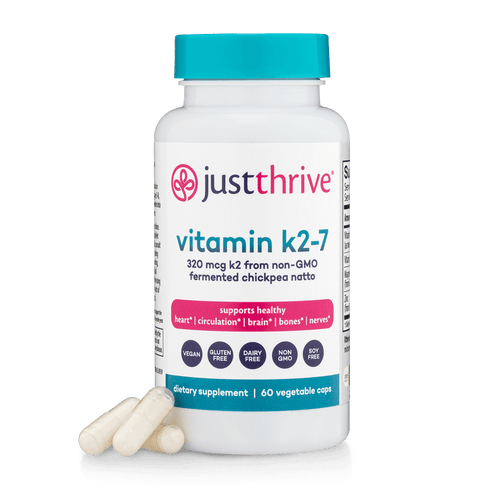
Support Steady Energy This Fall With Just Thrive
Fall changes your environment. But supporting your body through those changes doesn't have to be complicated.
Just Thrive can help you support your brain and gut for stable energy, mood, and focus when the season shifts.
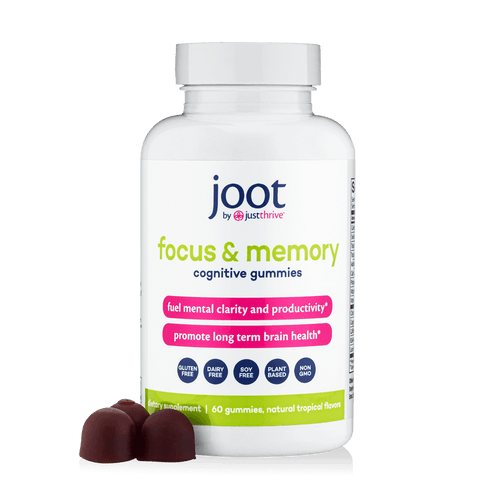
Just Thrive Focus & Memory is clinically formulated with brain-supporting ingredients that can help you stay sharp, focused, present, and mentally agile:
- Citicoline
- CognatiQ®
- Caffeine, but don’t worry, it’s less than half a cup of coffee!
- Lion’s Mane
- KSM-66 Ashwagandha
- Vitamin B12
- Vitamin D3
And they come in an easy-to-chew gummy, so adding them into your daily routine is simple.
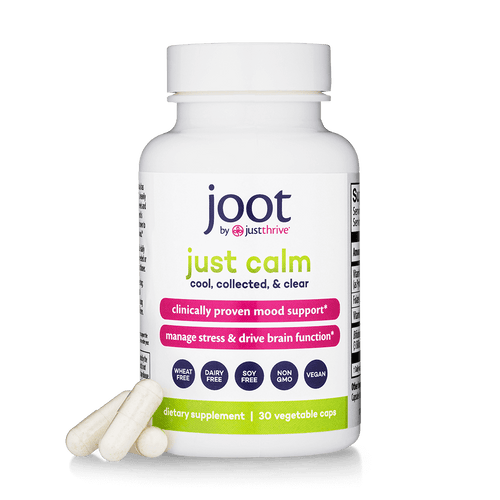
Just Calm is a stress and mood-supporting formula designed to promote healthy cognitive function, a balanced mood, and a healthy stress response.
Each capsule contains:
- Bifidobacterium longum
- Three B vitamins that support brain health: B6, B9, and B12
>> Support your brain, body, and circadian rhythm this fall with Just Thrive Focus & Memory and Just Calm.
Not sure whether Just Thrive Focus & Memory and Just Calm will work for you? We can help with that.
Every Just Thrive product comes with our Bottom of the Bottle, 100% money-back guarantee. So you can try them to see if they work for you.
But if for any reason you don’t feel a difference, simply ask for a full product refund at any time. Even if it’s been 3 weeks, 3 months, or 3 years… Even if the bottle is empty!
>> Try Just Thrive Focus & Memory and Just Calm 100% RISK FREE today, and save 30% on your first month’s subscription with code SUB30.

Sources
- de Menezes-Júnior LAA, Sabião TDS, Carraro JCC, Machado-Coelho GLL, Meireles AL. The role of sunlight in sleep regulation: analysis of morning, evening and late exposure. BMC Public Health. 2025;25(1):3362. Published 2025 Oct 6. doi:10.1186/s12889-025-24618-8
- Shochat T, Santhi N, Herer P, Flavell SA, Skeldon AC, Dijk DJ. Sleep Timing in Late Autumn and Late Spring Associates With Light Exposure Rather Than Sun Time in College Students. Front Neurosci. 2019;13:882. Published 2019 Aug 28. doi:10.3389/fnins.2019.00882
- Cleveland Clinic. Circadian Rhythm. Updated March 15, 2024. Accessed September 17, 2026. https://my.clevelandclinic.org/health/articles/circadian-rhythm
- Paul KN, Saafir TB, Tosini G. The role of retinal photoreceptors in the regulation of circadian rhythms. Rev Endocr Metab Disord. 2009;10(4):271-278. doi:10.1007/s11154-009-9120-x
- Cleveland Clinic. Melatonin. Updated April 28, 2025. Accessed September 17, 2026. https://my.clevelandclinic.org/health/articles/23411-melatonin
- Carabotti M, Scirocco A, Maselli MA, Severi C. The gut-brain axis: interactions between enteric microbiota, central and enteric nervous systems. Ann Gastroenterol. 2015;28(2):203-209.
- Petrut SM, Bragaru AM, Munteanu AE, Moldovan AD, Moldovan CA, Rusu E. Gut over Mind: Exploring the Powerful Gut-Brain Axis. Nutrients. 2025;17(5):842. Published 2025 Feb 28. doi:10.3390/nu17050842
- Strandwitz P. Neurotransmitter modulation by the gut microbiota. Brain Res. 2018;1693(Pt B):128-133. doi:10.1016/j.brainres.2018.03.015
- Sheffler ZM, Reddy V, Pillarisetty LS. Physiology, Neurotransmitters. Updated May 1, 2023. In: StatPearls [Internet]. Treasure Island (FL): StatPearls Publishing; 2026. Accessed September 17, 2026.
- Harvard Health Publishing. Serotonin: The natural mood booster. Accessed September 17, 2026.
- Johns Hopkins Medicine. Seasonal Affective Disorder. Accessed September 17, 2026. https://www.hopkinsmedicine.org/health/conditions-and-diseases/seasonal-affective-disorder
- Cardoso VM, Gusmão WDP, Moreno CRC. Morning light exposure: a potential modifier of cardiovascular risk factor. Med Hypotheses. 2025;199:111654. doi:10.1016/j.mehy.2025.111654.
- Weinert D, Gubin D. The Impact of Physical Activity on the Circadian System: Benefits for Health, Performance and Wellbeing. Applied Sciences. 2022; 12(18):9220.
- Reytor-González C, Simancas-Racines D, Román-Galeano NM, Annunziata G, Galasso M, Zambrano-Villacres R, Verde L, Muscogiuri G, Frias-Toral E, Barrea L. Chrononutrition and Energy Balance: How Meal Timing and Circadian Rhythms Shape Weight Regulation and Metabolic Health. Nutrients. 2025; 17(13):2135.
- Fioravanti M, Buckley AE. Citicoline (Cognizin) in the treatment of cognitive impairment. Clin Interv Aging. 2006;1(3):247-251. doi:10.2147/ciia.2006.1.3.247
- Jackson PA, Kenney C, Forster J, et al. Acute Cognitive Performance and Mood Effects of Coffeeberry Extract: A Randomized, Double Blind, Placebo-Controlled Crossover Study in Healthy Humans. Nutrients. 2023;15(11):2418. Published 2023 May 23. doi:10.3390/nu15112418
- Docherty S, Doughty FL, Smith EF. The Acute and Chronic Effects of Lion's Mane Mushroom Supplementation on Cognitive Function, Stress and Mood in Young Adults: A Double-Blind, Parallel Groups, Pilot Study. Nutrients. 2023;15(22):4842. Published 2023 Nov 20. doi:10.3390/nu15224842
- Gopukumar K, Thanawala S, Somepalli V, Rao TSS, Thamatam VB, Chauhan S. Efficacy and Safety of Ashwagandha Root Extract on Cognitive Functions in Healthy, Stressed Adults: A Randomized, Double-Blind, Placebo-Controlled Study. Evid Based Complement Alternat Med. 2021;2021:8254344. Published 2021 Nov 30. doi:10.1155/2021/8254344
- Markun S, Gravestock I, Jäger L, Rosemann T, Pichierri G, Burgstaller JM. Effects of Vitamin B12 Supplementation on Cognitive Function, Depressive Symptoms, and Fatigue: A Systematic Review, Meta-Analysis, and Meta-Regression. Nutrients. 2021;13(3):923. Published 2021 Mar 12. doi:10.3390/nu13030923
- Liu Y, Zhong Z, Xie J, Ni B, Wu Y. Neuroprotective Roles of Vitamin D: Bridging the Gap Between Mechanisms and Clinical Applications in Cognitive Decline. Int J Mol Sci. 2025;26(15):7146. Published 2025 Jul 24. doi:10.3390/ijms26157146
- Tardy AL, Pouteau E, Marquez D, Yilmaz C, Scholey A. Vitamins and Minerals for Energy, Fatigue and Cognition: A Narrative Review of the Biochemical and Clinical Evidence. Nutrients. 2020 Jan 16;12(1):228. doi: 10.3390/nu12010228. PMID: 31963141; PMCID: PMC7019700.
- Calderón-Ospina CA, Nava-Mesa MO. B Vitamins in the nervous system: Current knowledge of the biochemical modes of action and synergies of thiamine, pyridoxine, and cobalamin. CNS Neurosci Ther. 2020 Jan;26(1):5-13. doi: 10.1111/cns.13207. Epub 2019 Sep 6. PMID: 31490017; PMCID: PMC6930825.
- Durrani D, Idrees R, Idrees H, Ellahi A. Vitamin B6: A new approach to lowering anxiety, and depression? Ann Med Surg (Lond). 2022 Sep 15;82:104663. doi: 10.1016/j.amsu.2022.104663. PMID: 36268413; PMCID: PMC9577631.
- Allen AP, Hutch W, Borre YE, Kennedy PJ, Temko A, Boylan G, Murphy E, Cryan JF, Dinan TG, Clarke G. Bifidobacterium longum 1714 as a translational psychobiotic: modulation of stress, electrophysiology and neurocognition in healthy volunteers. Transl Psychiatry. 2016 Nov 1;6(11):e939. doi: 10.1038/tp.2016.191. PMID: 27801892; PMCID: PMC5314114.


