




If you’re a millennial and you’ve been struggling with mental health issues, you’re not alone. Because when it comes to mental health, millennials seem to be suffering more than any other generation.
Those lingering feelings of sadness and hopelessness can make it hard to get through the day. Fear, worry, and anxiety can make you feel stuck inside spiraling thoughts. And difficulty focusing or staying on task can stoke your struggles even more.
While it may sometimes feel like everything’s an uphill battle, there are things you can do to take charge of your mental health. And one of the best ways to start is by focusing on the health of your gut microbiome, a key source of all the feel-good brain chemicals you need to start feeling your best.
Quick Answer: Millennials report mental health struggles at higher rates than other generations, and research increasingly points to the gut as one important piece of the picture. Your gut and brain communicate through the gut-brain axis, and a balanced gut microbiome helps produce most of the body’s mood-related chemicals, including the majority of serotonin and about half of dopamine. When the gut falls out of balance, a state called dysbiosis, that production can be disrupted. Supporting a healthy microbiome is one self-care step that may help, using spore probiotics to crowd out pathogens and prebiotic fiber to nourish beneficial bacteria. This is general wellness support, not a substitute for professional mental health care.
Why Are Millennials Facing a Mental Health Crisis?
Millennials report mental health struggles at notably high rates, with surveys showing rising diagnoses of conditions like depression and ADHD. Factors such as social isolation and major life stressors have contributed to the trend.
Almost one-third of millennials suffer from at least one mental health condition, and the number of people affected keeps climbing. According to the Blue Cross Blue Shield report on the Health of Millennials:
- Major depression diagnoses have jumped 43% over the last five years
- The number of millennials with ADHD increased by 39%
- Millennials with mental health issues face double the risk of chronic physical conditions
- 92% say the pandemic has harmed their mental health
The last bullet point above may not come as any great surprise. Social isolation… lost loved ones… lost jobs… all of these have made existing mental health problems worse and triggered new ones.
But – studies show that levels of anger, anxiety, depression, and fatigue are “significantly higher among the Millennial Generation.” In fact, some researchers are calling millennials “The Anxious Generation.”

How Is Mental Health Linked to Physical Health?
Mental and physical health are closely connected. Research shows that millennials who struggle with mental health are also more likely to face physical conditions, many of which are tied to gut health.
As if struggling with depression, anxiety, and other mental health issues wasn’t hard enough, it turns out that they’re closely linked with physical health problems.
For example, millennials who struggle with mental health are also:
- 1.9 times more likely to develop high blood pressure
- 1.7 times more likely to develop high cholesterol
- 2.1 times more likely to develop Type II diabetes
- 2.7 times more likely to develop heart disease
- 1.9 times more likely to develop IBD (inflammatory bowel disease), including Crohn’s disease and ulcerative colitis
Luckily, there is an approach to easing mental health symptoms that also plays a key role in dealing with all of the conditions mentioned above… especially the ones directly related to your gut health.
How Is Your Gut Connected to Your Mental Health?
Your gut and brain are linked through the gut-brain axis, a direct physical pathway. A balanced gut microbiome also produces most of the mood-related brain chemicals, including the majority of serotonin and about half of dopamine.
Most millennials instinctively know that their mind and gut are linked. After all, anxiety often causes GI (gastrointestinal) problems like stomachaches and diarrhea. Excitement might lead to “butterflies” in your stomach. And gut problems – from gas to constipation to bloating – can leave you feeling down.
That all happens because there’s a real physical link called the gut-brain axis (GBA) that directly connects your gut and your mind. And your gut microbiome – the trillions of bacteria in your gut – plays a huge role in managing that connection. But that’s just where your gut’s contribution to better mental health starts.
Along with its part in the GBA, a well-balanced gut microbiome also produces most of the brain chemicals (neurotransmitters) that shape your mood. The most important of those for your mental health include:
A healthy gut microbiome also helps your body manage stress better, so you can fully calm down once a stressful experience has resolved.
But when your gut microbiome is out of balance – a condition called dysbiosis – you lose all of those benefits. And your unbalanced microbiome can make your mental health symptoms feel even worse.

Can an Unbalanced Gut Affect Your Mental Health?
When the gut falls out of balance, a state called dysbiosis, pathogens outnumber beneficial bacteria and can interfere with neurotransmitter levels. That disruption may make mood-related symptoms feel more intense.
A healthy, balanced gut microbiome contains vastly more beneficial probiotic bacteria than harmful pathogenic bacteria. And with those pathogens under control, the probiotic bacteria keep up with neurotransmitter production.
But in dysbiosis, when your gut becomes unbalanced, pathogens outnumber probiotics. That severely interferes with crucial neurotransmitter levels. And when your brain doesn’t have enough serotonin, dopamine, or GABA, you can end up with overwhelming depression, anxiety, and ADHD symptoms. That’s how an unbalanced gut can damage your mental health.
In fact, scientists can tell that you’re depressed just by looking at a profile of your gut bacteria!
So one of the best self-care steps you can take right now is to rebalance your gut microbiome. And that’s even easier than you think.
How Can You Rebalance Your Gut to Support Your Mood?
A common approach has three steps: use spore probiotics to crowd out overgrown pathogens, encourage a diverse range of beneficial bacteria, and nourish them with prebiotic fiber. Together these help support a balanced microbiome.
To get your gut microbiome in healthy balance – and keep it that way – three things need to happen.
First, harness the power of spore probiotics to wipe out overgrown pathogens and clear the way for beneficial probiotic bacteria to take over.
Second, use spore probiotics to nurture and encourage many different species of beneficial bacteria to grow and multiply.
Third, help beneficial probiotic bacteria flourish by nourishing them with their preferred diet of special prebiotic fiber.
By giving your gut microbiome a daily supply of spore probiotics and targeted prebiotics, you’ll quickly get your gut – and your mental health – back on track.
Frequently Asked Questions About Gut Health and Mental Health
Why do millennials report more mental health struggles?
Surveys such as the Blue Cross Blue Shield Health of Millennials report show rising rates of conditions like depression and ADHD in this generation, with factors like social isolation and major life stressors playing a role. This article focuses on one piece many people overlook: the connection between the gut and the brain.
What is the gut-brain axis?
The gut-brain axis is a two-way communication pathway that directly connects your gut and your brain. Your gut microbiome helps manage that connection and influences the production of mood-related brain chemicals.
How does gut health relate to mood?
A balanced gut microbiome helps produce most of the body’s serotonin and about half of its dopamine, along with GABA. When the gut is out of balance, those levels can be affected, which is why supporting gut balance is often discussed as part of overall well-being.
What is dysbiosis?
Dysbiosis is an imbalance in the gut microbiome, where harmful pathogenic bacteria outnumber the beneficial probiotic bacteria. This imbalance can interfere with normal neurotransmitter production.
How can I support my gut for better mood?
A common three-step approach is to use spore probiotics to crowd out overgrown pathogens, encourage a diverse range of beneficial bacteria, and feed those bacteria with prebiotic fiber. Supporting gut balance is a wellness step and not a replacement for professional care.
Just Thrive Emotional Health Products

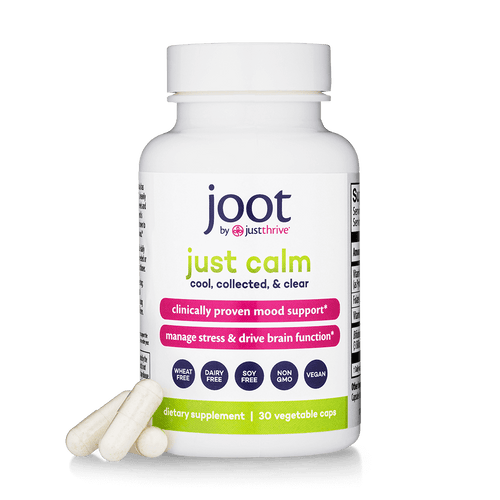
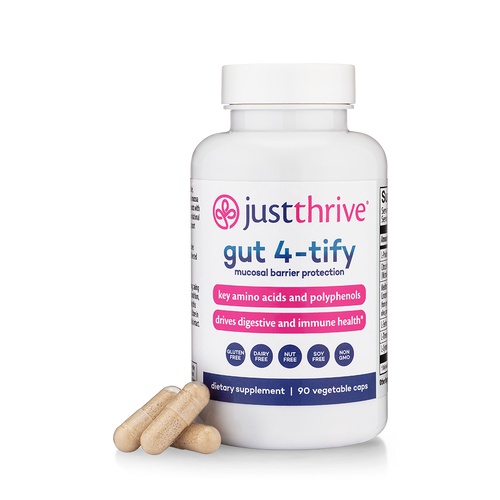

Take Great Care of Yourself with Just Thrive
Maintaining a healthy, balanced gut microbiome is a great way to support your mental health. And one of the easiest ways to accomplish that is with Just Thrive.
Just Thrive Probiotic supplies a daily dose of 4 clinically studied strains of highly effective spore probiotics.
Just Thrive Precision Prebiotic selectively nourishes only the beneficial bacteria in your gut microbiome.
Practice some self-care and emotional support today with Just Thrive.


