



Is your stress support routine really helping you recover from stress?
If you’re feeling calmer in the moment, but generally still exhausted, overwhelmed, irritable, or on edge, it may not be as effective as you think.
A lot of people think that managing stress is simply about finding ways to relax or escape from daily pressure. And while that might make you feel calm, temporarily, it doesn’t necessarily support actual recovery.
For stress support to really do its job, it needs to go deeper. It should help your body, especially your nervous system, recover and build resilience, so you can face future challenges more effectively.
Let’s look at some of the signs that your current approach is helping you cope with stress, rather than helping you recover over the long term.
1. Are You Feeling Calmer Only When Life Is Quiet?
If you only feel calm when nothing stressful is happening, your stress support routine may not be helping you build true resilience.1 Because while it’s easier to feel at peace when there aren’t any challenges on the horizon, effective stress recovery is designed to help when life gets busy.
Many stress-management habits provide temporary relief by removing you from the source of stress. Taking a “mental health day” from work or choosing a quiet evening over a loud gathering filled with semi-strangers can probably make you feel better. But if your sense of calm disappears when Monday morning rolls around or your schedule fills up, those strategies may only be providing short-term relief.
Instead of trying to avoid stress altogether, build small calming habits into your daily routine. Things like taking short walks, limiting constant stimulation (turn off screens or notifications), or even just taking a few minutes to focus on your breathing can all help your nervous system feel more balanced… even when life is busy.
That ability to bounce back is even more important if stress is also interfering with how rested you feel each day.
 Want to listen instead of read? CLICK HERE
2. Are You Sleeping but Still Waking Up Tense?
Many people associate stress with lying awake at night worrying and (incorrectly) assume that getting enough sleep means they have overcome stress. But how do you feel when you wake up?
Sleep quantity and quality aren’t the same thing. If you feel tense or on edge when you wake up, your nervous system might not have fully reset overnight.2
Ongoing stress can keep your body stuck in a “fight or flight “ state, even while you’re sleeping. Instead of shutting down to repair, your nervous system might be continuing to release cortisol, the stress hormone, throughout the night.3 When that happens, you can wake up with tight shoulders, a clenched jaw, or that feeling that you’re already in over your head even before the day has even begun.
To help your nervous system relax, build a short wind-down routine that helps it shift gears. If you’re stuck in a loop of overthinking, try journaling to clear mental clutter or mental grounding techniques to anchor yourself in the present moment. Things like aromatherapy or spending a few minutes on slow breathing help signal safety, so your body can move out of alert mode and into deeper rest.
When sleep isn’t fully restorative, instead of waking up feeling refreshed, you might find yourself stumbling to the kitchen for that first sip of coffee just to get started.
3. Are You Relying on Caffeine to Push Through?
Let’s be really honest here: you may love the taste of your morning latte, but if you feel like you truly need it to get through the day, your body may not be handling stress as well as it should. The temporary energy jolt is only masking your exhaustion, not restoring the resources that stress can deplete.4
In fact, caffeine can actually make things worse by keeping your body in “stress mode” by stimulating the release of stress hormones like cortisol and adrenaline.5 Relying on caffeine every day to fight fatigue makes it harder for your body to fully settle back into a rested state.
A more effective approach to support your energy is with strategies that work with your nervous system. Getting morning light, staying hydrated, and moving throughout the day can help stabilize your energy level more naturally.
Because while your coffee, caffeinated tea, or sodas might make you feel alert, your nervous system is still running on empty beneath the surface. And when that happens, the way you finish your day can start to shift, too.
4. Are You Mistaking Numbing Out for Winding Down?
Are you winding down at the end of the day in healthy ways, or are you disconnecting and shutting off emotionally? If you’re scrolling for hours or binge-watching shows, you may be numbing out instead of actually recovering.
When your nervous system is consistently overloaded by stress, your body can sometimes shift into a “shutdown” mode to protect itself. It’s an updated version of the classic “fight or flight” that you may have heard: fight, flight, or freeze.6
This reaction to prolonged stress, known as the dorsal vagal response, prompts your body to reduce emotional and mental activity instead of processing stress.7 This can leave you feeling like you’re detached or running on autopilot. And when you’re done distracting yourself, instead of feeling recovered you might feel flat or still tense beneath the surface.
Swap the mindless scrolling and disconnection at the end of your day for small sensory cues that actually help your body unwind, like a warm shower or gentle stretches. Even picking up a book instead of your phone can make a difference.
Numbing out won’t support stress recovery; it merely makes you less aware of what’s going on internally. So when that stress pops back up, instead of addressing it from a place of resilience, you may find yourself responding from a state of heightened reactivity.
5. Are You Constantly Reacting Instead of Resetting?
Part of being human is the occasional overreaction or snappy reply. But if you consistently find yourself reacting intensely to even the smallest frustrations or feeling easily irritated by others, it could be a sign that your nervous system is in a pattern of reactivity.
When this happens, your system doesn’t return to that steady recovery baseline between stressors. Instead, it stays slightly on edge, ready to jump into action at any opportunity. Over time, even everyday stress can start to feel overwhelming, because your body never fully resets in between triggers.8
You can help your nervous system by establishing a few helpful habits. It can be as simple as taking a brief pause for a few slow breaths between tasks or stepping outside for sunshine and fresh air. Over time, this helps you face new challenges from a place that is more resilient and grounded.
When these reset moments are missing, stress can continue in the background longer than you realize. Eventually, this can influence not just your nervous system but other systems as well, including your gut.
6. Are You Ignoring The Gut-Brain Connection?
Your digestive system can give you some pretty clear signs that your stress support routine isn’t truly helping you on a deeper level.
Your gut and nervous system are closely connected through the gut-brain axis (GBA).9 These two systems are in constant communication, each sending signals that can influence the other. This means that stress isn’t just in your mind; it can also be in your gut.
Just think of the times you’ve been stressed over a work presentation and ended up with an upset stomach, or when a disagreement with a friend had you feeling nauseous. These are simple reminders that stress shows up in your body, not just your mind or your mood.10
Fortunately, your gut can also send positive, supportive signals to your digestive system. Eating healthy, organic foods (and limiting processed foods), eating without rushing, getting plenty of prebiotics and probiotics, and staying hydrated can all help your digestive system work more smoothly, contributing to stress recovery.
And beyond supporting healthy digestion, you also want to make sure your body is getting the key nutrients it needs to manage daily stress effectively.
7. Are You Skipping Daily Mood and Stress Support?
When stress is ongoing, your body needs key nutrients to help maintain a balanced mood and a sense of calm. Without these, it may feel harder to stay calm under pressure or regain your sense of balance after a stressful experience.
Targeted nutritional support can play a helpful role in both nervous system balance and energy production.
Several B vitamins are especially helpful for this.11–14
- B6 can help your body synthesize gamma-aminobutyric acid (GABA), a chemical that helps regulate stress response. It also promotes the production of serotonin, one of the “happy hormones” that promotes feelings of calm and well-being.
- Folate, the water-soluble version of B9, is a crucial building block for neurotransmitters like serotonin, dopamine, and norepinephrine, which help support a balanced mood and emotional well-being.
- B12 supports your stress response by stimulating the production of serotonin and dopamine. It can also help your body combat fatigue and mental fog, which sometimes accompany ongoing stress.
And here’s something surprising: certain beneficial bacteria can also help your nervous system stay balanced during everyday stress! The strain Bifidobacterium longum 1714™ has been studied for its potential to support a sense of calm and emotional well-being, making it a unique addition to a daily wellness routine.
Frequently Asked Questions
Just Thrive Stress Support Products


Is There a Natural Way to Support a Healthy Stress Response?
Some stress advice focuses on doing less throughout the day. And while that may help you feel calmer in the moment, it’s not always realistic to do less or step away and reset when stress hits. Even when you can, it just may not be enough to help you long-term.
Alongside small daily habits, targeted support can help your body maintain a balanced mood and stress response.
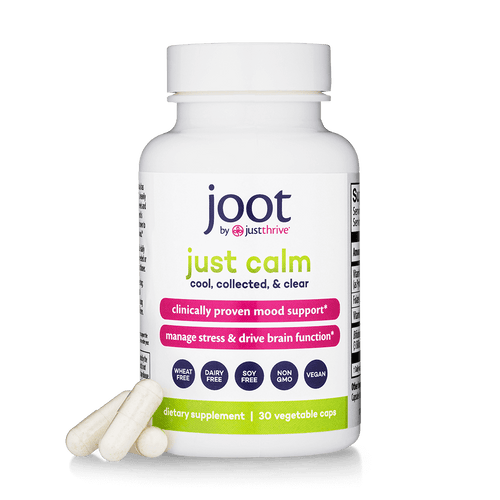
Just Calm features a carefully curated blend of ingredients that can help you navigate everyday stress:
- Vitamin B6
- Vitamin B9 (as folate)
- Vitamin B12
- B. longum 1714™
Paired with daily habits that help maintain healthy stress levels, Just Calm can support balanced cortisol levels and mood while promoting a calm response to everyday stress.
>> Start your new stress support routine with Just Calm.
Not sure whether Just Calm will work for you? We’ve got you covered.
Every Just Thrive purchase comes with our Bottom of the Bottle, 100% money back guarantee. So you can try Just Calm to see if it works for you. And we’re confident it will!
But if for any reason you don’t feel a difference, simply ask for a full product refund at any time. Even if it’s been 3 weeks, 3 months, or 3 years… Even if the bottle is empty!

Sources
- Hofmann SG, Hay AC. Rethinking avoidance: Toward a balanced approach to avoidance in treating anxiety disorders. J Anxiety Disord. 2018;55:14-21. doi:10.1016/j.janxdis.2018.03.004
- Kalmbach DA, Anderson JR, Drake CL. The impact of stress on sleep: Pathogenic sleep reactivity as a vulnerability to insomnia and circadian disorders. J Sleep Res. 2018;27(6):e12710. doi:10.1111/jsr.12710
- Yu X, Nollet M, Franks NP, Wisden W. Sleep and the recovery from stress. Neuron. 2025;113(18):2910-2926. doi:10.1016/j.neuron.2025.04.028
- Kosecka O, Charzyńska E, Czerwiński SK, Rudnik A, Atroszko PA. Caffeine intake mediates the relationship between problematic overstudying and psychological distress. Nutrients. 2025;17(17):2845. doi:10.3390/nu17172845
- Lane JD, Adcock RA, Williams RB, Kuhn CM. Caffeine effects on cardiovascular and neuroendocrine responses to acute psychosocial stress and their relationship to level of habitual caffeine consumption. Psychosom Med. 1990;52(3):320-336. doi:10.1097/00006842-199005000-00006
- Litz BT, Gray MJ. Emotional numbing in posttraumatic stress disorder: current and future research directions. Aust N Z J Psychiatry. 2002;36(2):198-204. doi:10.1046/j.1440-1614.2002.01002.x
- Porges SW. Polyvagal theory: a journey from physiological observation to neural innervation and clinical insight. Front Behav Neurosci. 2025;19:1659083. doi:10.3389/fnbeh.2025.1659083
- Lücke AJ, Hill Y, Baetzner AS, et al. Examining the daily life dynamics of anticipation and recovery from work-related stress in frontline medical professionals during pandemic work demands. J Public Health Res. 2026;15(1):22799036261428548. Published 2026 Mar 13. doi:10.1177/22799036261428548
- Carabotti M, Scirocco A, Maselli MA, Severi C. The gut-brain axis: interactions between enteric microbiota, central and enteric nervous systems. Ann Gastroenterol. 2015;28(2):203-209.
- Appleton J. The Gut-Brain Axis: Influence of Microbiota on Mood and Mental Health. Integr Med (Encinitas). 2018;17(4):28-32.
- Durrani D, Idrees R, Idrees H, Ellahi A. Vitamin B6: A new approach to lowering anxiety, and depression?. Ann Med Surg (Lond). 2022;82:104663. Published 2022 Sep 15. doi:10.1016/j.amsu.2022.104663
- Liwinski T, Lang UE. Folate and Its Significance in Depressive Disorders and Suicidality: A Comprehensive Narrative Review. Nutrients. 2023;15(17):3859. Published 2023 Sep 4. doi:10.3390/nu15173859
- Sofyan M, Fitriani DY, Friska D, Basrowi RW, Fuady A. B Vitamins, work-related stress and emotional mental disorders: a cross-sectional study among nurses in Indonesia. Nurs Open. 2022;9(4):2037-2043. doi:10.1002/nop2.1213
- Wang H, Braun C, Murphy EF, Enck P. Bifidobacterium longum 1714™ Strain Modulates Brain Activity of Healthy Volunteers During Social Stress. Am J Gastroenterol. 2019;114(7):1152-1162. doi:10.14309/ajg.0000000000000203


