



We’ve all heard the advice. Slow down, don’t stress out, just relax, take it easy. And while it’s well-intentioned, it’s not exactly realistic.
Stress is impossible to avoid. Work gets hectic, kids get sick, traffic piles up on the days you’re running late. Add to that the constant phone notifications (even if they’re silenced), and not feeling stressed all the time just doesn’t feel achievable.
Which is kind of the point. While you might not be able to escape stress entirely, you can learn how to respond to it differently.
This is where nervous system regulation comes in. It helps you notice how your body reacts to stress and slowly shift from a state of stress, to a calmer, more resilient mindset.
What Exactly Is Nervous System Regulation?
Your nervous system (brain, spinal cord, and nerves) is your body’s communications and control center.[1]
It’s constantly scanning your environment and your body based on input from your senses. When it receives sensory input, your nervous system processes that information and sends messages (electrical signals) to the rest of your body.
The signals sent by your nervous system can trigger two types of actions: voluntary actions, such as walking when a crosswalk turns green, and involuntary actions, such as pulling your hand away from a hot stove or sweating to cool off when you’re overheated.
Your nervous system also directs your response to factors like important work deadlines, sudden noises, or nonstop texts in a group chat. You might not think of these as stressors, but your nervous system does! And it helps you respond in ways that range from alert to relaxed, as needed.
Your nervous system moves between two states.
- Sympathetic state: This is your “fight or flight” response, your go-mode. It kicks in during stress or danger, or even when you’re performing intense physical activities. In this state, you are focused and alert.[2]
- Parasympathetic state: Often called “rest and digest,” this is where your body slows down, the recovery phase. Your breathing is slow and rhythmic, and your heart rate and blood pressure are lower. In this state, your body is relaxed, allowing it to repair itself and restore energy.[3]
 Want to listen instead of read? CLICK HERE
Because it’s impossible to eliminate stress completely, a regulated nervous system doesn’t mean you are calm (in a parasympathetic state) all the time. It means that you can move between these two states, adapting to what happens around you with resilience. This adaptability is what builds real emotional resilience. It helps you respond rather than just react.
Signs of a Dysregulated Nervous System
When your nervous system is healthy and regulated, you’re able to flow between the sympathetic and parasympathetic modes easily. But in a dysregulated state, your sympathetic nervous system tends to take the driver’s seat, keeping you on edge even when nothing’s wrong.
When your nervous system is dysregulated, it may show up as:[4]
- Anxiety or panic attacks
- Difficulty concentrating
- Digestive issues
- Disordered sleep; trouble falling or staying asleep
- Feeling especially tired or fatigued, even after adequate rest
- Heightened sensitivity to lights, noise, or other sensory input
- Mood changes; feeling irritable or frustrated
Understanding Emotional Resilience
Honestly, nowadays it’s pretty normal to feel drained or even a little on edge. Modern life makes nervous system regulation challenging, as you’re surrounded by constant stimulation. You might think you’re resting, but if you’re doom-scrolling right up until bedtime, your brain isn’t truly disconnected.
Emotional resilience is being able to handle what you feel, and what life throws at you, with more steadiness and less impulsivity. It’s what helps you shift from activation (sympathetic state) to rest (parasympathetic).
And you can build this skill on your own, by noticing how your body responds to stress triggers and integrating small, consistent practices into your everyday routine to support your nervous system.
4 Simple Ways to Regulate Your Nervous System
When your nervous system is dysregulated, it’s stuck on high alert, leaving you feeling stressed or even panicked.
One of the most effective ways to soothe your nervous system is to send your body gentle, repeated signals of safety throughout the day. These cues tell your body that it’s okay to rest or relax, and eventually shift into a more relaxed state. Over time, these signals will add up, helping you create a stronger emotional foundation built on resilience and ease.
But it’s also important not to add more overwhelm to your mind. While consistency is important, these don’t have to be rigid rules. Explore what fits naturally into your life, and give yourself grace when you have to skip a day or two.
Here are some of the most effective ways to support a healthy nervous system.
1. Somatic Movement
Somatic movement is a mindful practice that focuses on what you’re feeling (internal sensation) rather than fitness or performance goals. It helps encourage a deep mind-body connection, releasing stored tension as you build awareness of your internal state.[5]
This type of movement can help regulate your nervous system by gently reminding it that you are safe within your body.[6]
You might try:
- Slow, mindful stretching
- Body scans
- Shaking out your limbs to release tension
- Butterfly hugs: crossing your arms over your chest and gently tapping your shoulders
- Moving intuitively in whatever way feels natural and authentic
- More structured practices like Somatic Yoga, Tai Chi, or Qigong
No stress, no pressure. Simply notice how you feel.
2. Breathwork
It sounds almost too simple, but breathing is an excellent way of regulating your nervous system. Even better, it’s a practice that can be done anywhere, anytime.[7]
Your breathing sends immediate signals to your nervous system. Fast, shallow breathing tends to increase alarm or alertness. Slower, deeper breaths encourage calm. So by gently guiding your breath, you can let your nervous system know that you are safe and able to rest.
Some simple breathwork techniques include:
- Lengthening your exhale, making it slightly longer than your inhale
- Box breathing (inhale 4, hold 4, exhale 4, and hold 4)
- Diaphragmatic (belly) breathing, where your belly rises higher than your chest as you inhale through your nose, then falls as you exhale slowly through your mouth
Alternate nostril breathing
Breathwork doesn’t have to be overly complicated. Just a few deep, steady breaths can make a meaningful difference.
3. Mindful Rest Rituals
We mentioned this briefly earlier, but it’s certainly worth repeating and emphasizing. Just because you’re not being physically active doesn’t mean you’re truly resting.
If you’re scrolling through your phone or binging your favorite show, you might feel like you’re resting. But your nervous system is still engaged and processing input. Real rest only happens when you take a break from outside stimulation.
This could look like:
- Lying down for a few minutes, distraction-free
- Sitting in a quiet room with your eyes closed
- Listening to a guided meditation
- Practicing body scan meditation, guided or on your own[8]
You might feel uncomfortable or awkward at first, and that’s okay. Over time, your nervous system will gradually relearn how to truly unwind and restore.
4. Small Daily Habits That Add Up
There are other small, daily ways you can support your nervous system.
- Choose calming sensory input. Soft lights at night, sunlight during the day, soothing music, warm showers, and weighted blankets are all subtle cues of safety.
- Practice the pause. Instead of reacting immediately or impulsively to challenging situations, give your brain and body time to align. Respond from a place of calm confidence.
- Repeat affirmations to remind your body that you are safe and calm.[9]
- Release tension by dropping your shoulders and unclenching your jaw.
- Orient to your environment. Name three things you see, three you hear, and three things you feel (touch). Or try to find specific colors or shapes in your immediate surroundings.
- Play with temperatures. Splashing your face with cold water or holding an ice cube can reset your nervous system, while a warm shower can spur your parasympathetic nervous system into action.[10]
- Get your B vitamins. Certain B vitamins, especially B6, B9, and B12, are essential for maintaining a healthy nervous system. They work by supporting a calm and balanced mood as well as the production of mood-supportive neurotransmitters like serotonin and dopamine.[11,12,13]
- Add bacteria. Yes, bacteria! Specific strains of beneficial bacteria, such as Bifidobacterium longum (B. longum), can help maintain balanced cortisol levels and a healthy stress response.[14,15]
Just Thrive Emotional Health Products


Clinically Proven Support for Your Nervous System
The right supplement can help support a calm and balanced state.
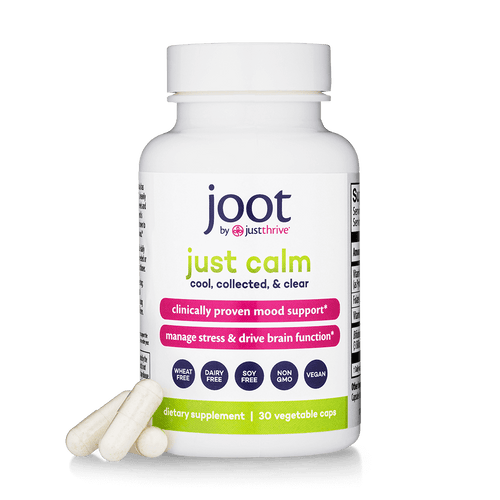
Just Calm offers a curated blend of four stress- and mood-supporting ingredients, chosen for their ability to encourage emotional health, a balanced mood, and peak cognition.
- Vitamin B6 (thiamine)
- Vitamin B9 (folate)
- Vitamin B12
- B. longum 1714™
This particular trio of B vitamins is crucial to the nervous system, supporting healthy levels of cortisol, dopamine, serotonin, and norepinephrine, which can help you feel calm and grounded.
Just Calm also contains B. longum 1714™, a proprietary “psychobiotic.” This beneficial bacteria strain can help promote a healthy stress response, balance cortisol levels, build emotional resilience, improve sleep, and support peak brain function.
Paired with daily techniques designed to help regulate your nervous system, Just Calm can help you manage everyday stress while promoting a healthy mood.
>> Support a healthy, regulated nervous system with Just Calm.
Not sure whether Just Calm will work for you? We’ve got you covered. Every Just Thrive purchase comes with our Bottom of the Bottle, 100% money back guarantee. So you can try Just Calm to see if it works for you, and we’re confident it will.
But if for any reason you don’t feel a difference, simply ask for a full product refund at any time. Even if it’s been 3 weeks, 3 months, or 3 years… and even if the bottle is empty.

Sources
- Institute for Quality and Efficiency in Health Care (IQWiG). In brief: How does the nervous system work? In: InformedHealth.org [Internet]. Cologne, Germany: Institute for Quality and Efficiency in Health Care (IQWiG); 2006–. Updated May 4, 2023. Accessed March 16, 2026. https://www.ncbi.nlm.nih.gov/books/NBK279390/
- Alshak MN, Das JM. Neuroanatomy, sympathetic nervous system. In: StatPearls [Internet]. Treasure Island, FL: StatPearls Publishing; 2026–. Updated May 8, 2023. Accessed March 16, 2026. https://www.ncbi.nlm.nih.gov/books/NBK542195/
- Tindle J, Tadi P. Neuroanatomy, parasympathetic nervous system. In: StatPearls [Internet]. Treasure Island, FL: StatPearls Publishing; 2026–. Updated October 31, 2022. Accessed March 16, 2026. https://www.ncbi.nlm.nih.gov/books/NBK553141/
- Elbers J, Jaradeh S, Yeh AM, Golianu B. Wired for threat: clinical features of nervous system dysregulation in 80 children. Pediatr Neurol. 2018;89:39-48. doi:10.1016/j.pediatrneurol.2018.07.007
- Meehan E, Carter B. Moving With Pain: What Principles From Somatic Practices Can Offer to People Living With Chronic Pain. Front Psychol. 2021 Jan 25;11:620381. doi: 10.3389/fpsyg.2020.620381. PMID: 33569028; PMCID: PMC7868595.
- Tsachor RP, Shafir T. A Somatic Movement Approach to Fostering Emotional Resiliency through Laban Movement Analysis. Front Hum Neurosci. 2017 Sep 7;11:410. doi: 10.3389/fnhum.2017.00410. PMID: 28936167; PMCID: PMC5594083.
- Bentley TGK, D'Andrea-Penna G, Rakic M, Arce N, LaFaille M, Berman R, Cooley K, Sprimont P. Breathing Practices for Stress and Anxiety Reduction: Conceptual Framework of Implementation Guidelines Based on a Systematic Review of the Published Literature. Brain Sci. 2023 Nov 21;13(12):1612. doi: 10.3390/brainsci13121612. PMID: 38137060; PMCID: PMC10741869.
- Gibson J. Mindfulness, Interoception, and the Body: A Contemporary Perspective. Front Psychol. 2019 Sep 13;10:2012. doi: 10.3389/fpsyg.2019.02012. PMID: 31572256; PMCID: PMC6753170.
- Cascio CN, O'Donnell MB, Tinney FJ, Lieberman MD, Taylor SE, Strecher VJ, Falk EB. Self-affirmation activates brain systems associated with self-related processing and reward and is reinforced by future orientation. Soc Cogn Affect Neurosci. 2016 Apr;11(4):621-9. doi: 10.1093/scan/nsv136. Epub 2015 Nov 5. PMID: 26541373; PMCID: PMC4814782.
- Montgomery JC, Macdonald JA. Effects of temperature on nervous system: implications for behavioral performance. Am J Physiol. 1990 Aug;259(2 Pt 2):R191-6. doi: 10.1152/ajpregu.1990.259.2.R191. PMID: 2201212.
- Tardy AL, Pouteau E, Marquez D, Yilmaz C, Scholey A. Vitamins and Minerals for Energy, Fatigue and Cognition: A Narrative Review of the Biochemical and Clinical Evidence. Nutrients. 2020 Jan 16;12(1):228. doi: 10.3390/nu12010228. PMID: 31963141; PMCID: PMC7019700.
- Calderón-Ospina CA, Nava-Mesa MO. B Vitamins in the nervous system: Current knowledge of the biochemical modes of action and synergies of thiamine, pyridoxine, and cobalamin. CNS Neurosci Ther. 2020 Jan;26(1):5-13. doi: 10.1111/cns.13207. Epub 2019 Sep 6. PMID: 31490017; PMCID: PMC6930825.
- Durrani D, Idrees R, Idrees H, Ellahi A. Vitamin B6: A new approach to lowering anxiety, and depression? Ann Med Surg (Lond). 2022 Sep 15;82:104663. doi: 10.1016/j.amsu.2022.104663. PMID: 36268413; PMCID: PMC9577631.
- Allen AP, Hutch W, Borre YE, Kennedy PJ, Temko A, Boylan G, Murphy E, Cryan JF, Dinan TG, Clarke G. Bifidobacterium longum 1714 as a translational psychobiotic: modulation of stress, electrophysiology and neurocognition in healthy volunteers. Transl Psychiatry. 2016 Nov 1;6(11):e939. doi: 10.1038/tp.2016.191. PMID: 27801892; PMCID: PMC5314114.
- Wang H, Braun C, Murphy EF, Enck P. Bifidobacterium longum 1714™ Strain Modulates Brain Activity of Healthy Volunteers During Social Stress. Am J Gastroenterol. 2019 Jul;114(7):1152-1162. doi: 10.14309/ajg.0000000000000203. PMID: 30998517; PMCID: PMC6615936.


