



Does your pet’s gut get a little “off” when you travel?
Summer can be an exciting time of year, for you and your pet. But changes in their routine can sometimes take their toll on their digestive health, leading to what some pet owners might think of as “vacation gut.”
Many people assume that travel-related stomach troubles happen if your pet picks up a bug or reacts to new foods. In reality, even something as simple as a different water source or schedule change may contribute to temporary digestive sensitivity in some pets.
The result? Things like loose stool, appetite changes, or just a fur baby that seems uncomfortable and “off” during your trip.
But with a few simple habits, you can help support your pet’s gut before you’ve even packed your suitcase, maintaining digestive balance before, during, and after your trip.
Quick Answer: Travel can sometimes leave your pet feeling a little “off,” even when nothing is actually wrong. Travel-related factors such as stress, new environments, unfamiliar microbes, different water sources, and disrupted feeding schedules can all affect a pet’s digestion and microbiome. These changes may contribute to loose stools, appetite shifts, gas, or digestive discomfort during or after a trip. This article explains how travel influences gut health and shares practical ways to support your pet’s digestive system, including maintaining familiar routines, bringing food and water from home, and providing probiotic support before and during travel.
How Does Traveling Affect Your Pet’s Gut Health?
Traveling and vacationing may seem mostly fun for you, but for your pet, even a small change in their environment or routine can affect their digestion and influence how their gut functions during your trip.
Here are three ways that traveling can contribute to the dreaded “vacation gut.”
1. Travel Stress Can Affect Digestion
Traveling can feel just as stressful for pets as it does for humans. Sure, they aren’t worried about catching a connection or navigating across a new city. But stress can come from things that do affect your pet’s world, like unfamiliar places, loud environments, and even just spending time away from you.
And that stress doesn’t just have a mental impact, it can affect your pet’s gut, too, through something known as the gut-brain axis (GBA).1
Just like humans, pets have a communication highway that allows messages to flow between your pet’s microbiome and their brain. When your pet’s gut is balanced and healthy, it sends supportive signals to the brain. Likewise, when your pet feels calm and secure, the brain sends signals that help support healthy digestion.
 Want to listen instead of read? CLICK HERE
Unfortunately, the reverse can also happen. Stress can send signals that disrupt digestion, while digestive discomfort can affect your pet’s mood. So when your pet is suddenly spending the day exploring a new, noisy, and confusing city, the stress can affect digestion, bowel movements, or even leave your usual good eater barely touching their food.
Traveling introduces a lot of unfamiliar and potentially stressful experiences for pets. Just think of some of the changes to their routines:
- Long car rides
- Plane flights (especially if they are kept away from you)
- Boarding facilities
- Loud environments
- Changes to sleep schedules
- Staying behind at a hotel
One way this stress can show up is through loose stools, constipation, reduced appetite, vomiting, gas, or changes in bowel habits during or after travel.2
In some pets, the release of stress hormones like cortisol and adrenaline can speed up gut motility (how quickly food moves through the digestive tract). This can contribute to diarrhea or loose stools because there is less time for their food to absorb water.
Stress can also affect the digestive contractions that move food through your pet’s digestive system, which may contribute to constipation in some pets. In some cases, it can even contribute to acid reflux or vomiting, as food travels backwards instead of forward.
2. New Microbes Can Shift Gut Balance
Traveling with your pet changes their environment, which can mean exposure to new and unfamiliar microbes.
Your pet is used to the bacteria and other organisms found in your home and other places they visit. But dog-friendly hotels, boarding facilities, parks, and the rest stops you choose all have their own unique microbial makeup, from the bedding to the soil.
And while their exposure might be short-lived, it can still impact their gut health.
Your pet’s microbiome, the community of bacteria living in their gut, affects almost every aspect of their well-being, especially their digestive health. New bacteria, even helpful ones, can temporarily influence the balance of this microbiome.3 In some pets, these shifts may contribute to temporary microbial imbalance, sometimes referred to as dysbiosis.
Even something as seemingly simple as a different water source can matter. Water composition can vary by location, and pets may respond when it’s not what their system is used to at home. Picking up locally made treats or even licking grass on a walk can also introduce new microbes.
In your pet’s microbiome, all these new microbes can contribute to digestive sensitivities like softer stools, gas, or even changes to their eating habits as their system adjusts.4
3. Disrupted Schedules Can Contribute to Disrupted Digestion
Travel can also throw off your pet’s circadian rhythm, the internal clock that helps regulate things like sleep, digestion, hormone release, and other daily processes.5
With changes in time zones, shifted sleep schedules or feeding times, or simply extra daily activity, your pet’s natural rhythms can become temporarily misaligned. And because their gut microbiome also follows these cycles, it can influence how efficiently digestion and metabolism function.
For example, your pet is likely used to eating and sleeping at certain times. Changing this could disrupt their usual digestive rhythm, contributing to temporary changes in things like appetite and bowel movements.6
The good news is that these effects are usually short-term. They tend to resolve once your pets are either back to their familiar routines or have adjusted to the new times.

How Can You Support Your Pet’s Gut Health When Traveling?
With a few simple habits, you can support your pet’s gut and enjoy traveling together.
Here are six practical steps you can take to help your pet’s gut adjust more smoothly when you’re on the move.
1. Bring food from home
Pets can be incredibly sensitive to changes in diet, and even small shifts in ingredients can affect digestion. When you’re in a new place, it may not be easy to find the same brands your pet prefers at home. Try to bring your pet’s usual food and treats to last for your entire trip.
If that’s not possible, plan ahead by ordering from a trusted retailer who will deliver to your hotel or rental, but always pack enough for the first day or two, in case there are shipping delays.
2. Bring water, too, if possible
Water composition can vary by location, which can disrupt your pet’s digestion. For road trips, bringing bottled water from home or using the same filtered water your pet is used to can help reduce the chance of digestive changes. This can be tricky if you’re flying, but even partial consistency can be helpful.
3. Adjust feeding schedules gradually
When you’re changing time zones, a sudden change in meal timing can be stressful to your pet’s digestive system. A slower approach can be more supportive of their gut health.
In the days leading up to travel, try slowly shifting feeding times to align with your expected schedule. Little tweaks of 15-30 minutes a day can help your pet, and their gut, adapt more comfortably.
4. Pack familiar-smelling items
New environments can bring a whole slew of new scents, which can be stressful for pets. Bringing items that smell like home, such as your pet’s blanket or favorite stuffed toy, can help reduce stress.
5. Keep routines consistent
Pets thrive on predictability. Beyond their feeding schedule, try to keep other routines like sleep, walks, and playtime as consistent as possible. This can calm their nervous system in unfamiliar environments.
6. Add probiotic support
Introducing a probiotic before traveling can support a healthy gut, helping your pet’s microbiome stay balanced and resilient during travel.
Look for supplements made specifically for pets, formulated with these universal animal colonizers:7,8
- Bacillus licheniformis (SL-307) helps your pet produce digestive enzymes and encourages balanced digestion. It also produces B vitamins in their gut, which helps maintain healthy skin, fur, and immunity.
- Bacillus subtilis promotes nutrient absorption and produces 12 defenders in your pet’s gut, supporting healthy digestive and immune systems.
- Pediococcus acidilactici helps crowd out less helpful bacteria in your pet’s gut, creating room for more beneficial ones, supporting a balanced microbiome and helping manage digestive troubles.
Ideally, start any new probiotics in advance of travels, to give your pet’s microbiome time to adjust and establish a stable balance before their routine changes begin.
Frequently Asked Questions
Just Thrive Pet Health Products
The Travel Essential for Your Pet’s Gut
Traveling with your pet can be fun and rewarding, for both of you, especially if you’re consistent with habits that support digestive balance. One key travel-friendly addition to your pet’s usual routine is a daily probiotic designed for pets, which can help them maintain a balanced gut microbiome when stress, schedule changes, and new environments disrupt their digestion.
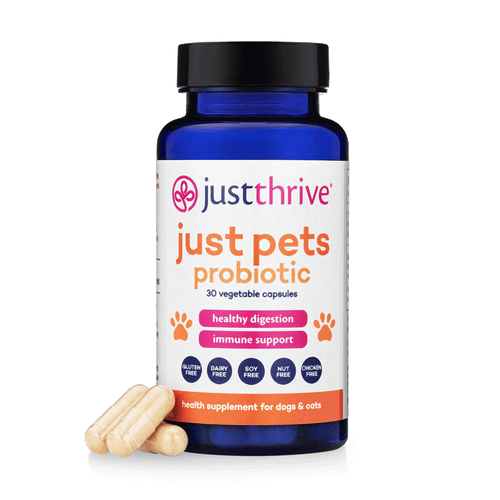
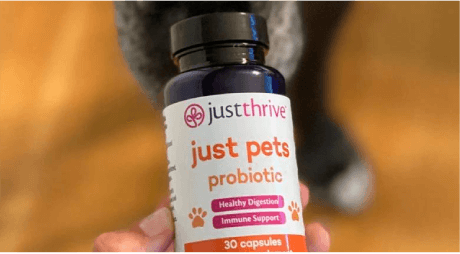
Just Pets Probiotic is designed to support your pet’s digestive health, keeping their microbiome balanced at home or away. Each capsule contains three universal animal colonizers carefully chosen to promote healthy digestion and overall well-being:
- Bacillus licheniformis (SL-307): for nutrient absorption and healthy digestion
- Bacillus subtilis HU58™: for digestive and immune health
- Pediococcus acidilactici: for microbiome balance
Plus, you won’t have to worry about trying to get your pet to take a pill; just sprinkle the contents of one capsule over your pet’s food. And since Just Pets Probiotic doesn’t have to be refrigerated, you can pack them in your bags, worry-free.
>> Support your pet’s digestive health wherever adventure takes you with Just Thrive.
Not sure if Just Pets Probiotic will work for your pet? We’ve got your back.
Every Just Thrive purchase is covered by our Bottom of the Bottle, 100% money back guarantee. So you can try Just Pets Probiotic to see if it works for your pet. And we’re confident it will.
But if for any reason you don’t see a difference, simply ask for a full product refund at any time. Even if it’s been 3 weeks, 3 months, or 3 years… and even if the bottle is empty.

Sources
- Sacoor C, Marugg JD, Lima NR, Empadinhas N, Montezinho L. Gut-Brain Axis Impact on Canine Anxiety Disorders: New Challenges for Behavioral Veterinary Medicine. Vet Med Int. 2024;2024:2856759. Published 2024 Jan 23. doi:10.1155/2024/2856759
- Fan Z, Bian Z, Huang H, et al. Dietary Strategies for Relieving Stress in Pet Dogs and Cats. Antioxidants (Basel). 2023;12(3):545. Published 2023 Feb 21. doi:10.3390/antiox12030545
- Rindels JE, Loman BR. Gut microbiome - the key to our pets' health and happiness?. Anim Front. 2024;14(3):46-53. Published 2024 Jun 20. doi:10.1093/af/vfae015
- Valbuena Graham M, Esposito MM. How the microbiome affects canine health. Appl Microbiol. 2025;5(4):148. doi:10.3390/applmicrobiol5040148
- Schork IG, Manzo IA, De Oliveira MRB, da Costa FV, Young RJ, de Azevedo CS. The cyclic interaction between daytime behavior and the sleep behavior of laboratory dogs. Sci Rep. 2022;12(1):478. Published 2022 Jan 10. doi:10.1038/s41598-021-04502-2
- Boumans IJMM, de Boer IJM, Hofstede GJ, la Fleur SE, Bokkers EAM. The importance of hormonal circadian rhythms in daily feeding patterns: an illustration with simulated pigs. Horm Behav. 2017;93:82-93. doi:10.1016/j.yhbeh.2017.05.003
- Zhang M, Xu H, Zhang T, et al. Dietary Supplementation with Bacillus licheniformis and Bacillus subtilis Modulates Immunity, Serum Metabolome, and Intestinal Homeostasis in Cats. Animals (Basel). 2025;15(20):2971. Published 2025 Oct 14. doi:10.3390/ani15202971
- Zhao M, Zhang Y, Li Y, Liu K, Bao K, Li G. Impact of Pediococcus acidilactici GLP06 supplementation on gut microbes and metabolites in adult beagles: a comparative analysis. Front Microbiol. 2024;15:1369402. Published 2024 Apr 3. doi:10.3389/fmicb.2024.1369402


