



Trying to improve your gut health can feel…overwhelming. There’s tons of information out there about what to do and what to avoid; much of which can seem conflicting. It can be hard to know what to trust or where to even begin.
That’s exactly why we put together this guide: To help you cut through the noise and take control of your gut health with clarity.
Below you’ll find clinically backed insights alongside simple, practical steps you can actually use, so you can support your gut with confidence.
The Foundation of Gut Health: Why Bacteria Is Crucial
Fun fact: You are more bacteria than you are human.
It’s true! And not just “a little bit” more… Bacteria in your body outnumber your human cells by a ratio of about 3 to 1.
And the vast majority of them, well into the trillions, live in your gut microbiome. Your gut bacteria are divided between probiotic (“good”) bacteria and pathogenic (“bad”) bacteria. They coexist in a precarious balance, constantly fighting for space and fuel.
When one type of bacteria flourishes, it can crowd out the other. If everything is going well, the colonies of beneficial bacteria thrive, weakening colonies of pathogenic bacteria. When your gut is healthy, it supports more than just smooth digestion. It can contribute to a balanced immune response, steady mood, good sleep, clear skin, and even a resilient stress response.
 Want to listen instead of read? CLICK HERE
Unfortunately, the opposite is often the case. Bad bacteria proliferate and crowd out good bacteria, disrupting the balance of your gut microbiome (a condition called dysbiosis).
When this happens, it can often lead to gastrointestinal (GI) issues like abdominal pain, bloating, diarrhea, or constipation.[1] It has also been linked to more severe GI conditions.
But dysbiosis affects much more than your digestive system.
The vast majority of your immune system is housed within your gut. When the microbiome falls out of balance, it can influence immune signaling and inflammatory pathways that play an important role in overall immune function.[2,3]
And thanks to the gut-brain axis, dysbiosis can even lead to emotional or mood-related issues.[4]

How to Balance Your Gut
Spore probiotics have been prescribed in Europe for over 50 years for their effectiveness. These hardy probiotics are highly valued for their ability to survive the digestive process and reach your gut 100% alive, something many traditional probiotics struggle to do.
How can they survive the journey through stomach acids and digestive enzymes?
Spore probiotics have a secret: when they detect a hostile environment, they erect a natural endospore shell around themselves. This shield is so incredibly resilient that one strain of spore probiotic was found and revived in the stomach of a fossilized bee that was 25 million years old!
Once the spore probiotic reaches a safe environment (your gut), they shed their shell and become active, supporting beneficial bacteria and encouraging a balanced microbiome.
Specific spore-based strains have been shown to be especially effective:
- Bacillus indicus HU36™ is the only bacterial strain that encourages the production of antioxidants in your gut (where they are best absorbed), combating oxidative stress and supporting gut health.[5]
- Bacillus subtilis HU58™ has been linked to improved gut and overall health.[6] Along with promoting the growth of good bacteria, it also produces over 12 "protectors" that defend your body from harmful bacteria and pathogens.
- Bacillus coagulans has been shown to help improve digestion, reduce GI symptoms, and promote overall gut health.[7]
- One of the few probiotic species resistant to antibiotics, Bacillus clausii can help balance your microbiome, post-antibiotics. It also supports microbiome balance and immune function.[8]
Taken together, these spore probiotics can help support your gut health, immune response, and overall well-being.

How to Fuel Your Good Bacteria
Like every living organism, gut bacteria need fuel to grow and survive. And they get that fuel—prebiotics—from what you eat and drink.
Prebiotics are fibers your body can’t digest. Instead, they get broken down and digested by your gut bacteria. Some foods feed a broad range of bacteria, even the less desirable ones. Others selectively nourish only the good bacteria. When you choose the type of fiber, you encourage the growth of beneficial bacteria colonies, supporting digestion, immune function, and your overall health.[9]
The main food for good gut bacteria is the prebiotic fibers found in fruits, vegetables, and whole grains, especially garlic, onions, leeks, asparagus, artichokes, bananas, and oats. On the flip side, bad gut bacteria tend to thrive when the diet is high in added sugar, refined carbs, and ultra-processed foods.
Since it can be challenging to get enough of the right kinds of fiber through diet alone, many people choose to supplement with prebiotics as a more consistent solution. Fortunately, there are some prebiotic supplements, formulated with “smart” fibers shown to nourish only beneficial bacteria and support a balanced microbiome.
Look for prebiotics that contain these fibers.[10,11,12]
- Actazin®, made from organic kiwifruit powder, to support a healthy digestive function
- Xylooligosaccharides (XOS), to promote a balanced microbiome and a healthy immune system
- Galactooligosaccharides (GOS), to encourage the growth of good bacteria and improve nutrient absorption.
Studies show that, when paired with a spore-based probiotic, prebiotics can more than double the population of good bacteria.

How Mucus Keeps You Healthy (Really!)
If you’re like most people, you probably associate mucus with being sick and a big box of tissues.
But did you know mucus is actually one of your body’s most important resources?
Your body has what’s called a mucosal barrier, an actual physical barrier that defends your body from pathogens, toxins, and other unwanted substances. It’s found in several areas throughout your body, like your lungs, mouth, nose… and in your gut.
This sticky, protective shield lines the inside of your gut, where it acts like a security screen on a window. It blocks the things you don’t want, like pathogens, but lets important things pass through.[12]
When your mucosal gut barrier is healthy, only nutrients and water are able to pass through, enter your bloodstream, and travel through your body. Meanwhile, toxins, bacteria, pathogens, partially digested food particles, and other potentially harmful substances are blocked.
But when your mucosal barrier is weakened, things that you do not want in your bloodstream leak through. This condition, known as “leaky gut,” can negatively impact digestion, immunity, and overall health.[13]
So what can you do to support a healthy gut lining? Ensure you get enough of the following:
- The amino acids threonine, serine, proline, and cysteine, which play key roles in producing and maintaining mucin proteins, the main physical component of the mucosal barrier.[14,15]
- Polyphenols, which also promote mucin production while supporting gut lining strength.[16]
By prioritizing the health of your mucosal barrier, you support your body’s defensive system and whole-body health.

The Power of Daily Gut Detox
Have you ever heard the saying, “Success is built by what you do daily”? Well, that certainly applies to your gut health. And one of the best ways to keep your gut healthy is through consistent detox.
Detoxification is often associated with extreme cleanses and restrictive measures. But did you know? Your body is already equipped with its own built-in detox system, one that works gently and consistently.
Antibody proteins known as immunoglobulins (Ig) are the key to keeping your gut clean and clear. These antibodies patrol your body, looking for harmful invaders. And once found, immunoglobulins quickly bind to, neutralize, and eliminate them from your body.
While there are a few different types of immunoglobulins, some are especially effective at keeping your body healthy.[17]
- Immunoglobulin G (IgG), the primary defender, helps neutralize unwanted gut invaders. It also remembers past germ exposure, for a faster response time in the future.
- Immunoglobulin M (IgM) helps your body quickly recognize and address potential threats.
- Immunoglobulin A (IgA) blocks, helps keep harmful pathogens from entering your gut and lungs.
As hard as these proteins work, in times of high stress or when slowed down by things like poor diet or environmental toxins, your natural production of immunoglobulins falls off, leaving you vulnerable.
When that happens, your body might need a little outside help.
Daily supplemental immunoglobulin support can help maintain healthy immune function and keep your body resilient.

Kick-Start Digestion with Digestive Bitters
Healthy digestion doesn’t start in your stomach. It actually starts the moment you taste your food.
That's because you have specialized bitter receptors throughout your digestive tract that alert your body that food is on the way. This “wake-up call” tells your digestive system to start releasing stomach acid, bile, and digestive enzymes.[18]
This is exactly why bitter herbs have been used for centuries across traditional wellness practices. They were taken before meals to help stimulate digestion and support the body’s natural processes.
Without this early signal, digestion can feel slow or incomplete. Your body may not release enough of what it needs to properly break down food.
And that’s when things like bloating, heaviness, discomfort, or lingering indigestion after meals tend to show up.
Some of the most effective bitters for healthy digestion include:[19,20,21,22]
- Dandelion root
- Ginger
- Dong quai
- Hops flower
- Gentian root
- Peppermint
Today, bitter foods have all but disappeared from the modern Western diet, replaced by sweet, salty, and highly processed foods that don’t provide the same digestive cues. Even those bitters that remain have been engineered over time to be less bitter.
By incorporating digestive bitters before your largest meal in particular, you can help your body digest efficiently and effectively.
When digestion is functioning well, your body is better able to extract and utilize vitamins and minerals from the foods you eat. This not only supports overall health, but can contribute to improved satiety after meals. When you feel full longer, this can even help tame cravings and that urge to snack shortly after eating.
By signaling your digestive system ahead of time, bitters support a complete and efficient digestive process from the very beginning of your meal, helping to minimize occasional post-meal discomforts.
Just Thrive Gut Health Products


Support Digestive Health with Your Just Thrive Tool Kit
Taking care of your gut doesn’t have to be complicated, but it does need to be consistent. With the right tools, you can target the very foundation of digestive health and give your body what it needs to function at its peak.
Think of these five supplements as your simple, daily toolkit for building and maintaining a strong, balanced gut.
1. Just Thrive Probiotic
Just Thrive Probiotic supports a healthy, balanced gut microbiome, thanks to its four clinically proven spore-based probiotics.
- Bacillus indicus HU36™
- Bacillus subtilis HU58™
- Bacillus clausii
- Bacillus coagulans
2. Just Thrive PREbiotic
Just Thrive PREbiotic is formulated with three “smart” fibers designed to fuel only the beneficial bacteria in your microbiome, promoting peak gut health.
- Actazin®
- Xylooligosaccharides (XOS)
- Galactooligosaccharides (GOS)
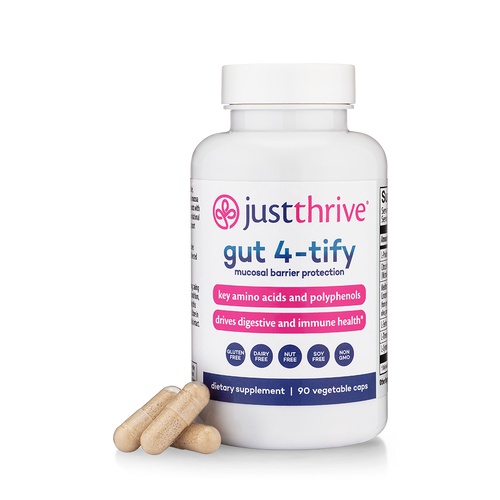
3. Gut 4-tify
Gut 4-tify features essential amino acids that can support the strength of your mucosal barrier.
- L-threonine
- L-serine
- L-proline
- L-cysteine
It also contains two potent polyphenol blends, Oxxynea® and MicrobiomeX®.
4. Daily Gut Detox
Daily Gut Detox delivers IgA, IgG, and IgM to help your body gently eliminate toxic residue and support immune function, while also driving gut health.
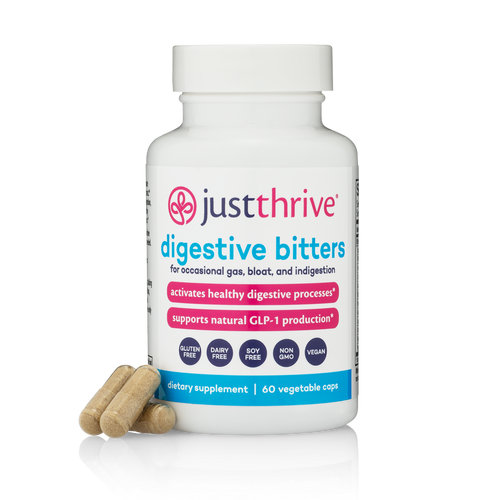
5. Digestive Bitters
Digestive Bitters contains 12 well-studied bitters, including dandelion root, ginger root, dong quai, hops flower extract, Chinese gentian root extract, and peppermint. These clinically proven herbs help stimulate the digestive process, even before you’ve taken a single bite.
>> Build the foundation of a healthy gut with Just Thrive Probiotic, PREbiotic, Gut 4-tify, Daily Gut Detox, and Digestive Bitters.
(Plus, save more by bundling!)
Not sure whether these Just Thrive all-stars will support your digestive health? We can help with that.
We cover every Just Thrive product with our Bottom of the Bottle, 100% money back guarantee. So you can try Just Thrive Probiotic, PREbiotic, Gut 4-tify, Daily Gut Detox, and Digestive Bitters to see if they work for you. And we’re confident they will.
But if for any reason you don’t feel a difference in your digestive health, simply ask for a full product refund at any time. Even if it’s been 3 weeks, 3 months, or 3 years… Even if the bottle is empty!
>> Try Just Thrive Probiotic, PREbiotic, Gut 4-tify, Daily Gut Detox, and Digestive Bitters 100% RISK FREE today, and save 30% on your first month’s subscription with code SUB30.

Sources
- Carías Domínguez AM, de Jesús Rosa Salazar D, Stefanolo JP, Cruz Serrano MC, Casas IC, Zuluaga Peña JR. Intestinal Dysbiosis: Exploring Definition, Associated Symptoms, and Perspectives for a Comprehensive Understanding - a Scoping Review. Probiotics Antimicrob Proteins. 2025 Feb;17(1):440-449. doi: 10.1007/s12602-024-10353-w. Epub 2024 Sep 5. PMID: 39235661; PMCID: PMC11832579.
- Hrncir T. Gut Microbiota Dysbiosis: Triggers, Consequences, Diagnostic and Therapeutic Options. Microorganisms. 2022 Mar 7;10(3):578. doi: 10.3390/microorganisms10030578. PMID: 35336153; PMCID: PMC8954387.
- Gomaa EZ. Human gut microbiota/microbiome in health and diseases: a review. Antonie Van Leeuwenhoek. 2020 Dec;113(12):2019-2040. doi: 10.1007/s10482-020-01474-7. Epub 2020 Nov 2. PMID: 33136284.
- Clapp M, Aurora N, Herrera L, Bhatia M, Wilen E, Wakefield S. Gut microbiota's effect on mental health: The gut-brain axis. Clin Pract. 2017 Sep 15;7(4):987. doi: 10.4081/cp.2017.987. PMID: 29071061; PMCID: PMC5641835.
- Sy, C., Dangles, O., Borel, P., & Caris-Veyrat, C. (2015). Interactions between Carotenoids from Marine Bacteria and Other Micronutrients: Impact on Stability and Antioxidant Activity. Marine Drugs, 13(11), 7020-7039. https://doi.org/10.3390/md13117020
- Sorensen K, Khanna S, Porwal A, et al. Effects of a Bacillus subtilis HU58 and Heyndrickxia faecalis SC208 spore-forming probiotic formula on gastrointestinal health: results of a randomised, double-blind, placebo-controlled pilot study. Benef Microbes. Published online February 17, 2026. doi:10.1163/18762891-bja00113
- Jiang Cao, Zhiming Yu, Wenyin Liu, Jianxin Zhao, Hao Zhang, Qixiao Zhai, Wei Chen, Probiotic characteristics of Bacillus coagulans and associated implications for human health and diseases, Journal of Functional Foods, Volume 64, 2020, 103643, ISSN 1756-4646, https://doi.org/10.1016/j.jff.2019.103643.
- Ghelardi E, Abreu Y Abreu AT, Marzet CB, Álvarez Calatayud G, Perez M 3rd, Moschione Castro AP. Current Progress and Future Perspectives on the Use of Bacillus clausii. Microorganisms. 2022 Jun 17;10(6):1246. doi: 10.3390/microorganisms10061246. PMID: 35744764; PMCID: PMC9230978.
- Carlson JL, Erickson JM, Lloyd BB, Slavin JL. Health Effects and Sources of Prebiotic Dietary Fiber. Curr Dev Nutr. 2018 Jan 29;2(3):nzy005. doi: 10.1093/cdn/nzy005. PMID: 30019028; PMCID: PMC6041804.
- Emma Graham, Starin McKeen, Erin D. Lewis, Malkanthi Evans, Zhaoping Li, Susanne M. Henning, Neville Jopson, Jennifer Gu, Doug Rosendale, Actazin® green kiwifruit powder consumption at 600 mg per day for 28 days improves stool form and relieves occasional constipation in healthy individuals: A randomized controlled trial, Bioactive Carbohydrates and Dietary Fibre, Volume 32, 2024, 100436, ISSN 2212-6198, https://doi.org/10.1016/j.bcdf.2024.100436.
- Valladares-Diestra KK, de Souza Vandenberghe LP, Vieira S, Goyzueta-Mamani LD, de Mattos PBG, Manzoki MC, Soccol VT, Soccol CR. The Potential of Xylooligosaccharides as Prebiotics and Their Sustainable Production from Agro-Industrial by-Products. Foods. 2023 Jul 12;12(14):2681. doi: 10.3390/foods12142681. PMID: 37509773; PMCID: PMC10379617.
- Paone P, Cani PD. Mucus barrier, mucins and gut microbiota: the expected slimy partners? Gut. 2020 Dec;69(12):2232-2243. doi: 10.1136/gutjnl-2020-322260. Epub 2020 Sep 11. Erratum in: Gut. 2023 Nov 24;72(12):e7. doi: 10.1136/gutjnl-2020-322260corr1. PMID: 32917747; PMCID: PMC7677487.
- Aleman, R. S., Moncada, M., & Aryana, K. J. (2023). Leaky Gut and the Ingredients That Help Treat It: A Review. Molecules, 28(2), 619. https://doi.org/10.3390/molecules28020619
- Faure M, Mettraux C, Moennoz D, Godin JP, Vuichoud J, Rochat F, Breuillé D, Obled C, Corthésy-Theulaz I. Specific amino acids increase mucin synthesis and microbiota in dextran sulfate sodium-treated rats. J Nutr. 2006 Jun;136(6):1558-64. doi: 10.1093/jn/136.6.1558. PMID: 16702321.
- Song Zh, Tong G, Xiao K, Jiao le F, Ke Yl, Hu Ch. L-cysteine protects intestinal integrity, attenuates intestinal inflammation and oxidant stress, and modulates NF-κB and Nrf2 pathways in weaned piglets after LPS challenge. Innate Immun. 2016 Apr;22(3):152-61. doi: 10.1177/1753425916632303. Epub 2016 Feb 25. PMID: 26921254.
- Li H, Gao J, Peng W, Sun X, Qi W, Wang Y. Dietary Polyphenols-Gut Microbiota Interactions: Intervention Strategies and Metabolic Regulation for Intestinal Diseases. Biology (Basel). 2025 Nov 30;14(12):1705. doi: 10.3390/biology14121705. PMID: 41463478; PMCID: PMC12730813.
- Schroeder HW Jr, Cavacini L. Structure and function of immunoglobulins. J Allergy Clin Immunol. 2010 Feb;125(2 Suppl 2):S41-52. doi: 10.1016/j.jaci.2009.09.046. PMID: 20176268; PMCID: PMC3670108.
- Rezaie P, Bitarafan V, Horowitz M, Feinle-Bisset C. Effects of Bitter Substances on GI Function, Energy Intake and Glycaemia-Do Preclinical Findings Translate to Outcomes in Humans? Nutrients. 2021 Apr 16;13(4):1317. doi: 10.3390/nu13041317. PMID: 33923589; PMCID: PMC8072924.
- Li Y, Chen Y, Sun-Waterhouse D. The potential of dandelion in the fight against gastrointestinal diseases: A review. J Ethnopharmacol. 2022 Jul 15;293:115272. doi: 10.1016/j.jep.2022.115272. Epub 2022 Apr 8. PMID: 35405251.
- Lemlem Gebremariam Aregawi, Csiki Zoltan, Ginger's nutritional implication on gastrointestinal health, Clinical Nutrition Open Science, Volume 61, 2025, Pages 1-13, ISSN 2667-2685, https://doi.org/10.1016/j.nutos.2025.02.008. (https://www.sciencedirect.com/science/article/pii/S2667268525000233)
- Ling FANG, Xue-feng XIAO, Chang-xiao LIU, Xin HE, Recent Advance in Studies on Angelica sinensis, Chinese Herbal Medicines, Volume 4, Issue 1, 2012, Pages 12-25, ISSN 1674-6384, https://doi.org/10.3969/j.issn.1674-6384.2012.01.004. (https://www.sciencedirect.com/science/article/pii/S1674638412600306)
- Chumpitazi BP, Kearns GL, Shulman RJ. Review article: the physiological effects and safety of peppermint oil and its efficacy in irritable bowel syndrome and other functional disorders. Aliment Pharmacol Ther. 2018 Mar;47(6):738-752. doi: 10.1111/apt.14519. Epub 2018 Jan 26. PMID: 29372567; PMCID: PMC5814329.


