



How to soothe your stress for a calmer, healthier baby
Life is stressful and even more so for new moms.
On top of all the regular everyday problems the world throws at you, you’re probably running on no sleep…not eating enough…dealing with post-pregnancy hormone surges…and facing a whole host of new mom worries.
That stress can make you feel antsy and edgy. It can make your head ache and your heart pound. And it can make your fight-or-flight responses kick in, releasing all sorts of hormones and survival compounds.
When you’re breastfeeding, all of those stress chemicals can pass to your baby. And you can just imagine how much that doesn’t help the situation.
And while you can’t stop life from throwing stressors your way, you can help your body manage stress more effectively…and keep that stress chemical stew from affecting your baby.
Quick Answer: Yes, stress can affect breast milk. When you are stressed, your body releases hormones like cortisol and adrenaline that can change your milk's composition, including its natural fat balance, and these stress chemicals can pass to your baby. Prolonged stress can also tip your gut microbiome out of balance, which influences the beneficial bacteria your milk passes along. Because you cannot eliminate every stressor, the goal is to help your body manage stress more calmly. Research points to a specific probiotic strain, Bifidobacterium longum 1714, plus B vitamins, as gentle ways to support a healthy stress response, calmer mood, and better sleep.
What Is in Breast Milk Besides Nutrition?
Breast milk carries far more than calories and nutrients. Along with proteins, fats, vitamins, and minerals, it also delivers digestive enzymes, hormones, immune cells, prebiotic fiber, short chain fatty acids, and probiotic bacteria.
Your breastmilk carries essential nutrition to your baby. It’s rich in proteins, fats, vitamins, and minerals, and so much more.
Along with providing your baby with calories and critical nutrients, breast milk also contains:[1,2,3]
- Digestive enzymes
- Hormones
- Immune cells (like antibodies)
- Bioactive molecules
- Prebiotic fiber
- Short chain fatty acids
- Probiotic bacteria
All of these compounds help keep your baby healthy and happy.
But stress can change your milk composition and have a big effect on your baby.
 Want to listen instead of read? CLICK HERE
How Does Stress Change Breast Milk?
When you are stressed, your body floods with hormones like cortisol and adrenaline. Over time these can interfere with milk production and composition, especially the natural balance of milk fats, and the stress hormones themselves can show up in your milk.
When your body experiences stress, it sets off a slew of biological reactions. Your body’s stress response goes into the classic fight-flight-freeze mode to try to protect you. This system can’t tell the difference between an overdue bill and being chased by a tiger…so it goes into protection mode whenever it senses any kind of stress.
So you get flooded with hormones like cortisol and adrenaline designed to help you escape from danger.
Those stress chemicals affect your body in many ways, especially when you feel stressed often or for prolonged periods. They can interfere with milk production and composition, especially disrupting the natural proportions of milk fats.[4]
And your stress hormones also show up in breast milk[5]…and in the baby.[6] That can lead to a fussier baby who’s harder to soothe. And with prolonged stress, cortisol and other stress chemicals may cause your baby to gain excess fat, which can lead to lifelong issues with weight management and blood sugar control.[7]
How Does Stress Affect Your Gut Microbiome?
The gut microbiome is one of the areas hardest hit by stress. Ongoing stress can push it toward dysbiosis, where pathogens outnumber beneficial bacteria, and through breastfeeding that imbalance can influence your baby's microbiome too.
One of the areas hardest hit by stress is the gut microbiome, the trillions of bacteria in your gut. A healthy microbiome contains a diverse population of beneficial probiotic bacteria, along with a few pathogens.
Those probiotic bacteria contribute to your overall wellness in dozens of ways including proper immune system function and production of short chain fatty acids that promote wellness and help manage healthy inflammatory responses. They also flow through your breastmilk into your baby, helping seed their gut microbiomes with beneficial bacteria. Your gut microbiome composition has a strong influence on your baby’s gut microbiome…
But if stress knocks your gut microbiome out of balance, a condition called dysbiosis, it can cause problems for both you and your baby. In dysbiosis, pathogens flourish and take over the gut microbiome, outnumbering probiotic bacteria and eliminating all of their health benefits.
And through breastfeeding, your dysbiosis can change the baby’s gut microbiome, which can have a lifelong effect on their health and wellness.[8,9]
Bottom line: Stress can make this magical time tougher on you and your baby. So you’ll want to give your body the right stress soother. One that helps your body turn down the volume on stress so you can feel calmer and more relaxed…and produce even healthier milk.

What Is a Gentle Way to Manage Stress While Breastfeeding?
A gentle approach is to help your body quiet its stress signals rather than sedate it. Research points to the probiotic strain Bifidobacterium longum 1714 and key B vitamins as ways to support a healthy stress response, calmer mood, and better sleep.
Stress can make everything about having a new baby harder to manage. At a time when sleep is rare and precious, stress can keep you awake. Stress can crank up the volume on heightened emotions and hormone spikes. It can knock your gut microbiome out of balance. And it can affect your breastmilk and your baby.
So you want a safe solution that helps your body manage stress effectively and gently. And there’s a simple way to do that.
A special strain of probiotics called Bifidobacterium longum 1714™ has the unique ability to help your body quiet stress signals, giving you have a chance to feel calm, peaceful, and relaxed.[10]
Scientific research shows that this probiotic helps minimize stress reactions and maximize calm and that taking B. longum 1714™ regularly helps:
- promote a healthy stress response and deliver a reduced sense of daily stress[11]
- encourage calmness and creativity by increasing theta wave activity in the brain[12]
- support healthy sleep quality and duration even during stressful times[13]
Another healthy, natural stress-management option: essential B vitamins that help your mind stay relaxed.
Your nervous system relies on vitamins B6, B9 (folate), and B12 to function properly, and that includes settling down in times of stress.[14] These critical B vitamins also support the production of feel-good brain chemicals like GABA and serotonin.[15]
Just Thrive Stress Support Products


Frequently Asked Questions About Stress and Breast Milk
Can stress affect your breast milk?
Yes. Stress triggers the release of hormones like cortisol and adrenaline, which can change milk composition, especially the natural balance of milk fats. These stress hormones can also show up in breast milk and reach the baby.
How does stress affect a breastfed baby?
Stress chemicals that pass through breast milk can contribute to a fussier baby who is harder to soothe. Research has also linked prolonged maternal stress to changes in the baby over time, which is why managing stress matters.
How does stress affect the gut microbiome?
The gut microbiome is one of the areas hardest hit by stress. Ongoing stress can push it toward dysbiosis, a state where pathogens outnumber beneficial bacteria, and through breastfeeding that imbalance can influence your baby's microbiome too.
Can probiotics help with stress?
Research on the specific strain Bifidobacterium longum 1714 shows it may help support a healthy stress response, encourage calm, and support sleep quality during stressful times. It works through the gut-brain connection rather than by sedating you.
Which B vitamins support stress management?
Vitamins B6, B9 (folate), and B12 help the nervous system function properly and support the production of calming brain chemicals like GABA and serotonin, so they can be part of a natural approach to managing stress.
Tame Your Stress with Just Calm
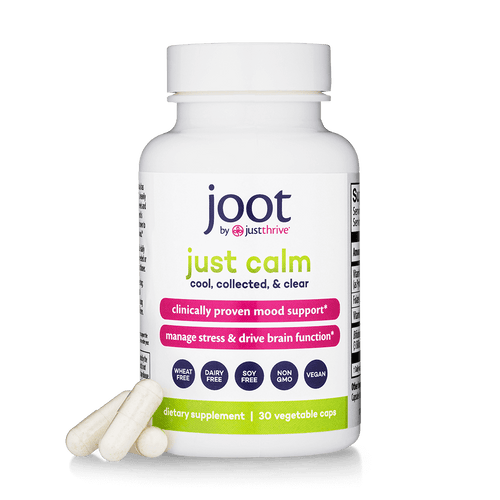
Help your body manage stress effectively so you and your baby can enjoy peaceful, relaxed time together. Just Calm supports a healthy stress response to soothe your system with clinically studied Bifidobacterium longum 1714™ and a targeted blend of B vitamins.
Stressors are everywhere, but you can help your mind and body manage them more easily with a gentle assist from Just Calm.
>> With the help of Just Calm, experience the peace and clarity you deserve, so you can focus on what matters most.
But if you’re not quite sure if Just Calm is right for you…we can help. We’re confident that when you take Just Calm as directed, you’ll enjoy all the benefits it delivers.
But, if you’re not 100% happy, we’ve got your back.
If you’re not satisfied with your Just Thrive purchase for ANY reason, you can take advantage of our “Bottom of the Bottle” money-back guarantee: Love your Just Thrive purchase, or request a full product refund at any time…Whether it’s 3 days, 3 weeks, or 3 months later…Even if the bottle is empty!
Sources
- Martin CR, Ling PR, Blackburn GL. Review of Infant Feeding: Key Features of Breast Milk and Infant Formula. Nutrients. 2016 May 11;8(5):279. doi: 10.3390/nu8050279. PMID: 27187450; PMCID: PMC4882692.
- Moore RE, Townsend SD. Temporal development of the infant gut microbiome. Open Biol. 2019 Sep 27;9(9):190128.
- Xi M, Yan Y, Duan S, Li T, Szeto IM, Zhao A. Short-chain fatty acids in breast milk and their relationship with the infant gut microbiota. Front Microbiol. 2024 Feb 19;15:1356462.
- Ziomkiewicz A, et al. Psychosocial stress and cortisol stress reactivity predict breast milk composition. Sci Rep. 2021 Jun 2;11(1):11576.
- Aparicio M, Browne PD, Hechler C, Beijers R, Rodríguez JM, de Weerth C, Fernández L. Human milk cortisol and immune factors over the first three postnatal months: Relations to maternal psychosocial distress. PLoS One. 2020 May 21;15(5):e0233554.
- Hinde K, Skibiel AL, Foster AB, Del Rosso L, Mendoza SP, Capitanio JP. Cortisol in mother's milk across lactation reflects maternal life history and predicts infant temperament. Behav Ecol. 2015 Jan-Feb;26(1):269-281.
- Pundir S, Gridneva Z, Pillai A, Thorstensen EB, Wall CR, Geddes DT, Cameron-Smith D. Human Milk Glucocorticoid Levels Are Associated With Infant Adiposity and Head Circumference Over the First Year of Life. Front Nutr. 2020 Sep 11;7:166.
- Li X, Yu D, Wang Y, Yuan H, Ning X, Rui B, Lei Z, Yuan J, Yan J, Li M. The Intestinal Dysbiosis of Mothers with Gestational Diabetes Mellitus (GDM) and Its Impact on the Gut Microbiota of Their Newborns. Can J Infect Dis Med Microbiol. 2021 Sep 22;2021:3044534.
- Fernández-Tuñas MDC, Pérez-Muñuzuri A, Trastoy-Pena R, Pérez Del Molino ML, Couce ML. Effects of Maternal Stress on Breast Milk Production and the Microbiota of Very Premature Infants. Nutrients. 2023 Sep 16;15(18):4006.
- Allen, A., Hutch, W., Borre, Y. et al. Bifidobacterium longum 1714 as a translational psychobiotic: modulation of stress, electrophysiology and neurocognition in healthy volunteers. Transl Psychiatry 6, e939 (2016). https://doi.org/10.1038/tp.2016.191
- Allen AP, Hutch W, Borre YE, Kennedy PJ, Temko A, Boylan G, Murphy E, Cryan JF, Dinan TG, Clarke G. Bifidobacterium longum 1714 as a translational psychobiotic: modulation of stress, electrophysiology and neurocognition in healthy volunteers. Transl Psychiatry. 2016 Nov 1;6(11):e939.
- Wang H, Braun C, Murphy EF, Enck P. Bifidobacterium longum 1714™ Strain Modulates Brain Activity of Healthy Volunteers During Social Stress. Am J Gastroenterol. 2019 Jul;114(7):1152-1162. doi: 10.14309/ajg.0000000000000203. PMID: 30998517; PMCID: PMC6615936.
- Moloney GM, et al. Improvements in sleep indices during exam stress due to consumption of a Bifidobacterium longum. Brain Behav Immun Health. 2020 Nov 13;10:100174.
- Calderón-Ospina CA, Nava-Mesa MO. B Vitamins in the nervous system: Current knowledge of the biochemical modes of action and synergies of thiamine, pyridoxine, and cobalamin. CNS Neurosci Ther. 2020 Jan;26(1):5-13.
- Kennedy DO. B Vitamins and the Brain: Mechanisms, Dose and Efficacy--A Review. Nutrients. 2016 Jan 27;8(2):68. doi: 10.3390/nu8020068. PMID: 26828517; PMCID: PMC4772032.


