



And how to keep them both healthy and strong
They’re your body’s greatest protectors against the outside world. Your gut lining and your skin keep you safe from external threats. These two protective barriers are your first line of defense against pathogens and toxins.
They’re the main reason you’re alive and well.
But if either of these critical barriers malfunctions, the other one can too, setting off a chain of events that can threaten your health. When barrier function is compromised, it may affect overall wellness and immune balance and set you up for more problems down the road.
That’s why it’s crucial to defend your best defenders. They need proactive protection to stay strong and functional so they can keep you safe and healthy.
Quick Answer: Your gut lining (the mucosal gut barrier) and your skin barrier are your body's two main physical barriers against the outside world, and they have a lot in common. Both are built from tightly packed epithelial cells, use tight junctions to let nutrients in while blocking toxins and pathogens, host their own communities of beneficial microbes, and rely on chemical defenses like antimicrobial peptides. They are also connected through the gut-skin axis, so when one barrier is weakened the other often follows. You can support both by giving them targeted amino acids, antioxidants, and citrus polyphenols that help maintain healthy barrier function.
How Are Your Gut Lining and Skin Alike?
Your gut lining and your skin barrier are remarkably similar: both are made of tightly packed epithelial cells, use tight junctions for selective permeability, host beneficial microbes, and rely on chemical defenses. Both also trigger inflammation when they stop working properly.
Your skin barrier and gut lining (also called the mucosal gut barrier) are surprisingly similar in how they function. They both act as physical boundaries between your body and the outside world. And they have much more in common than you might expect.[1]
Your skin barrier, the outer layer known as the stratum corneum[2], and your mucosal intestinal (gut) barrier share several features. They both:
- Are lined by epithelial cells, protective cells that fit snugly together to cover critical surfaces[3]
- Use tight junctions that allow selective permeability, meaning they know to block out pathogens and toxins while allowing nutrients in[4]
- Host diverse populations of microbes, mainly beneficial bacteria that support their function[5]
- Employ chemical defenses against potential threats, such as antimicrobial peptides (AMPs) that discourage pathogens[6,7]
- Cause inflammatory immune system responses when they aren’t working properly[8,9]
These two barriers are essential for your health and well-being. And when they malfunction, it can cause all sorts of problems.
 Want to listen instead of read? CLICK HERE
What Is the Gut Lining (Mucosal Gut Barrier)?
The gut lining, or mucosal gut barrier, is a thick layer of protective mucus that lines your intestines. It controls what passes into your bloodstream, letting in small healthful molecules while blocking larger toxins, allergens, and harmful bacteria.
You see your skin every day and have a pretty good idea of how it looks when it’s healthy. But your gut lining is a bit more mysterious.
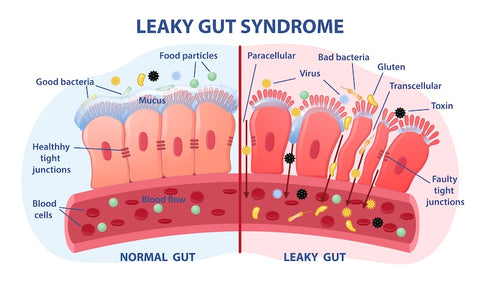
Your intestines are lined by the mucosal gut barrier, a thick layer of protective mucus.[10] That barrier controls what gets through and what stays locked in. Healthful molecules like vitamins and antioxidants are very small, so the mucosal barrier lets them into your bloodstream. Larger molecules like toxins, allergens, and harmful bacteria are blocked and trapped for elimination.
At least that’s what happens when everything is working the way it’s supposed to.
Unfortunately, toxins, harmful bacteria, and the compounds those bacteria produce can weaken your mucosal gut barrier. They attack it constantly until the tight junctions are damaged, making the barrier more permeable and those large molecules can slip through.
That’s called leaky gut[11]… and it can cause problems for your skin barrier too.
What Is the Gut-Skin Connection?
The gut-skin connection is the two-way link between your gut barrier and your skin, known as the gut-skin axis. Because they communicate, a problem with one barrier can affect the other, so leaky gut and leaky skin often go hand in hand.
Your gut barrier and your skin share a direct connection through the gut-skin axis. And because of this two-way communication highway, a problem with one can affect the other.
Leaky gut can lead to leaky skin, where the skin barrier becomes compromised and lets irritants and allergens in. Leaky skin can also cause leaky gut. And when both barriers malfunction, they create a negative feedback loop with each worsening the other.
That can cause skin and gut-related issues such as[12,13,14]:
- Acne
- Eczema
- Psoriasis
- Rashes
- Aging skin
- Diarrhea
- Constipation
- Gas and bloating
- Nausea
- Abdominal pain
You can see why it’s so important to maintain strong, healthy skin and gut barriers. And you can do that by taking proactive steps to support both your skin and gut health.
What Nutrients Support Skin and Gut Barrier Health?
Three groups of nutrients support both barriers: targeted amino acids (the building blocks of protective mucus and skin cells), strong antioxidants to neutralize free radicals, and citrus polyphenols that nourish healthy barrier function.
You can keep your skin and your gut barriers in top shape naturally by taking some simple steps. And making sure both are strong and healthy will do wonders for your overall wellness.
The first step involves targeted amino acids, the building blocks of protein your body uses to produce the mucus that coats your gut lining[15] and supports skin cell maintenance. A combination of four key amino acids works for both barriers[16,17]:
- L-proline
- L-serine
- L-cysteine
- L-threonine
Step two calls for strong antioxidant protection. Both your outer skin layer and your gut lining are bombarded by free radicals all the time.[18,19] Adding in more antioxidants helps them neutralize those free radicals and calm oxidative stress. Powerful natural antioxidants include:
- Olive leaf
- Grape seed
- Pomegranate
- Green tea
The third step adds a level of nourishing support to both barriers. Citrus polyphenols (special plant chemicals) such as citrus sinensis and citrus paradisi are known to promote skin health[20,21] and healthy gut barrier function[22,23]
Taking these steps can help shore up these two crucial barriers and reinforce a healthy relationship between them.
| Feature | Gut lining (mucosal gut barrier) | Skin barrier (stratum corneum) |
|---|---|---|
| Building blocks | Epithelial cells lining the intestines | Epithelial cells in the outer skin layer |
| How it controls what passes | Tight junctions allow nutrients in, block toxins | Tight junctions allow selective permeability |
| Microbial community | Gut microbiome of beneficial bacteria | Skin microbiome of beneficial bacteria |
| When it malfunctions | Leaky gut, inflammation, digestive issues | Leaky skin, inflammation, acne or eczema |
Frequently Asked Questions About the Gut-Skin Connection
What do the gut lining and skin barrier have in common?
Both are physical barriers between your body and the outside world. They are built from epithelial cells, use tight junctions for selective permeability, host beneficial microbes, and use chemical defenses like antimicrobial peptides. Both can trigger inflammation when they stop working properly.
What is the gut-skin axis?
The gut-skin axis is the two-way communication highway between your gut barrier and your skin. Because they are linked, a problem with one barrier can affect the other, which is why gut issues and skin issues so often show up together.
Can a weak gut lining affect your skin?
Yes. When the gut lining becomes more permeable (often called leaky gut), it can contribute to leaky skin, where the skin barrier lets in irritants and allergens. The two can feed a negative loop, each worsening the other.
What nutrients support gut and skin barrier health?
Targeted amino acids (L-proline, L-serine, L-cysteine, L-threonine), a strong antioxidant blend (olive leaf, grape seed, pomegranate, green tea), and citrus polyphenols are all studied for supporting healthy barrier function in both the gut and the skin.
How can I keep both barriers strong?
Support them proactively with the right nutrients, manage oxidative stress, and maintain overall gut health. Strong, healthy gut and skin barriers help keep your immune system balanced and support whole-body wellness.
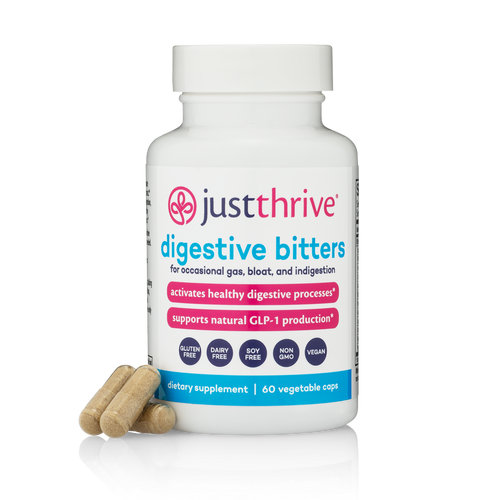
Just Thrive Gut Health Products


How to Give Your Skin & Gut the Support They Need to Stay Healthy
Your skin and gut barriers are directly linked… and so is their healthy function. These two whole-body shields help keep your immune system balanced and functioning properly, nurturing whole body wellness.
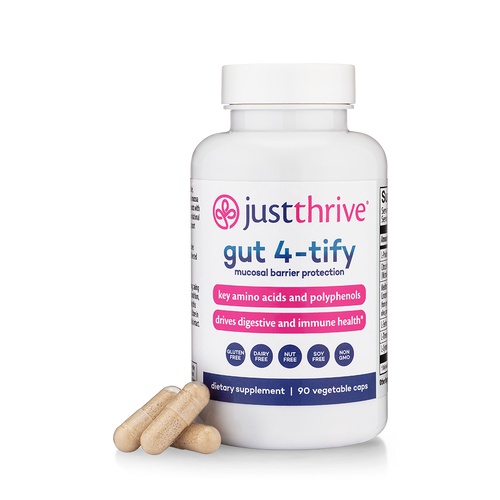
You can support your body’s most important defense mechanisms with Gut 4-tify.
Gut 4-tify provides daily support your mucosal gut barrier and skin barrier need to stay in top shape:
- 4 key amino acids:
- L-proline
- L-serine
- L-cysteine
- L-threonine
- A powerful antioxidant blend that includes olive leaf, grape seed, pomegranate, and green tea to help manage free radicals.
- A natural citrus polyphenol extract that offers nourishing support for healthy function
Not sure about trying Gut 4-tify? We can help with that.
EVERY Just Thrive purchase is covered by our Bottom of the Bottle, 100% money back guarantee.
So you can try Gut 4-tify to see if it works for you… and we’re betting you’ll love the way you feel.
But if for any reason you don’t feel a difference, simply ask for a full product refund. Any time. Even if it’s been 3 months… or 3 years. Even if the bottle is empty! You’ll get your money back at any time, no matter what!

Sources
- Coates M, Lee MJ, Norton D, MacLeod AS. The Skin and Intestinal Microbiota and Their Specific Innate Immune Systems. Front Immunol. 2019 Dec 17;10:2950.
- Rajkumar J, Chandan N, Lio P, Shi V. The Skin Barrier and Moisturization: Function, Disruption, and Mechanisms of Repair. Skin Pharmacol Physiol. 2023;36(4):174-185.
- Kurn H, Daly DT. Histology, Epithelial Cell. [Updated 2023 Feb 17]. In: StatPearls [Internet]. Treasure Island (FL): StatPearls Publishing; 2025 Jan-. Available from: https://www.ncbi.nlm.nih.gov/books/NBK559063/
- Citi S, Fromm M, Furuse M, González-Mariscal L, Nusrat A, Tsukita S, Turner JR. A short guide to the tight junction. J Cell Sci. 2024 May 1;137(9):jcs261776.
- Woo YR, Kim HS. Interaction between the microbiota and the skin barrier in aging skin: a comprehensive review. Front Physiol. 2024 Jan 19;15:1322205.
- Gong T, Fu J, Shi L, Chen X, Zong X. Antimicrobial Peptides in Gut Health: A Review. Front Nutr. 2021 Sep 30;8:751010.
- Clausen ML, Agner T. Antimicrobial Peptides, Infections and the Skin Barrier. Curr Probl Dermatol. 2016;49:38-46.
- Michielan A, D'Incà R. Intestinal Permeability in Inflammatory Bowel Disease: Pathogenesis, Clinical Evaluation, and Therapy of Leaky Gut. Mediators Inflamm. 2015;2015:628157.
- Dong S, Li D, Shi D. Skin barrier-inflammatory pathway is a driver of the psoriasis-atopic dermatitis transition. Front Med (Lausanne). 2024 Mar 28;11:1335551. doi: 10.3389/fmed.2024.1335551. PMID: 38606161; PMCID: PMC11007107.
- Vancamelbeke M, Vermeire S. The intestinal barrier: a fundamental role in health and disease. Expert Rev Gastroenterol Hepatol. 2017 Sep;11(9):821-834.
- Iacob S, Iacob DG. Infectious Threats, the Intestinal Barrier, and Its Trojan Horse: Dysbiosis. Front Microbiol. 2019 Aug 7;10:1676.
- Sánchez-Pellicer P, Eguren-Michelena C, García-Gavín J, Llamas-Velasco M, Navarro-Moratalla L, Núñez-Delegido E, Agüera-Santos J, Navarro-López V. Rosacea, microbiome and probiotics: the gut-skin axis. Front Microbiol. 2024 Jan 8;14:1323644.
- Camilleri M. Leaky gut: mechanisms, measurement and clinical implications in humans. Gut. 2019 Aug;68(8):1516-1526. doi: 10.1136/gutjnl-2019-318427. Epub 2019 May 10. PMID: 31076401; PMCID: PMC6790068.
- Paray BA, Albeshr MF, Jan AT, Rather IA. Leaky Gut and Autoimmunity: An Intricate Balance in Individuals Health and the Diseased State. Int J Mol Sci. 2020 Dec 21;21(24):9770. doi: 10.3390/ijms21249770. PMID: 33371435; PMCID: PMC7767453.
- Tadesse S, Corner G, Dhima E, Houston M, Guha C, Augenlicht L, Velcich A. MUC2 mucin deficiency alters inflammatory and metabolic pathways in the mouse intestinal mucosa. Oncotarget. 2017 Apr 6;8(42):71456-71470
- Li M, Wu Y, Ye L. The Role of Amino Acids in Endothelial Biology and Function. Cells. 2022 Apr 18;11(8):1372.
- Faure M, Mettraux C, Moennoz D, Godin JP, Vuichoud J, Rochat F, Breuillé D, Obled C, Corthésy-Theulaz I. Specific amino acids increase mucin synthesis and microbiota in dextran sulfate sodium-treated rats. J Nutr. 2006 Jun;136(6):1558-64
- Yajie Wang, Y. Wang, Yue Chen, Y. Chen, Xiaoyu Zhang, X. Zhang, Yangpeng Lu, Y. Lu, & Haixia Chen, H. Chen. (0000). New insights in intestinal oxidative stress damage and the health intervention effects of nutrients: A review. Journal of functional foods, 75, 104248
- Poljšak B, Dahmane R. Free radicals and extrinsic skin aging. Dermatol Res Pract. 2012;2012:135206.
- Giftarina, B., Ramadhanti, J., Rohmawaty, E., & Wiraswati, H. L. (2025). Citrus sinensis extract in skin aging: a comprehensive review of antioxidant, anti-inflammatory, and skin-health effects. All Life, 18(1).
- Nobile V, et al. Skin photoprotective and antiageing effects of a combination of rosemary (Rosmarinus officinalis) and grapefruit (Citrus paradisi) polyphenols. Food Nutr Res. 2016 Jul 1;60:31871.
- Stevens Y, Rymenant EV, Grootaert C, Camp JV, Possemiers S, Masclee A, Jonkers D. The Intestinal Fate of Citrus Flavanones and Their Effects on Gastrointestinal Health. Nutrients. 2019 Jun 27;11(7):1464.
- Nakajima VM, Moala T, Caria CREP, Moura CS, Amaya-Farfan J, Gambero A, Macedo GA, Macedo JA. Biotransformed citrus extract as a source of anti-inflammatory polyphenols: Effects in macrophages and adipocytes. Food Res Int. 2017 Jul;97:37-44.


