



You love everything about your dog… Well… almost everything.
Truth be told, you could do without the foul-smelling farts that can kill a mood and clear the room.
Of course, just like people, dogs pass gas. Sometimes loudly, sometimes silent but deadly. And lots of things can cause stinky dog farts, like new food, speed eating, or chewing on your old pair of running shoes.
While it’s quite normal for your dog to fart occasionally, excessive smelly gas can be a sign of a larger concern, one that requires your attention and intervention.
Quick Answer: Occasional dog farts are normal, but frequent, room-clearing gas usually traces back to the gut. The number one cause is changing what your dog eats, followed by speed eating, which swallows extra air. Hard-to-digest ingredients like dairy, soy, corn, peas, beans, and high-fat foods add to it. Persistent stinky gas can also signal a gut imbalance (dysbiosis), where harmful bacteria outnumber beneficial ones. The most effective thing most owners can do is support the dog's gut microbiome with a pet-specific probiotic. In one 30-day study, a spore probiotic with Bacillus subtilis and Pediococcus acidilactici reduced farting and GI symptoms in dogs.
Why Does My Dog Fart So Much?
The most common cause of dog farts is changing what your dog eats, including new brands, flavors, or anything they get into. Speed eating is the next biggest cause, and hard-to-digest ingredients like dairy, soy, corn, peas, beans, and high-fat foods can lead to ongoing gas.
If you had to guess, what’s the most common cause of dog farts?
- Gluttony or compulsive eating
- Eating shortly after exercise
- Diets high in non-organic or GMO ingredients
The answer?
Many dog owners are surprised to find that the #1 culprit is CHANGING what their dog eats.[1]
So if you switch brands or flavors of dog food, or add something new that they don’t normally eat, the gas will flow...
 Want to listen instead of read? CLICK HERE
NOTE: Food changes also include anything your dog gets into, from trash to deer poop to table scraps.
Building on that, ongoing and/or chronic farting tends to be caused by hard-to-digest ingredients, which include:
- Dairy products like milk and cheese
- Soy products
- Corn
- Peas
- Beans
- High-fat foods (like cat food or bacon)
Interestingly, right behind dietary change is another leading cause of dog farts: speed eating.
When your dog wolfs down their meals, they introduce a lot of air into the digestive tract. That trapped air needs to get out somehow… and farting is the easiest pathway out.
As common as both of these issues are, food changes and speed eating can really do a number on your puppy's intestines. More specifically, it can really mess up the balance of good and bad bacteria in your dog’s gut microbiome. And that can make your dog (and you) very uncomfortable.

Is It More Than Just Gas?
Sometimes, yes. A dog that farts almost constantly or has excessively foul gas could be dealing with an underlying issue such as food allergies, inflammatory bowel disease, IBS, leaky gut, or SIBO, so it is worth checking with your vet.
If your dog farts almost constantly, or if the farts smell excessively bad, it could be a sign that your dog is dealing with more than just gas. So you’ll want to keep your nose peeled and your vet on speed dial. Here’s why...
An overly gassy dog could be dealing with:
- Food allergies or intolerances
- Inflammatory bowel disease IBD)
- Irritable bowel syndrome (IBS)
- Leaky gut
- Small intestinal bacterial overgrowth (SIBO)
Once your vet has pinpointed the cause of your dog’s noxious gas and other symptoms, they’ll come up with a treatment plan to help. And that plan will almost always include targeted gut support.
What Is the Best Way to Stop Stinky Dog Farts?
The most effective thing most owners can do is support the dog's gut microbiome with a pet-specific probiotic. When the gut falls out of balance (dysbiosis), harmful bacteria multiply and can cause smelly gas, and rebalancing it can soothe GI discomfort.
Your dog has a gut microbiome, just like you do. It contains trillions of bacteria, including beneficial probiotics and harmful pathogens.
When your dog’s gut microbiome is in healthy balance, probiotics greatly outnumber pathogens. But when it falls out of balance, those harmful bacteria grow and multiply out of control. That condition is called dysbiosis, and it can cause all sorts of gut health issues for your dog[2]… including very smelly gas!
Luckily, giving your dog specific gut support in the form of a probiotic supplement is a proven safe way to balance your pup’s gut microbiome and soothe their GI discomfort.[3] And when your dog’s gut is in healthy balance[4], they’ll sit up and bark for joy.
Plus, new research shows that the right probiotics, meaning specially formulated for your pet, can transform your dog’s gut health.[5]
Which Probiotic Strains Are Most Effective for Dogs?
The strains studied for dog gas and GI issues are Bacillus subtilis and Pediococcus acidilactici. In a 30-day clinical study, a spore probiotic with these two strains significantly reduced GI issues and farting, even in healthy dogs.
Probiotics can work wonders for your dog’s smelly gas problem. But you want to make sure that you use a probiotic that’s been proven to help resolve this issue in dogs. Luckily, you don’t have to guess which probiotic strains will be most effective...
In a 30-day clinical study, a specially formulated spore probiotic offered significant relief for dogs suffering from GI issues.[6] That supplement contained two dog-specific probiotic strains: Bacillus subtilis and Pediococcus acidilactici.
To test that probiotic, researchers worked with two groups of dogs: one group with gut dysbiosis experiencing uncomfortable symptoms and one group of healthy dogs with no GI issues. All 11 dogs got the spore probiotic for 30 days with highly positive results:
- GI issues were dramatically reduced or in some cases disappeared
- Markers of leaky gut decreased substantially
- Farting was reduced even in healthy dogs
- No healthy dogs experienced negative side effects
The bottom line: These targeted pet probiotic strains helped reduce gas and other uncomfortable symptoms in healthy dogs and in dogs experiencing GI issues. And that means breathing easy around your best friend is now within reach.
Just Thrive Pet Health Products
Frequently Asked Questions About Dog Farts
Why does my dog fart so much all of a sudden?
The most common trigger is a change in diet, including new brands, flavors, or anything your dog gets into like trash or table scraps. Speed eating, which swallows extra air, is another leading cause.
When are dog farts a sign of something serious?
If your dog farts almost constantly or the gas smells excessively bad, it can point to an underlying issue such as food allergies, inflammatory bowel disease, IBS, leaky gut, or SIBO. It is worth checking with your vet in those cases.
Can probiotics help with dog gas?
Supporting the gut microbiome with a pet-specific probiotic can help rebalance the good and bad bacteria behind smelly gas. In a 30-day study, a spore probiotic reduced GI symptoms and farting in dogs.
What probiotic strains are best for dogs?
The two strains studied for canine gas and GI issues are Bacillus subtilis and Pediococcus acidilactici. These are the strains used in Just Pets Probiotic.
What foods make dogs gassy?
Hard-to-digest foods are common culprits, including dairy like milk and cheese, soy, corn, peas, beans, and high-fat foods such as cat food or bacon. Sudden changes to any food can also bring on gas.
Show Your Dog (and Your Nose) Some Love with Just Pets Probiotic
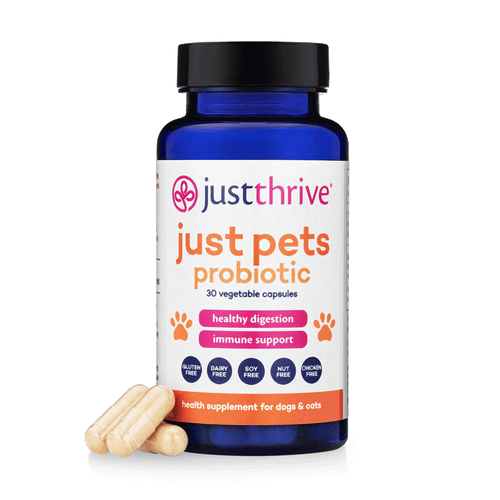
Just Pets Probiotic contains Bacillus subtilis and Pediococcus acidilactici, two probiotic strains proven effective for keeping your dog’s gut healthy and comfortable.
A single capsule of Just Pets Probiotic mixed into your dog’s food every day helps:
- Maintain a well-balanced gut microbiome
- Keep your dog’s GI system comfortable
- Support healthy immune system function
>> Soothe your dog’s gut and help them feel their best with Just Pets Probiotic.
Still on the fence about Just Pets Probiotic? We’re confident that you’ll notice a positive difference when you use Just Pets as directed, but if you’re not 100% tail-waggingly happy, we’ve got your back.
EVERY Just Thrive purchase is covered by our hassle-free, Bottom of the Bottle, 100% money-back guarantee.
Love your Just Thrive purchase, or request a full product refund at any time… Whether it’s 3 days, 3 weeks, or 3 months later… Even if the bottle is empty!

Sources
- Hunter T, Ward E. Flatulence in Dogs. VCA Animal Hospitals. Accessed February 20, 2025. https://vcahospitals.com/know-your-pet/flatulence-in-dogs.
- Suchodolski J. Intestinal Microbes and Digestive System Disease in Dogs. Today’s Veterinary Practice. September/October 2017. Accessed February 20, 2025. https://todaysveterinarypractice.com/gastroenterology/intestinal-microbes-digestive-system-disease-dogs/.
- Schmitz S, Suchodolski J. Understanding the canine intestinal microbiota and its modification by pro-, pre- and synbiotics - what is the evidence?. Vet Med Sci. 2016;2(2):71-94. Published 2016 Jan 11. doi:10.1002/vms3.17
- Pilla R, Suchodolski JS. The role of the canine gut microbiome and metabolome in health and gastrointestinal disease. Front Vet Sci. 2020;6:498. doi:10.3389/fvets.2019.00498
- White R, Atherly T, Guard B, et al. Randomized, controlled trial evaluating the effect of multi-strain probiotic on the mucosal microbiota in canine idiopathic inflammatory bowel disease. Gut Microbes. 2017;8(5):451-466. doi:10.1080/19490976.2017.1334754
- Matei MC, Andrei SM, Buza V, et al. Natural Endotoxemia in Dogs-A Hidden Condition That Can Be Treated with a Potential Probiotic Containing Bacillus subtilis, Bacillus licheniformis and Pediococcus acidilactici: A Study Model. Animals (Basel). 2021;11(5):1367. Published 2021 May 11. doi:10.3390/ani11051367


