



Spring is often described as the season of renewal, and for good reason. As the days get longer and the weather gets warmer, our daily routines naturally start to shift. We throw open the windows and let the sunshine stream in, spend more time outdoors, and embrace the extra daylight and movement.
There’s a new energy in the air, a fresh rhythm that adds a touch of excitement. And we’re not the only ones who feel it.
Our pets are incredibly sensitive and highly attuned to environmental changes. They notice even the most subtle shifts in daylight, temperature, and household schedules. And this seasonal transition can influence how they feel, both physically and emotionally.
Spring might bring enthusiasm, with zoomies in the backyard, and longer, more eager walks. You may even get demands for more playtime indoors, as your pets channel some of their energy into connecting with you.
But beyond their adorable excitement, the spring transition can also be stressful for your pets. Changes in routine, diet, and activity can sometimes lead to digestive upset. Extra time outdoors means more exposure to pollen that may trigger allergies or skin sensitivities. Busier schedules, including outings and travel, can create anxiety in pets who thrive on routine.
Your pet needs time to adjust to spring, just like we do. But with a little proactive care, spring can become a wonderful opportunity to support your pet’s overall wellness and enjoy a healthy, vibrant season ahead.
Let’s look at five strategies you can follow to help your pets stay happy and thrive this spring.
Spring Strategy 1: Manage Seasonal Anxiety

While spring’s energy is full of joy and renewal, it’s not always calming for pets. Changes in household schedules, noisy yardwork on the weekends, spring thunderstorms, and even busier dog parks can disrupt your pet’s once-predictable routine and leave them feeling unsettled.
If you’ve updated your usual routine this season, keep an eye on your pets for signs of anxiety. Stress can manifest as pacing, excessive barking, clinginess, hypervigilance, disordered sleep, impulsivity, compulsion, and any other unusual behaviors.[1,2] And because your pet’s gut and nervous system are so closely connected, just like in humans, anxiety can show up as changes in appetite, diarrhea, or constipation.[3]
To soothe your pet and help ease their anxiety, focus first on consistency. Predictable feeding times, walks, and evening wind-down routines can help them feel safe and supported.
 Want to listen instead of read? CLICK HERE
Enrichment toys and puzzle feeders can also redirect nervous energy, encouraging your fur baby to engage in a focused and ultimately rewarding activity. Short training sessions can provide mental engagement to distract from stress. Other natural measures can include calming chews or supplements, structured outdoor playtime, and pet-safe aromatherapy.
Probiotic supplements can also help ease your fur baby’s stress due to the two-way communication highway, called the gut-brain axis, that sends signals between your pet’s gut and their central nervous system. By encouraging a healthy, thriving gut, you can promote your pet’s mental health, too.
A little extra structure and a predictable routine (that still leaves space for fun) can keep your pet from feeling overwhelmed.
Spring Strategy 2: Increase Outdoor Activity Safely

As we mentioned earlier, spring brings an invigorating surge of outdoor activity. And although your pet will enjoy the extra movement, play time, and engagement, there are some risks.
After a more sedentary winter, it’s possible that too much exercise, too fast, could increase strain on your pet’s body. Just as with humans, a sudden increase in activity can lead to muscle strain, joint flare-ups, and dehydration.
To keep your pet healthy, take a more gradual approach to conditioning. Increase duration and intensity slowly, building up over several weeks. When going for long walks or hikes, take time for both a warm-up and a cool-down, which will benefit both you and your fur baby.
Heat-related injuries also rise as the weather gets warmer.[4] If you’re spending extended time outdoors, watch for signs of overexertion. These can vary by species and breed; talk to your veterinarian so you know exactly what to look for.
How else can you help your fur baby enjoy spring playtime safely? Surprisingly, technology can play a role in preventive care. Just as you wear a fitness tracker, there are pet wearables that can track steps, heart rate, sleep patterns, and even stress levels. Once you’ve identified your pet’s baseline, you can monitor their activity data for signs that your playful pal might be overdoing it.
Spring Strategy 3: Lean Into Awareness

Several pet health awareness campaigns occur in spring, including parasite prevention and poison prevention initiatives. During these awareness periods, veterinary clinics, pet “daycares,” and local animal rescue centers often provide free or low-cost resources designed to support preventive care.
March is Pet Poison Awareness Month, and it brings an annual reminder to check your pet’s space for environmental hazards. This is especially important in spring, when many people resume gardening. Hazards like fertilizer, mulch, toxic plants, and pest control products might become more common. Curious pets can easily get into these harmful substances. Even a walk across a recently treated lawn can be dangerous if your pet licks their paws afterward. Exposure to these hazards can also affect your pet’s gut health and may show up as digestive upset.
To keep your pet safe, make sure you store garden supplies, cleaning products, medications, and other chemicals securely out of reach.[5] This is also a good time to have a conversation about toxins with your vet and which human foods are toxic for your fur baby.
Another campaign, World Parasite Awareness Day, is held annually on March 20th. In many areas, this coincides with the start of flea, tick, and heartworm season. Warmer temperatures create ideal breeding grounds for parasites, and additional outdoor time increases the risk of exposure. Your veterinarian can help you choose preventive options that protect your pet before exposure occurs.
Spring Strategy 4: Address Seasonal Allergies and Skin Sensitivities

Sneezing fits. Runny eyes. Itchy skin. Sound familiar? Spring is one of the most common seasons for allergies, and not just for humans. Your fur baby could also experience seasonal allergies.
In spring, environmental allergens like pollen, freshly mown grass, mold spores, and other allergens are found in greater concentration. And with more time spent outside, your pet’s exposure will increase, too.
While some symptoms may overlap, pets show very unique signs when they are dealing with allergies.
The main way allergies often make themselves known is with skin issues, manifesting as intense scratching, licking their paws, inflamed ears, hot spots, and other skin irritations. As a result, your pet may exhibit some unusual behaviors, such as chewing at their feet after a walk or rubbing their face along furniture or a carpet. Other common signs of seasonal allergies include digestive issues, respiratory symptoms (sneezing or coughing), and recurring ear infections.[6]
But before turning to stronger allergy medications, consider gentle, all-natural options.
- Omega-3 fatty acids (in oral or topical pet-safe formulations) can support skin barrier health and help manage inflammatory responses.[7]
- Rinsing your pet’s paws after outdoor time can help remove allergens.
- Regular baths with skin-soothing or hypoallergenic formulations can further reduce allergen buildup.
- HEPA filters can help decrease airborne allergens inside your home. (Tina's favorite air filter is AirDoctor.)
- A probiotic supplement formulated specifically for pets can help support their immune system and encourage a healthy inflammatory response.
Gentle, consistent care can help your pet enjoy outdoor fun in the spring in greater comfort. But if your pet’s allergy issues persist or they have a sudden or severe reaction, consult your veterinarian promptly.
Spring Strategy 5: Support Your Pet’s Gut Health
From new food intolerances to unexpected potty issues, once springtime takes hold, you may notice a shift in your pet’s digestion. They may seem gassier, have loose or soft stools, or their appetite may just seem “off.”
But while it’s natural to worry when your fur baby isn’t quite themselves, these mild digestive changes are often linked to the spring transition.
Spring’s long, mild days often bring a bustle of activity: longer walks, extra backyard play sessions, and weekend hikes. While the increased exercise is wonderful for your pet’s cardiovascular and mental health, their digestive system may need a little extra support.
Higher activity levels can stimulate your pet’s digestive tract, making potty breaks more frequent. Extra time outdoors also means your fur baby has more chances to nibble on grass and flowers, drink from puddles, and sample anything that tempts their taste buds. In the end, springtime fun might temporarily disrupt your pet pal’s digestive balance.
Food and treats might also affect your pet’s stomach. Have you adjusted your pet’s feeding schedule this spring? Maybe the long days have you doing extra training, which could mean more treats (as training rewards). Or perhaps you’re eating later meals and have shifted your pet’s schedule to match yours.
Even seemingly small shifts to your pet’s diet, treat frequency, or feeding time can affect their gut microbiome, the community of beneficial bacteria that supports digestion, immune health, and overall well-being.
The good news is that a gentle, proactive approach can go a long way.
Here are a few ways to support your pet’s gut health.
- Add prebiotics, often found in fiber-rich whole foods, to your pet’s diet. Even simple additions, like a spoonful of plain pumpkin, can be helpful.[8]
- Supplement your pet’s beneficial gut bacteria with probiotics. The strains Bacillus licheniformis and Bacillus subtilis can promote more regular bowel movements[9], while Pediococcus acidilactici, a universal animal colonizer, may help regulate your pet’s gut microbiota and offer digestive support.[10] Choose probiotic supplements designed specifically for pets to best support their gut microbiome and overall wellness.
- Make sure your pet has plenty of fresh, clean water. Bring a travel bowl when you’ll be spending extended time outdoors.
Always consult your veterinarian before making any changes to your fur baby’s diet, especially if your pet has a history of digestive troubles.
With a little awareness, spring can be a season for thriving, not tummy troubles.
Just Thrive Pet Health Products
Support Your Pet’s Health During the Spring Transition with Just Thrive
Spring is an excellent opportunity to reset your pet’s wellness routine, establishing habits that help your fur baby thrive year-round.
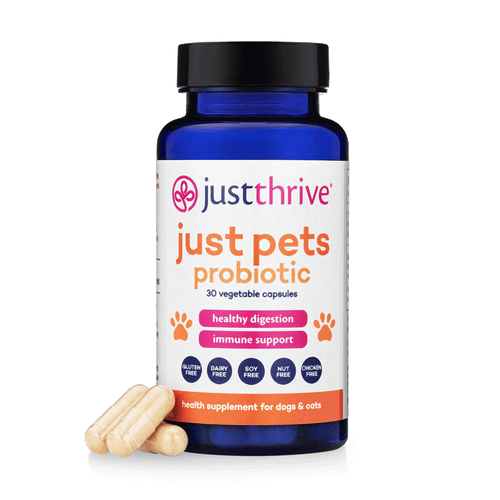
Encourage your pet’s overall health with Just Pets Probiotic. Each capsule contains three unique probiotic strains carefully chosen to support your fur baby’s well-being.
- Bacillus licheniformis SL-307: promotes healthy digestion, gut barrier strength, and energy
- Bacillus subtilis HU58™: supports digestive and immune health and promotes proper nutrient absorption
- Pediococcus acidilactici: encourages a balanced microbiome by crowding out pathogens
Together, these probiotics can help your pet handle the spring transition smoothly, easing occasional digestive issues, soothing itchy skin, promoting healthy hips and joints, and encouraging youthful energy.
And unlike many other pills, Just Pets Probiotic is easy to administer. Just sprinkle the contents of one capsule over your pet’s food, and let your fur baby enjoy all the outdoor fun of springtime.
>> Support your pet’s best health during the spring transition (and beyond) with Just Pets.
And if you’re worried about whether your Just Pets Probiotic will work for your pet, we’ve got your back.
Every Just Thrive purchase is covered by our Bottom of the Bottle, 100% money back guarantee. So you can try Just Pets Probiotic to see if it works for your pet. And we’re confident it will.
But if for any reason you don’t see a difference, simply ask for a full product refund at any time. Even if it’s been 3 weeks, 3 months, or 3 years… and even if the bottle is empty.

Sources
- Barrios F, Ruiz P, Damián JP. Tools for the Approach of Fear, Anxiety, and Stress in the Domestic Feline: An Update. Vet Med Int. 2025 Aug 6;2025:9109397. doi: 10.1155/vmi/9109397. PMID: 40809800; PMCID: PMC12349988.
- Salonen, M., Sulkama, S., Mikkola, S. et al. Prevalence, comorbidity, and breed differences in canine anxiety in 13,700 Finnish pet dogs. Sci Rep 10, 2962 (2020). https://doi.org/10.1038/s41598-020-59837-z
- Sacoor C, Marugg JD, Lima NR, Empadinhas N, Montezinho L. Gut-Brain Axis Impact on Canine Anxiety Disorders: New Challenges for Behavioral Veterinary Medicine. Vet Med Int. 2024 Jan 23;2024:2856759. doi: 10.1155/2024/2856759. PMID: 38292207; PMCID: PMC10827376.
- Hall EJ, Carter AJ, O'Neill DG. Dogs Don't Die Just in Hot Cars-Exertional Heat-Related Illness (Heatstroke) Is a Greater Threat to UK Dogs. Animals (Basel). 2020 Jul 31;10(8):1324. doi: 10.3390/ani10081324. PMID: 32751913; PMCID: PMC7459873.
- Mahdi A, Van der Merwe D. Dog and cat exposures to hazardous substances reported to the Kansas State Veterinary Diagnostic Laboratory: 2009-2012. J Med Toxicol. 2013 Jun;9(2):207-11. doi: 10.1007/s13181-013-0289-8. PMID: 23381600; PMCID: PMC3657027.
- Jackson, H. A. (2023). Food allergy in dogs and cats; current perspectives on etiology, diagnosis, and management. Journal of the American Veterinary Medical Association, 261(S1), S23-S29. Retrieved Mar 4, 2026, from https://doi.org/10.2460/javma.22.12.0548
- Sawada Y, Saito-Sasaki N, Nakamura M. Omega 3 Fatty Acid and Skin Diseases. Front Immunol. 2021 Feb 5;11:623052. doi: 10.3389/fimmu.2020.623052. PMID: 33613558; PMCID: PMC7892455.
- Rindels JE, Loman BR. Gut microbiome - the key to our pets' health and happiness? Anim Front. 2024 Jun 20;14(3):46-53. doi: 10.1093/af/vfae015. PMID: 38910954; PMCID: PMC11188957.
- Zhang M, Xu H, Zhang T, Kang J, Xu Z, Wu P, Niu Y, Shi Y, Zhong Y, Yang C. Dietary Supplementation with Bacillus licheniformis and Bacillus subtilis Modulates Immunity, Serum Metabolome, and Intestinal Homeostasis in Cats. Animals (Basel). 2025 Oct 14;15(20):2971. doi: 10.3390/ani15202971. PMID: 41153898; PMCID: PMC12560935.
- Fu W, Chen C, Xie Q, Gu S, Tao S, Xue W. Pediococcus acidilactici Strain Alleviates Gluten-Induced Food Allergy and Regulates Gut Microbiota in Mice. Front Cell Infect Microbiol. 2022 Apr 22;12:845142. doi: 10.3389/fcimb.2022.845142. PMID: 35531345; PMCID: PMC9072736.


