



Walk down any supplement aisle, and you'll see dozens of bottles labeled "probiotic for women," each promising something slightly different.
Some tout billions of CFUs.
Some focus on a single strain.
Some bundle in cranberry or D-mannose.
It's easy to assume more CFUs or a longer ingredient list means a better product, but neither tells you what actually matters: whether the bacteria survive long enough to do anything once you swallow them.
The right probiotic for women comes down to a short list of specific, checkable things— not marketing claims. Below are eight things worth looking for before you buy, in the order they matter most.
Quick answer: The best probiotic for women is one that survives stomach acid long enough to reach the gut alive, includes well-studied strains, rather than just a high CFU count, has been tested under real digestive conditions (not just in a lab dish), and is transparent about sourcing and third-party testing. Look past the CFU number on the label and focus on strain survivability, diversity, and manufacturing transparency instead.
1. Does It Use Strains That Can Survive Stomach Acid?
Most probiotic strains never make it past the stomach; they're destroyed by acid before they reach the gut where they do their work. This is one of the most overlooked factors in choosing a probiotic, and it matters more than the number on the label.
Many common probiotic strains, particularly non-spore-forming ones, have thin cell walls that break down quickly in an acidic environment. Spore-forming strains, like those in the Bacillus genus, have a protective outer shell that's naturally built to withstand heat, acid, and pressure—the same properties that let them survive in soil.1
What to look for: a formula that either uses spore-forming strains or publishes independent survivability data, rather than relying on the CFU count alone as a proxy for effectiveness.
2. Does It Include More Than One Probiotic Strain?
A single-strain formula can only do what that one strain is capable of. Different strains interact with the gut in different ways—some support regularity, some support immune signaling, some produce compounds that help other beneficial bacteria thrive.
Research on the gut microbiome consistently points to diversity, not just quantity, as a marker of a well-functioning gut ecosystem.2 A formula built around several complementary strains is more likely to support that diversity than one built around a single strain at a very high dose.
There is one caveat though. Just because a probiotic supplement contains many strains doesn't necessarily make it more effective. The effectiveness of a probiotic depends on the specific strains, their doses, and whether they've been clinically studied together. Without research on the exact combination, it's difficult to know how the strains will interact or whether they'll provide the intended benefits.
What to look for: a multi-strain formula where each strain's role is disclosed, not just a total CFU count with no explanation of what's actually in the blend. Also look for clinical studies on the entire formulation, especially if the strains number in the double or triple digits.
3. Is the CFU Count Actually Meaningful?
A high CFU count only matters if those organisms are alive when you take them and still alive when they reach your gut. CFU counts are often measured at the time of manufacturing, not at the time you swallow the capsule months later.
Heat, humidity, and time can all reduce the live count of a non-spore-forming probiotic well before the expiration date. A lower CFU count of a strain that survives intact can outperform a higher CFU count of a strain that mostly dies in the bottle or in the stomach.1
What to look for: CFU guarantees through the end of shelf life, not just at the time of manufacture.
4. Has the Formula Been Tested Under Realistic Digestive Conditions?
Lab testing in a petri dish doesn't tell you how a probiotic behaves once it's mixed with stomach acid, bile, and digestive enzymes. Some manufacturers test survivability using simulated digestive models that mimic the stomach and small intestine more closely than a shelf-stability test alone.
What to look for: published, third-party data—not just internal marketing claims—showing how the product performs under conditions that resemble actual digestion.
5. Does It Support More Than Digestion Alone?
The gut is connected to far more than digestion. Roughly 70% of the immune system is associated with gut tissue, and gut bacteria play a role in nutrient absorption, in producing certain vitamins, and in supporting the gut lining itself.3 A well-rounded formula reflects that broader relationship rather than positioning itself as a digestion-only product.
What to look for: a formula designed with the gut's broader role in mind, not just marketed for digestive issues. If it contains strains known to create antioxidants in the gut, that's a bonus.
6. Is It Free From Unnecessary Fillers and Common Allergens?
Some probiotic capsules include binders, artificial colors, or common allergens (soy, dairy, gluten) that aren't necessary for the product to work. For anyone managing sensitivities, this list is worth checking before the strain list.
What to look for instead: a short, recognizable ingredient list and clear allergen labeling.
7. Is the Manufacturer Transparent About Sourcing and Testing?
Reputable supplement manufacturers publish information about where strains are sourced, how they're tested, and whether third-party labs have verified potency and purity. A company unwilling to share that information is asking you to take its quality on faith.
What to look for instead: published third-party testing results, clear manufacturing standards (like NSF or cGMP certification), and a company that answers sourcing questions directly.
8. Does It Fit Easily Into a Daily Routine?
The most effective probiotic is the one you actually take consistently. Formulas that require refrigeration, multiple daily doses, or awkward timing around meals are harder to stick with long-term, and consistency matters more for gut health than any single dose.
What to look for instead: a shelf-stable, once-daily formula that doesn't require refrigeration or specific meal timing.
Quick Comparison: What to Skip vs. What to Look For
| Common Mistake | Better Choice |
|---|---|
| Choosing based on CFU count alone | Choosing based on strain survivability and diversity |
| Trusting CFU claims at time of manufacture | Looking for CFU guarantees through shelf life |
| Assuming all probiotics survive stomach acid | Checking for spore-forming strains or published survivability data |
| Picking a formula that requires refrigeration and strict timing | Picking a shelf-stable, once-daily formula you'll actually stick with |
Frequently Asked Questions
Support your best gut health. Try Just Thrive Probiotic today!
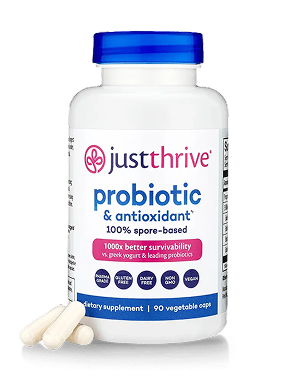
Just Thrive Probiotic (30/90)
The only probiotic guaranteed to arrive 100% alive


Where Just Thrive Fits In
Just Thrive Probiotic & Antioxidant was built around all of the criteria above: it uses spore-forming Bacillus strains selected for their ability to survive stomach acid, combines multiple, complementary strains rather than relying on one, has clinical studies behind its formulation, is DNA verified, and is GMP certified (manufactured under strict quality, safety, and testing standards). It's a shelf-stable, once-daily capsule, so it's designed to fit into a routine rather than complicate it. (There's even a gummy option made with the same great formula for those who don't like or struggle to swallow capsules.)
No single product is the right fit for everyone—but if survivability, strain diversity, and transparency are the criteria that matter to you, they're worth checking against any formula you're considering, including this one.
>> See how Just Thrive Probiotic & Antioxidant is formulated
If you’re not quite sure about trying Just Thrive Probiotic, we can help with that.
EVERY Just Thrive purchase is covered by our Bottom of the Bottle, 100% money back guarantee.
That means you can try Just Thrive Probiotic to see how well it works for you… and we’re betting that you’ll notice a positive difference.
But if for any reason you're not satisfied, you can ask for a full product refund at any time. Even if it’s 3 months or 3 years later. Even if the bottle is empty!

Sources
- Elshaghabee FMF, Rokana N, Gulhane RD, Sharma C, Panwar H. Bacillus As Potential Probiotics: Status, Concerns, and Future Perspectives. Front Microbiol. 2017;8:1490. Published 2017 Aug 10. doi:10.3389/fmicb.2017.01490
- Lloyd-Price J, Abu-Ali G, Huttenhower C. The healthy human microbiome. Genome Med. 2016;8(1):51. Published 2016 Apr 27. doi:10.1186/s13073-016-0307-y
- Belkaid Y, Hand TW. Role of the microbiota in immunity and inflammation. Cell. 2014;157(1):121-141. PMID: 24679531.


