



Most people associate antioxidants with glowing skin and healthy aging. But what you see in the mirror is only part of the story…and that story begins in your gut.
Antioxidants help counter oxidative stress, which can affect cells throughout your entire body. However, before your body can use antioxidant nutrients, it first needs to digest and absorb them. And a healthy gut is a key player in that process.
Let’s take a closer look at how antioxidants and your gut work together to support healthy aging and overall wellness.
Quick Answer: Healthy aging depends on more than getting enough antioxidants—it also depends on how well your body can digest, absorb, and use them. A healthy gut and balanced microbiome play an important role in making antioxidant compounds available while also supporting nutrient absorption and the body’s natural defenses against oxidative stress. This article explains the connection between antioxidants, gut health, and aging, explores how oxidative stress affects cells over time, highlights antioxidant-rich foods, and examines how supporting digestive health may help promote overall wellness and resilience as you age.
What Are Antioxidants?
Antioxidants are compounds that can help protect your cells from the damage caused by free radicals.1 Free radicals are unstable, reactive molecules with at least one unpaired electron. They can be formed naturally by your body through everyday processes like digestion and exercise or produced by environmental exposures like cigarette smoke and UV radiation.2
Because free radicals like to exist in pairs, they try to “steal” or borrow electrons from other cells in the body. Eventually, this can lead to the damage known as oxidative stress.3
That’s where antioxidants step in. They can neutralize free radicals by donating one of their own electrons, while remaining relatively stable themselves. Your body produces some antioxidants on its own; others come from what you eat and drink.
When free radicals and antioxidants are in balance, your cells can function normally. But when free radicals outnumber the body’s antioxidant defenses, oxidative stress can occur.
 Want to listen instead of read? CLICK HERE
What Is Oxidative Stress?
When your body produces or is exposed to more free radicals than it can manage, oxidative stress can occur.4
That doesn’t mean that oxidative stress or free radicals are something to fear. In fact, free radical activity is a normal part of life, to some degree. But there are factors that can tip the scales and contribute to a greater imbalance.5
- Poor diet
- Smoking
- Environmental substances like air pollution, toxic chemicals, and pesticides
- Chronic stress
- Lack of regular physical activity
Aging can also play a role in oxidative stress. Over time, the body’s antioxidant defenses may become less effective at keeping free radicals in check, creating an imbalance that can influence many aspects of health and aging.
How Does Oxidative Stress Affect Aging?
While it’s easy to think of wrinkles as the most obvious sign of aging, oxidative stress may contribute to age-related changes long before they become visible on the outside.6
When free radicals consistently outnumber antioxidants, the resulting oxidative stress can make it challenging for cells to function as they should. This damage at the cellular level is associated with many signs of aging.
Some areas that may be influenced by oxidative stress include:7–10
- Skin appearance: Oxidative stress can contribute to changes in skin elasticity and the appearance of fine lines and wrinkles, especially when combined with environmental factors like smoking or UV exposure. This is why antioxidants are often linked to healthy aging and skincare.
- Cellular health: Oxidative stress can affect cells throughout your whole body, affecting how well cells maintain normal function and repair themselves.
- Energy production: Mitochondria, often called the “powerhouse” of the cell, are particularly vulnerable to oxidative stress, which may disrupt their ability to produce energy.
- Cognitive health: Oxidative stress may be a factor in age-related changes to cognitive function.
- Whole-body resilience: As you age, your body’s ability to adapt to physical, mental, and environmental stressors naturally changes, and oxidative stress may contribute to those changes.
Aging is also influenced by things like genetics and lifestyle. Still, maintaining a healthy balance between antioxidants and free radicals can help support your body’s natural resilience.
That balance depends not only on the antioxidants you produce, but also on how effectively your body can access them. And that’s exactly why gut health matters.

What Are the Most Antioxidant-Rich Foods?
Many antioxidant compounds can be found in some of the healthy, organic foods you might already be consuming every day, particularly plant-based foods and beverages. Eating these nutrient-dense foods can support your body’s natural defenses against oxidative stress and promote your overall well-being.
Some of the most antioxidant-rich foods include:11
- Berries: blackberries, blueberries, cranberries, and strawberries
- Beverages: coffee and green tea
- Dark chocolate
- Fruits: apples and grapes
- Nuts: pecans and walnuts
- Spices and herbs: cinnamon, clove, curcumin, oregano, and turmeric
- Vegetables: artichokes, carrots, tomatoes, and leafy greens like kale and spinach
- Whole grains
It’s also important to include a wide range of these foods in your regular diet, since each contains different types of antioxidants. For example, tomatoes contain carotenoids, while green tea is prized for its polyphenols.
But eating foods packed with antioxidants is only the first step. Your body also has to use them efficiently.
What Does the Gut Have to Do with Antioxidant Support?
Before your body can put antioxidants to work, it has to digest, absorb, and process them, tasks that depend heavily on a healthy digestive system.
A healthy gut supports your body’s antioxidant balance in two important ways:12
- Absorbing antioxidant compounds: Consuming antioxidants is only the first step. Beneficial gut bacteria may help break down certain antioxidant compounds into metabolites that are easier for your body to access and use.
- Contributing to antioxidant activity: Beneficial microbes can also support antioxidant activity within the microbiome. A healthy microbiome is associated with butyrate production and glutathione-related activity. Butyrate helps support gut barrier integrity, while glutathione is one of the body’s primary antioxidants involved in neutralizing free radicals.
But supporting antioxidant balance is only part of the picture. Once these compounds are available in the gut, your body still has to absorb and use them effectively. That’s where nutrient absorption becomes especially important.
Why Does Nutrient Absorption Matter for Aging Well?
Regardless of how many berries you snack on or green teas you sip, your body can only use the nutrients it is able to absorb.
And it’s not just antioxidants this applies to. For example, your body also needs things like calcium and vitamins D and K2 for healthy bones, protein for muscles, fiber for healthy digestion, and vitamin B12 for nerve function.13 These are important at every age, but especially as your body faces age-related changes.
Things like age, stress, certain medications, lifestyle factors like smoking and regular alcohol use, and digestive health can influence how effectively your body digests and absorbs nutrients.
One of the most important factors here is the health of the gut itself.14 The digestive tract is responsible for breaking down food and moving nutrients across the intestinal barrier. Here, they can be carried throughout the body, to the places they’re needed the most.
But when the gut microbiome becomes imbalanced, a state often referred to as dysbiosis, it may influence digestive processes that help support nutrient absorption.
Beneficial microbes in the gut also help break down dietary fibers that the body cannot digest on its own and contribute to the production of certain vitamins, including some B vitamins and vitamin K.
Because both the microbiome and the intestinal barrier contribute to digestive function, maintaining a balanced gut environment is an important part of supporting the body's nutritional needs throughout the aging process.
Can Supplements Support Antioxidant Defenses?
Yes! While a healthy diet is a strong way to support antioxidant status, certain supplements can also contribute to your body’s antioxidant defenses.
But there’s another angle worth considering. While most people may think of vitamins and minerals when they think of supplements, beneficial bacteria are becoming an important part of the conversation. And research has explored one probiotic strain in particular in relation to antioxidant-related activity.
Bacillus indicus HU36™ has been studied for its ability to produce 15 antioxidants directly within the gut, where nutrient absorption takes place, rather than supplying them from an external source.15
Other probiotics can also play their part in antioxidant defenses by supporting a healthy gut.
Some of the key strains for gut health include:16–18
- Bacillus subtilis HU58™ promotes a balanced microbiome, nutrient absorption, and supports overall digestive health. It also produces 12 defenders that help maintain a thriving gut microbiome.
- Bacillus coagulans contributes to colonies of beneficial microbes in the gut and supports balance and smooth digestion.
- Bacillus clausii has been studied for its ability to survive antibiotic-related changes. It can help recondition your gut while supporting healthy digestive function.
Together, these probiotics highlight an important takeaway: gut health is an important part of overall wellness, including the body’s ability to digest and use antioxidants and other nutrients.
Frequently Asked Questions
Support your best gut health. Try Just Thrive Probiotic today!
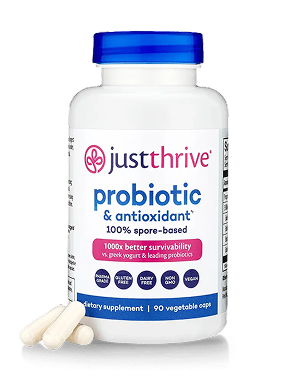
Just Thrive Probiotic (30/90)
The only probiotic guaranteed to arrive 100% alive


Healthy Aging Starts in the Gut
When people think about healthy aging, they often focus on what they can see or feel: their skin, energy levels, or physical changes over time. But many of the things that influence healthy aging begin much deeper within the body.
Just Thrive Probiotic provides four clinically studied spore-based probiotics, specifically chosen to support a balanced gut and healthy digestion.
- Bacillus indicus HU36™
- Bacillus subtilis HU58™
- Bacillus clausii
- Bacillus coagulans
Together, these powerful strains can support both your antioxidant defenses and gut health, building a foundation for overall resilience and wellness as you age.
>> Support healthy aging from the inside out with Just Thrive Probiotic.
Not sure if Just Thrive Probiotic is right for you? We’ve got your back.
Every Just Thrive purchase comes with our Bottom of the Bottle, 100% money back guarantee. So you can try Just Thrive Probiotic to see if it works for you. And we’re confident it will.
But if for any reason you don’t feel a difference, simply ask for a full product refund at any time. Even if it’s been 3 weeks, 3 months, or 3 years… Even if the bottle is empty!

Sources
- Gulcin İ. Antioxidants: a comprehensive review. Arch Toxicol. 2025;99(5):1893-1997. doi:10.1007/s00204-025-03997-2
- Cleveland Clinic. Why you should care about free radicals. Health Essentials. Published July 19, 2022. Accessed June 12, 2026. https://health.clevelandclinic.org/free-radicals
- Pizzino G, Irrera N, Cucinotta M, et al. Oxidative Stress: Harms and Benefits for Human Health. Oxid Med Cell Longev. 2017;2017:8416763. doi:10.1155/2017/8416763
- UCF Health. Understanding oxidative stress: what it is and why it matters. UCF Health. Accessed June 12, 2026. https://ucfhealth.com/our-services/cardiology/what-is-oxidative-stress/
- Liguori I, Russo G, Curcio F, et al. Oxidative stress, aging, and diseases. Clin Interv Aging. 2018;13:757-772. Published 2018 Apr 26. doi:10.2147/CIA.S158513
- Rinnerthaler M, Bischof J, Streubel MK, Trost A, Richter K. Oxidative stress in aging human skin. Biomolecules. 2015;5(2):545-589. Published 2015 Apr 21. doi:10.3390/biom5020545
- Dossena S, Marino A. Cellular Oxidative Stress. Antioxidants (Basel). 2021;10(3):399. Published 2021 Mar 6. doi:10.3390/antiox10030399
- Guo C, Sun L, Chen X, Zhang D. Oxidative stress, mitochondrial damage and neurodegenerative diseases. Neural Regen Res. 2013;8(21):2003-2014. doi:10.3969/j.issn.1673-5374.2013.21.009
- Franzoni F, Scarfò G, Guidotti S, Fusi J, Asomov M, Pruneti C. Oxidative Stress and Cognitive Decline: The Neuroprotective Role of Natural Antioxidants. Front Neurosci. 2021;15:729757. Published 2021 Oct 13. doi:10.3389/fnins.2021.729757
- Mahdi L, Graziani A, Baffy G, Mitten EK, Portincasa P, Khalil M. Unlocking Polyphenol Efficacy: The Role of Gut Microbiota in Modulating Bioavailability and Health Effects. Nutrients. 2025;17(17):2793. Published 2025 Aug 28. doi:10.3390/nu17172793
- Rahaman MM, Hossain R, Herrera-Bravo J, et al. Natural antioxidants from some fruits, seeds, foods, natural products, and associated health benefits: An update. Food Sci Nutr. 2023;11(4):1657-1670. Published 2023 Jan 13. doi:10.1002/fsn3.3217
- McBeth A, Miller EA, Thompson B, Hanaway P, Thexton A, Zwickey H. Balancing Oxidative Stress: How the Gut Microbiome Supports Redox Homeostasis and Mitochondrial Health. J Restor Med. 2025;15(1):4-19. doi:10.14200/jrm.2025.0002
- National Institute on Aging. Vitamins and minerals for older adults. National Institute on Aging. Updated January 2, 2025. Accessed June 12, 2026. https://www.nia.nih.gov/health/vitamins-and-supplements/vitamins-and-minerals-older-adults
- Krajmalnik-Brown R, Ilhan ZE, Kang DW, DiBaise JK. Effects of gut microbes on nutrient absorption and energy regulation. Nutr Clin Pract. 2012;27(2):201-214. doi:10.1177/0884533611436116
- Baumgärtner S, Creer S, Jones C, James J, Ellison A. Bacillus indicus and Bacillus subtilis as alternative health and colouration promoters to synthetic astaxanthin in cyprinid aquaculture species. Aquaculture. 2024;578:740016. doi:10.1016/j.aquaculture.2023.740016.
- Williams N, Weir TL. Spore-Based Probiotic Bacillus subtilis: Current Applications in Humans and Future Perspectives. Fermentation. 2024; 10(2):78.
- Mu Y, Cong Y. Bacillus coagulans and its applications in medicine. Benef Microbes. 2019;10(6):679-688. doi:10.3920/BM2019.0016
- Acosta-Rodríguez-Bueno CP, Abreu Y Abreu AT, Guarner F, Guno MJV, Pehlivanoğlu E, Perez M 3rd. Bacillus clausii for Gastrointestinal Disorders: A Narrative Literature Review. Adv Ther. 2022;39(11):4854-4874. doi:10.1007/s12325-022-02285-0


