



Pickleball seemed to come out of nowhere. One minute it was a simple backyard game, then bam! It was everywhere. Local courts are popping up all over, and waitlists are packed with people squeezing in matches before and after work.
It’s easy to see why it caught on so quickly. It’s similar enough to tennis to feel familiar, yet the smaller courts feel more doable, even for beginners.
The ease with which players can pick up the game is a bit deceiving. Sure, it’s easy to jump into the sport. But although pickleball games feel casual enough, they can be pretty dynamic once you start playing. And our bodies aren’t necessarily made for the way the game actually moves, with quick pivots, sudden stops, and lunging for a shot that’s barely within reach.
It doesn’t take long before your body is doing more than you might have expected. And if you want to keep playing pickleball for years, and enjoying it, your body needs to be ready for that level of movement.
Today’s blog will reveal why pickleball injuries are so common and what you can do to protect your body while staying active and having fun on the court.
Why Pickleball Injuries Are Suddenly Everywhere
If your body isn’t properly prepared to play pickleball, it will soon let you know.
A sore knee that lingers slightly longer than expected. A tweaked ankle after a quick pivot. Sometimes it’s so subtle that you can’t even say what’s wrong, you just know your body needs a day or two off. Other times, it’s a fall that leaves you feeling out of sorts for days.
For a lot of people, getting game-day ready is all about their muscles. They focus on building strength and flexibility, and do a quick warmup before stepping on the court. But with sports like pickleball, that kind of prep doesn’t fully match what your body is doing during the game.[1]
It goes deeper than muscle issues. The way you move on the pickleball court, combined with the very real risk of falling, puts a real demand on your bones. And if they aren’t well supported, small injuries or issues could turn into something bigger.
 Want to listen instead of read? CLICK HERE
Bone Strength Isn’t Just About Calcium
“If I need stronger bones, then I’ll just take more calcium.”
Whenever bone health comes up, calcium seems to be the go-to solution. Just drink more milk or maybe take a calcium supplement, and your bones will grow stronger. If only it were that simple.
You see, bone isn’t static. Even after you’ve reached adulthood and your bones have stopped growing, it’s constantly breaking down and repairing based on your body's needs, a process known as bone remodeling.
The process begins when cells known as osteocytes detect damage and trigger bone remodeling. From there, osteoclasts break down and eliminate old or damaged bone, while osteoblasts build new bone to replace the older ones.
Bone remodeling looks a little different for everyone. It’s influenced by a number of things, including how you move and how often. Physical activities, including pickleball, can actually help support bone strength and density if your body already has what it needs to respond properly.
And sure, calcium is part of the picture. But adding more doesn’t automatically make your bones stronger. Your body needs to know what to do with that added calcium, where to send it within your body, and how to use it. Without that extra coordination, calcium can actually cause damage.[2]

What Happens When Your Body Uses Calcium Wrong
You probably already know what happens when you don’t have enough calcium, from a greater risk of fracture to more serious conditions like osteoporosis. But that’s only part of the story.[3] Bone health depends on more than the right amount of calcium. It also depends on that calcium getting to the fight places.
Getting too much calcium or not directing it properly? That can be just as harmful.[4]
Calcium is constantly moving through your body. Some of it is stored in your bones, ready to jump into action when needed. Some calcium is also circulating in your blood, where it makes its way to where it can help the most.
When everything is functioning as it should, calcium supports strong, healthy bones. But if anything is off, it doesn’t always end up where you need it (your bones). If calcium doesn’t reach your bones, you might not get its full benefits. And that can be problematic for two big reasons.
- During sports like pickleball, you're putting repeated stress on your musculoskeletal system. There’s impact and force, plus the occasional load. Under these conditions, it’s especially important that your bones get enough calcium to stay strong and resilient over time.
- Then there’s the calcium misdirection issue. When calcium doesn’t make it to your bones, because too much is released into the blood, it can instead end up in your soft tissues, most concerningly, the blood vessels or heart valves. If it builds up enough (calcification), it can lead to heart-related issues.[5]
So while getting the right amount of calcium is important, making sure it ends up where it’s actually needed is crucial.
This Is Where Vitamin K2-7 Comes In
Once it enters your body, calcium needs a traffic cop to direct it, a role played by vitamin K2-7.[6]
Its benefits are twofold: K2-7 activates specific proteins that deposit calcium into your bones and teeth, where it belongs and can contribute to structure. It also keeps it away from where it doesn’t belong, soft tissues, like your arteries.[7]
When you’re playing an active sport like pickleball, this becomes even more important. All of that unpredictable movement places a strong load on your bones. Having the right support means that you’re working with your body instead of placing unnecessary strain on it.
And it’s not just your bones that vitamin K2-7 helps. It also supports peak heart health, whether you’re on the pickleball court or off. By preventing calcium deposits from building up in blood vessel walls, it encourages healthy blood flow. Healthy bones, healthy heart, and years of fun on the pickleball court!
Getting Enough K2-7
So, how can you make sure you’re getting enough vitamin K2-7?
It’s often found in dairy, fermented foods, and animal products. You can try adding it into your diet with foods like:[8]
- Natto (a fermented soybean dish)
- Sauerkraut
- Cheeses like aged Gouda, Brie, Munster, or Edam
- Chicken or beef liver
- Egg yolks
- Grass-fed beef
But some of these foods aren’t quite healthy enough to eat every day or may not fit into your lifestyle. And even if you do consume them often, you might not actually get enough K2-7 to promote bone strength. A supplement can go a long way towards supporting healthy bones and a healthy diet.
But not all versions of vitamin K2 are the same. Be sure to choose a supplement formulated with MK-7, which is considered superior due to its high bioavailability and potency.[9] It’s easier for your body to absorb, which makes it more effective in aiding your bones.
You also want to make sure your body has the nutrients that help it use vitamin K2-7 effectively.
Magnesium and zinc both play supporting roles in nutrient metabolism and enzyme activity.[10] Vitamin K1 also contributes to overall levels of vitamin K. It’s used primarily for roles like blood clotting, leaving K2-7 available for crucial bone support.[11]
Just Thrive Bone Health Products

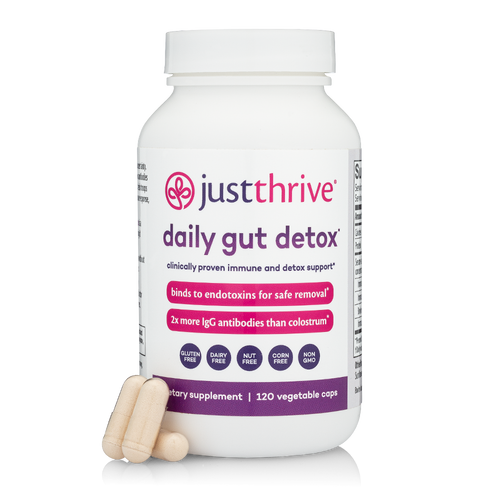
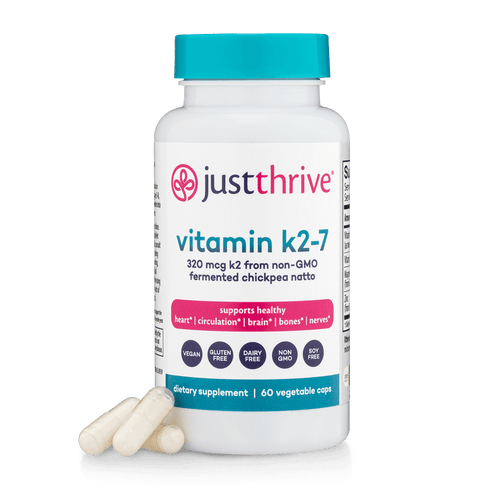
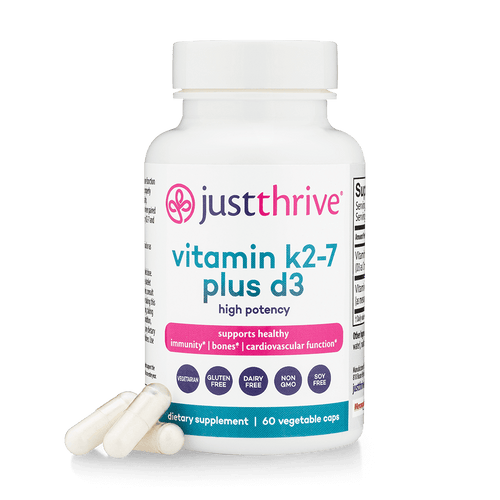
Maintain Healthy, Pickleball-Ready Bones with Just Thrive
Pickleball is a fun, social way to stay active. Whether you’re heading to a nearby park for casual games or joining a local league, it’s a sport that you can play for years, with the right bone support.
Just Thrive Vitamin K2-7 helps guide calcium where your body needs it most, promoting strong, healthy bones that will keep you moving and thriving on the court and off.
Just one capsule delivers:
- Vitamin K2-7 in its most bioavailable form, MK-7. Formulated with MenaquinGold® for 100% guaranteed potency.
- Magnesium and zinc to encourage vitamin K2 absorption. Zinc also promotes enzyme function, helping with K2 metabolization.
- Vitamin K1, which helps maintain healthy levels of vitamin K.
So you can play pickleball, work in your garden, keep up with kids or grandkids, or just simply enjoy life without worrying about how your body, or your bones, will hold up.
>> Support bone health for pickleball and beyond with Just Thrive Vitamin K2-7
Not sure whether vitamin K2-7 is right for you? We can help with that.
Every single Just Thrive purchase is covered by our Bottom of the Bottle, 100% money back guarantee. So you can try vitamin K2-7 to see how it works for you.
But if for any reason you don’t feel a difference, simply ask for a full product refund at any time. Even if it’s been 3 weeks, 3 months, or 3 years… and even if the bottle is empty.

Sources
- Owoeye OBA, Yemm T, Blechle R, Wayne M, Kennedy D, Mourad W, Stamatakis K, Howell T. Understanding Injury Patterns and Predictors in Pickleball Players: A Nationwide Study of 1,758 Participants. Sports Med Open. 2025 Aug 22;11(1):100. doi: 10.1186/s40798-025-00900-2. PMID: 40847179; PMCID: PMC12373573.
- Li K, Wang XF, Li DY, Chen YC, Zhao LJ, Liu XG, Guo YF, Shen J, Lin X, Deng J, Zhou R, Deng HW. The good, the bad, and the ugly of calcium supplementation: a review of calcium intake on human health. Clin Interv Aging. 2018 Nov 28;13:2443-2452. doi: 10.2147/CIA.S157523. PMID: 30568435; PMCID: PMC6276611.
- Fong J, Khan A. Hypocalcemia: updates in diagnosis and management for primary care. Can Fam Physician. 2012 Feb;58(2):158-62. PMID: 22439169; PMCID: PMC3279267.
- Sadiq NM, Anastasopoulou C, Patel G, et al. Hypercalcemia. In: StatPearls [Internet]. Treasure Island, FL: StatPearls Publishing; 2026–. Updated May 7, 2024. Accessed March 16, 2026. https://www.ncbi.nlm.nih.gov/books/NBK430714/
- Mohan J, Shams P, Bhatti K, et al. Coronary artery calcification. In: StatPearls [Internet]. Treasure Island, FL: StatPearls Publishing; 2026–. Updated November 8, 2024. Accessed March 16, 2026. https://www.ncbi.nlm.nih.gov/books/NBK519037/
- Jadhav N, Ajgaonkar S, Saha P, Gurav P, Pandey A, Basudkar V, Gada Y, Panda S, Jadhav S, Mehta D, Nair S. Molecular Pathways and Roles for Vitamin K2-7 as a Health-Beneficial Nutraceutical: Challenges and Opportunities. Front Pharmacol. 2022 Jun 14;13:896920. doi: 10.3389/fphar.2022.896920. PMID: 35774605; PMCID: PMC9237441.
- Hariri E, Kassis N, Iskandar JP, Schurgers LJ, Saad A, Abdelfattah O, Bansal A, Isogai T, Harb SC, Kapadia S. Vitamin K2-a neglected player in cardiovascular health: a narrative review. Open Heart. 2021 Nov;8(2):e001715. doi: 10.1136/openhrt-2021-001715. PMID: 34785587; PMCID: PMC8596038.
- Walther B, Karl JP, Booth SL, Boyaval P. Menaquinones, bacteria, and the food supply: the relevance of dairy and fermented food products to vitamin K requirements. Adv Nutr. 2013 Jul 1;4(4):463-73. doi: 10.3945/an.113.003855. PMID: 23858094; PMCID: PMC3941825.
- Sato T, Inaba N, Yamashita T. MK-7 and Its Effects on Bone Quality and Strength. Nutrients. 2020 Mar 31;12(4):965. doi: 10.3390/nu12040965. PMID: 32244313; PMCID: PMC7230802.
- Bleizgys A. Zinc, Magnesium and Vitamin K Supplementation in Vitamin D Deficiency: Pathophysiological Background and Implications for Clinical Practice. Nutrients. 2024 Mar 14;16(6):834. doi: 10.3390/nu16060834. PMID: 38542745; PMCID: PMC10974675.
- 11. Schwalfenberg GK. Vitamins K1 and K2: The Emerging Group of Vitamins Required for Human Health. J Nutr Metab. 2017;2017:6254836. doi: 10.1155/2017/6254836. Epub 2017 Jun 18. PMID: 28698808; PMCID: PMC5494092.


