



Finding out that your blood sugar level is higher than you expected can send you searching for answers and solutions. And if you start researching online, there’s no shortage of advice on what to eat, how often to exercise, or even which supplements to take.
Understanding what’s happening in your body might be the best place to start.
One area that is often overlooked in blood sugar conversations is the gut. Yet, microbes living there can influence processes throughout the whole body, including insulin response.
That’s why researchers are taking a closer look at the relationship between the gut microbiome and blood sugar. Before deciding your best path to supporting healthy glucose metabolism, it helps to understand what’s happening in the gut and why it matters for insulin sensitivity.
What Happens in the Gut That Most People Never Learn About?
Bacteria living in your gut do more than digest food; they can influence processes throughout your entire body.
Your gut is home to trillions of microorganisms, collectively known as the gut microbiome, that are interacting with the food you eat and each other.1
When these gut bacteria break down nutrients your body can’t fully digest on its own, they produce compounds known as microbial metabolites.
Some metabolites stay in the gut, while others enter the bloodstream and circulate throughout your body, interacting with tissues and physiological processes well beyond the digestive system.2 In fact, research suggests that microbial metabolites can influence processes related to metabolism, immune function, and communication between the gut and other organs.3,4
So while the microbes in your gut play a vital role in digestion, their impact extends far beyond their immediate environment, especially when you look at metabolic signaling.
What Is the Relationship Between Gut Bacteria and Metabolic Signaling?
Gut bacteria can influence metabolic signaling by sending chemical signals that reach cells involved in energy, glucose regulation, hormone release, inflammation, and metabolism. This communication helps connect what’s happening in the gut with processes in other parts of the body.5
Metabolism depends on constant communication between different parts of the body. In the gut microbiome, this can mean interacting with the systems involved in how the body uses and stores energy. And it starts with what bacteria produce from the foods we eat.
For example, when certain bacteria ferment dietary fiber, they produce short-chain fatty acids (SCFAs) such as acetate, propionate, and butyrate. These compounds can act as signaling molecules, interacting with receptors involved in processes related to glucose metabolism and inflammation.
Gut bacteria can also modify bile acids, which are made by the liver to help digest fat. These modified bile acids can interact with receptors associated with energy and glucose regulation.
Some of these signals may relate to insulin sensitivity. Insulin helps the body move glucose (blood sugar) from the bloodstream into cells for energy.6 Insulin sensitivity describes how well cells respond to that signal; when cells respond appropriately to insulin, they can help support healthy glucose regulation.7 Microbial metabolites may affect some of the processes involved in this response, making the microbiome an important part of metabolic health.
But while some of the compounds produced by gut bacteria may support healthy metabolic signaling, others can contribute to inflammatory processes that may interfere with it.
What Is Endotoxemia, and Why Does It Matter for Insulin Sensitivity?
Endotoxemia occurs when bacterial endotoxins, like lipopolysaccharide (LPS), an endotoxin found in the outer membrane of Gram-negative bacteria, enter the bloodstream.8 In some cases, this may affect insulin sensitivity.
The intestinal barrier helps keep substances in the gut from crossing into circulation. It allows nutrients and water to pass through, while helping limit the passage of potentially harmful substances into the bloodstream.
If that barrier becomes more permeable, a phenomenon sometimes referred to as “leaky gut,” LPS may be able to pass through more easily.9 Once in the bloodstream, LPS can activate an immune response that may contribute to inflammation.10
So might this relate to insulin sensitivity? Inflammation may interfere with the body’s normal insulin response. This is one reason the gut barrier has become part of the conversation around metabolic health.
But supporting the gut barrier is only one piece of the larger picture. How does a gut-focused approach compare with more familiar ingredients like berberine, chromium, and fiber?
How Is a Gut-Focused Approach Different from Berberine, Chromium, or Fiber-Only Approaches?
The main difference between these approaches is what they target. Berberine, chromium, and fiber take a reactive approach, focusing on specific compounds or nutrients.
Meanwhile, a gut-forward approach targets the root cause by supporting the microbiome, its components, and the processes that connect it to insulin sensitivity and metabolic health.
Berberine, chromium, and fiber can each support specific aspects of metabolic health in different ways.
- Berberine, a bitter-tasting compound found in barberry, goldenseal, and Oregon grape, has been studied for its effects on the signaling pathways involved in glucose metabolism and insulin sensitivity.11
- Chromium is a mineral that plays a role in healthy blood sugar maintenance and insulin action.12
- Fiber can help slow the absorption of glucose from food, supporting healthy blood glucose levels.13
These approaches aren't necessarily mutually exclusive. Instead, they show why looking at metabolic health from multiple angles can be useful and how supporting the microbiome may complement other strategies for healthy blood sugar regulation.
Why Are Researchers Increasingly Studying the Microbiome in Metabolic Health?
Researchers are increasingly studying the connection between the microbiome and metabolic health because evidence suggests gut bacteria may be connected to how the body regulates glucose and responds to insulin.
The research is still focused on understanding these relationships, including how microbial diversity and changes in the microbiome may relate to insulin sensitivity, blood glucose regulation, and other measures of metabolic health.14,15
A recent randomized, double-blind, placebo-controlled clinical study looked at the effects of a synbiotic—a combination of probiotics and prebiotics—on glucose regulation.16
The synbiotic included six probiotic species:
- Bifidobacterium bifidum
- Limosilactobacillus reuteri
- Lactiplantibacillus plantarum
- Lacticaseibacillus rhamnosus
- Lacticaseibacillus casei
- Bacillus coagulans
It also contained inulin, a prebiotic derived from chicory root that helps nourish beneficial bacteria and support metabolite production, plus Lactobacillus delbrueckii, a metabiotic (postbiotic) component.
After six months, adults with prediabetes who received the synbiotic saw a greater improvement in their average blood sugar levels than those who received a placebo. They also showed improvements in measures related to insulin response.
The findings are encouraging, but the research is still developing, and researchers are working to understand which microbiome changes might support healthy blood sugar levels.
Overall, the research suggests that the gut may be one place to explore when considering the processes involved in healthy insulin function.
Frequently Asked Questions
Just Thrive Gut Health Products


Support Healthy Blood Sugar with Just Thrive
The gut, its microbiome, and the intestinal barrier all play a role in metabolic health. Supporting a healthy gut can also help support healthy blood sugar regulation.
Good Glucose by Just Thrive is formulated with six bacterial species clinically studied for their potential contributions to healthy blood sugar.
- Bifidobacterium bifidum
- Limosilactobacillus reuteri
- Lactiplantibacillus plantarum
- Lacticaseibacillus rhamnosus
- Lacticaseibacillus casei
- Bacillus coagulans
Good Glucose also includes two prebiotics that provide a food source for beneficial bacteria:
- Inulin
- Fructooligosaccharide (FOS)
Good Glucose also contains a metabiotic derived from Lactobacillus delbrueckii, an ingredient studied in connection with healthy blood sugar levels.
We'll be releasing Good Glucose soon. But before we do, we are giving it away for FREE!
Five people will win:
- 3 bottles of our new product, Good Glucose (That’s a full 90-day supply.)
- A 90-day supply of Just Thrive Probiotic
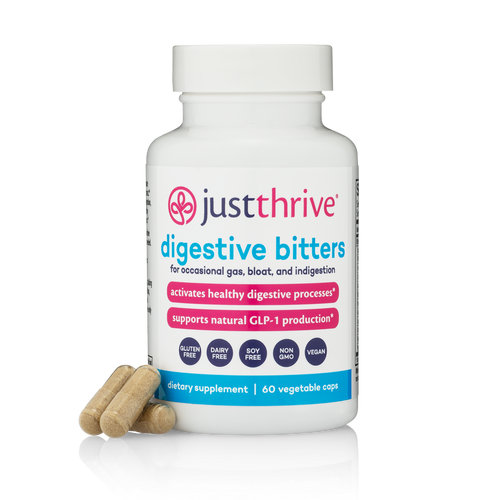
- 3 bottles of Digestive Bitters
Altogether, that’s more than $450 in Just Thrive products!
Enter for your chance to win + get early access to Good Glucose before it's released to the general public.
Sources
- Cleveland Clinic. Gut Microbiome. Updated August 18, 2023. Accessed September 25, 2026. https://my.clevelandclinic.org/health/body/25201-gut-microbiome
- Martinez KB, Leone V, Chang EB. Microbial metabolites in health and disease: Navigating the unknown in search of function. J Biol Chem. 2017;292(21):8553-8559. doi:10.1074/jbc.R116.752899
- Kim CH. Immune regulation by microbiome metabolites. Immunology. 2018;154(2):220-229. doi:10.1111/imm.12930
- Liu J, Tan Y, Cheng H, Zhang D, Feng W, Peng C. Functions of Gut Microbiota Metabolites, Current Status and Future Perspectives. Aging Dis. 2022;13(4):1106-1126. Published 2022 Jul 11. doi:10.14336/AD.2022.0104
- Jyoti, Dey P. Mechanisms and implications of the gut microbial modulation of intestinal metabolic processes. NPJ Metab Health Dis. 2025;3(1):24. Published 2025 Jun 10. doi:10.1038/s44324-025-00066-1
- Rahman MS, Hossain KS, Das S, et al. Role of Insulin in Health and Disease: An Update. Int J Mol Sci. 2021;22(12):6403. Published 2021 Jun 15. doi:10.3390/ijms22126403
- ScienceDirect. Insulin sensitivity. Elsevier. Accessed September 25, 2026. https://www.sciencedirect.com/topics/psychology/insulin-sensitivity
- André P, Laugerette F, Féart C. Metabolic Endotoxemia: A Potential Underlying Mechanism of the Relationship between Dietary Fat Intake and Risk for Cognitive Impairments in Humans?. Nutrients. 2019;11(8):1887. Published 2019 Aug 13. doi:10.3390/nu11081887
- Li Q, von Ehrlich-Treuenstätt V, Schardey J, et al. Gut Barrier Dysfunction and Bacterial Lipopolysaccharides in Colorectal Cancer. J Gastrointest Surg. 2023;27(7):1466-1472. doi:10.1007/s11605-023-05654-4
- Page MJ, Kell DB, Pretorius E. The Role of Lipopolysaccharide-Induced Cell Signalling in Chronic Inflammation. Chronic Stress (Thousand Oaks). 2022;6:24705470221076390. Published 2022 Feb 8. doi:10.1177/24705470221076390
- Yin J, Xing H, Ye J. Efficacy of berberine in patients with type 2 diabetes mellitus. Metabolism. 2008;57(5):712-717. doi:10.1016/j.metabol.2008.01.013
- Havel PJ. A scientific review: the role of chromium in insulin resistance. Diabetes Educ. 2004;Suppl:2-14.
- Giuntini EB, Sardá FAH, de Menezes EW. The Effects of Soluble Dietary Fibers on Glycemic Response: An Overview and Futures Perspectives. Foods. 2022;11(23):3934. Published 2022 Dec 6. doi:10.3390/foods11233934
- Letchumanan G, Abdullah N, Marlini M, et al. Gut Microbiota Composition in Prediabetes and Newly Diagnosed Type 2 Diabetes: A Systematic Review of Observational Studies. Front Cell Infect Microbiol. 2022;12:943427. Published 2022 Aug 15. doi:10.3389/fcimb.2022.943427
- Palmnäs-Bédard MSA, Costabile G, Vetrani C, et al. The human gut microbiota and glucose metabolism: a scoping review of key bacteria and the potential role of SCFAs. Am J Clin Nutr. 2022;116(4):862-874. doi:10.1093/ajcn/nqac217
- García G, Campos MdC, Soto J, Diaz A, Buchaca E, Martínez D, Bernal M, Escobar V, Rodríguez L, Valdés E, et al. Effects of the Synbiotic Formulation EDC-HHA01 on Glucose Regulation in Adults with Type 2 Diabetes and Prediabetes: A Randomized, Placebo-Controlled Study. Microorganisms. 2026; 14(4):749. https://doi.org/10.3390/microorganisms14040749


