



Has your stomach been feeling “off” lately? Digestive troubles like bloating, heaviness after meals, burping, and even the occasional heartburn are often blamed on one thing: too much stomach acid. And so for many people, the automatic response is to reach for antacids.
But what if the problem isn’t excess acid at all? In some cases, your digestive discomfort could actually be caused by the opposite, too little acid! Because stomach acid plays such an essential role in breaking down food and supporting healthy digestion, reducing it might not always be the best answer.
A better approach focuses on supporting digestion itself, including how your body breaks down food. And natural solutions, like digestive bitters, can be just what your digestion needs.
Let’s look at what stomach acid really does, why low acid may sometimes contribute to digestive discomfort, and why digestive bitters have become a popular ally in supporting healthy digestion naturally.
Quick Answer: Digestive troubles like bloating, heaviness after meals, and burping are often blamed on too much stomach acid, but in some cases the opposite, too little acid, may be the issue. Stomach acid plays an essential role in breaking down food and absorbing nutrients, so reducing it is not always the best answer. When acid is low, food can sit longer and ferment, leading to gas and that heavy, sluggish feeling. Rather than simply lowering acid, a better approach supports digestion as a whole. Digestive bitters are a popular natural option: their bitter taste signals the body to release stomach acid, bile, and enzymes, helping food break down before and during a meal.
What Is Stomach Acid, and Why Does It Matter?
Stomach acid, made up mostly of hydrochloric acid, is a digestive fluid your body produces naturally to help break down food and absorb nutrients. A healthy stomach is meant to be acidic, so acid is a normal and necessary part of digestion, not the enemy.
Stomach acid, made up mostly of hydrochloric acid, is a digestive fluid your body produces naturally.1 Sometimes called gastric acid, it helps your body break down food and supports things like nutrient absorption.
And, contrary to what many believe, your stomach is actually supposed to be acidic. In fact, a healthy stomach naturally produces 3–4 liters of acid…every day.2
Stomach acid plays a major role in healthy digestion. It also helps your body properly absorb and use nutrients, including important vitamins and minerals like iron, B12, magnesium, and calcium.
When food proteins aren’t broken down efficiently in the stomach, it can leave you feeling uncomfortably full after meals, experiencing things like:3
- Abdominal pain
- Bloating
- Constipation
- Diarrhea
- Gas
- Heartburn
- Reflux
- Undigested food in your stool
 Want to listen instead of read? CLICK HERE
Because digestion plays a role in nutrient absorption, ongoing digestive issues may sometimes overlap with symptoms associated with low nutrient intake or poor absorption. In some cases, this can show up as:
- Brittle fingernails
- Fatigue
- Hair loss
- Headaches
- Memory loss
- Numbness or tingling in hands and feet
- Paleness
- Weakness
Stomach acid does more than people realize, helping you not just digest food in the moment, but also absorb nutrients afterwards.
Because stomach acid isn’t the enemy. It’s a normal and necessary part of how your body processes food. In other words, healthy, comfortable digestion is less about reducing acid levels and more about supporting healthy digestive function.
Could Your Digestive Troubles Come From Low Stomach Acid?
In some cases, yes. When acid is too low, food can break down slowly and sit longer, sometimes fermenting and creating gas, bloating, and a heavy feeling after meals. Supporting digestion as a whole is often more helpful than simply reducing acid.
In a nutshell: yes, sometimes they could.
Digestive discomforts like bloating, fullness after a meal, burping, and that general feeling of having a “sour stomach” are often automatically blamed on too much acid. But that’s not telling the full story of what happens in your stomach.
When your stomach acid level is too low and food isn’t breaking down as quickly and efficiently as it should, it can end up sitting in your stomach longer than usual. In some cases, partially digested food can ferment in your gut, creating discomfort, especially excess gas.4 This can contribute to bloating and that heavy, sluggish feeling after meals.
Reducing acid isn’t always the answer. It’s better to support digestion as a whole, to help your body’s processes function at their best.

What Do Antacids Actually Do?
Antacids neutralize existing stomach acid, and other medications reduce how much acid the stomach makes over time. They can offer temporary relief for occasional discomfort but are not designed to support long-term digestive function as a whole.
Antacids work by neutralizing existing stomach acid. Other acid-reducing medications work by lowering the amount of acid your stomach produces over time.5
In the moment, they can be helpful when you’re dealing with indigestion, heartburn, and other occasional digestive troubles. When used appropriately, and often under the guidance of a healthcare provider, they may provide some temporary relief from discomfort, especially after large meals or foods that feel harder to digest.
But while antacids can help manage infrequent issues, they aren’t meant to support long-term function as a whole. For overall digestive health, it can be helpful to consider your body’s natural digestive process from the very beginning, when stomach acid is first produced to help break down food.

What Are Digestive Bitters?
Digestive bitters are herbs and plant compounds with a distinctly bitter taste. That taste signals your body that food is coming, prompting the release of stomach acid, bile, and enzymes that help break food down efficiently.
Digestive bitters are a category of herbs and plant compounds known for their distinctly bitter taste. And while “bitter” might not sound very appetizing, they’ve traditionally been used to support digestion in some interesting ways.6 That’s because your body has a very specific response to bitter flavors.
When you eat or drink bitter compounds, receptors on your tongue and throughout the digestive tract react to them by signaling to your body that food is on the way. This stimulates your digestive system to begin releasing the stomach acid, bile, and digestive enzymes needed to help break down food efficiently.
For centuries, cultures around the world have used bitters to help encourage healthy digestion. These were traditionally taken before meals in the form of tinctures, teas, or as naturally bitter greens and herbs, as part of an all-natural approach to health and wellness.
Some of the most powerful bitters for supporting healthy digestion include:8–13
- Artichoke leaf
- Dandelion root
- Dong quai
- Gentian root
- Ginger
- Hops flower
- Peppermint
- Wormwood
Those bitter foods and flavors rarely show up in the modern Western diet, which tends to favor sweeter, saltier, or highly processed food. The few foods that still contain bitters have mostly been bred for a milder, less bitter flavor, meaning they don’t prompt the same digestive response that traditional bitters once did.
Without regular exposure to bitters, the body may not receive the same digestive signaling traditionally triggered by these compounds. And that might contribute to things like bloating, heaviness, or just a nagging feeling that something is off with your digestive system.
Bitters also help support nutrient absorption, encouraging healthy digestive function from the very beginning of the process. When digestion is working well and stomach acid is helping to break down food, it’s easier for your body to extract and use the vitamins and minerals from the foods you eat. In the end, this can support satiety: feeling full for longer after a meal.14
That’s why many people take digestive bitters, especially before their largest meal, as a simple, natural way to support the body’s natural digestive response and overall wellness.
Frequently Asked Questions
Just Thrive Gut Health Products


What’s the Best Way to Support Healthy Digestion Naturally?
There’s a reason why bitters have been around for generations.
Digestive discomfort isn’t always about reducing stomach acid. Instead, it can be more helpful to work with your body’s natural digestive signals and support healthy digestion even before meals.
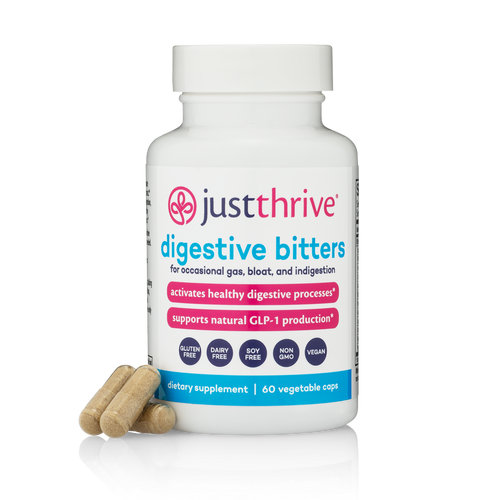
Just two capsules of Just Thrive Digestive Bitters a day before your biggest meal can support the production of stomach acids, promoting both smooth digestion and nutrient absorption.
Each Digestive Bitters capsule contains 12 clinically proven herbs, including:
- Artichoke Extract
- Dandelion Root
- Dong Quai (root)
- Chinese Gentian Root Extract
- Ginger Root/Rhizome Extract
- Hops Flower Extract
- Peppermint (leaf)
- Sweet Wormwood
These traditionally used bitters can help stimulate digestive function and encourage your body’s natural processes, without the bitter taste.
>> Support healthy digestive function with Digestive Bitters.
Not sure if Digestive Bitters will work for you? We’ve got that covered.
Every Just Thrive purchase is backed by our Bottom of the Bottle, 100% money back guarantee. So you can try Digestive Bitters to see how it works for you.
But if for any reason you don’t feel a difference, you can ask for a full product refund at any time. Even if it’s been 3 weeks, 3 months, or 3 years… Even if the bottle is empty.

Sources
- Fatima R, Aziz M. Achlorhydria. In: StatPearls [Internet]. Treasure Island, FL: StatPearls Publishing; 2026–. Updated August 14, 2023. Accessed March 16, 2026. https://www.ncbi.nlm.nih.gov/books/NBK507793/
- Institute for Quality and Efficiency in Health Care (IQWiG). In brief: How does the stomach work? In: InformedHealth.org [Internet]. Cologne, Germany: Institute for Quality and Efficiency in Health Care (IQWiG); 2006–. Updated August 5, 2024. Accessed March 16, 2026. https://www.ncbi.nlm.nih.gov/books/NBK279304/
- Cleveland Clinic. Hypochlorhydria (low stomach acid): symptoms, tests, treatment. Published December 11, 2025. Accessed March 16, 2026. https://my.clevelandclinic.org/health/diseases/23392-hypochlorhydria
- Modesto A, Cameron NR, Varghese C, et al. Meta-analysis of the composition of human intestinal gases. Dig Dis Sci. 2022;67(8):3842-3859. doi:10.1007/s10620-021-07254-1
- Salisbury BH, Terrell JM. Antacids. In: StatPearls [Internet]. Treasure Island, FL: StatPearls Publishing; 2026–. Updated August 8, 2023. Accessed March 16, 2026. https://www.ncbi.nlm.nih.gov/books/NBK526049/
- Rezaie P, Bitarafan V, Horowitz M, Feinle-Bisset C. Effects of Bitter Substances on GI Function, Energy Intake and Glycaemia-Do Preclinical Findings Translate to Outcomes in Humans? Nutrients. 2021 Apr 16;13(4):1317. doi: 10.3390/nu13041317. PMID: 33923589; PMCID: PMC8072924.
- McMullen MK, Whitehouse JM, Towell A. Bitters: Time for a New Paradigm. Evid Based Complement Alternat Med. 2015;2015:670504. doi: 10.1155/2015/670504. Epub 2015 May 14. PMID: 26074998; PMCID: PMC4446506.
- Li Y, Chen Y, Sun-Waterhouse D. The potential of dandelion in the fight against gastrointestinal diseases: A review. J Ethnopharmacol. 2022 Jul 15;293:115272. doi: 10.1016/j.jep.2022.115272. Epub 2022 Apr 8. PMID: 35405251.
- Fang L, Xiao XF, Liu CX, He X. Recent advance in studies on Angelica sinensis. Chin Herb Med. 2012;4(1):12-25. doi:10.3969/j.issn.1674-6384.2012.01.004
- Aregawi LG, Zoltan C. Ginger's nutritional implication on gastrointestinal health. Clin Nutr Open Sci. 2025;61:1-13. doi:10.1016/j.nutos.2025.02.008
- Kok BP, Galmozzi A, Littlejohn NK, et al. Intestinal bitter taste receptor activation alters hormone secretion and imparts metabolic benefits. Mol Metab. 2018;16:76-87. doi:10.1016/j.molmet.2018.07.013
- Chumpitazi BP, Kearns GL, Shulman RJ. Review article: the physiological effects and safety of peppermint oil and its efficacy in irritable bowel syndrome and other functional disorders. Aliment Pharmacol Ther. 2018;47(6):738-752. doi:10.1111/apt.14519
- Cleveland Clinic. The benefits of bitters: they’re not just for cocktails. Published March 7, 2022. Accessed March 16, 2026. https://health.clevelandclinic.org/digestive-bitters
- Lvovskaya S, Smith DP. A spoonful of bitter helps the sugar response go down. Neuron. 2013;79(4):612-614. doi:10.1016/j.neuron.2013.07.038


