



When it comes to the world of wellness, detoxes are everywhere. From the Grapefruit Diet of the 1970s to more modern versions, like juice cleanses and restrictive fasts, they tend to have one thing in common: the promise to “flush out toxins” fast and reset the body.
But what many of these approaches overlook is that your body already has its own built-in detox systems, working around the clock. One of the biggest players in that process? Your gut.
Here’s the truth behind detoxing your gut, and why a foundational approach might be a better way to support how you feel every day.
Quick Answer: A gut detox is not a “cleanse” that rapidly flushes toxins, but a way of supporting the body’s existing detoxification systems—especially the gut and its connection to the liver, immune system, and microbiome. The body already processes and eliminates waste continuously through organs like the liver, kidneys, lungs, skin, and primarily the digestive tract. The gut plays a key role by regulating what is absorbed into the bloodstream and what is eliminated. Unlike restrictive detox diets, which may be harsh or unsustainable, a gut-supportive approach focuses on maintaining a healthy gut barrier, balanced microbiome, and normal immune function to support everyday digestion and natural elimination processes.
How Is a Gut Detox Different from a General Detox?
A general “detox” usually refers to full-body cleanses that claim to “flush toxins” from the entire system. They often focus on the liver, and encourage extreme fasting or restrictions.
A gut detox takes a more holistic approach. Its goal is to support not just the liver, but also the gut and immune system because these systems work together to process waste, filter out unwanted substances, and support whole body health, especially in times of stress.
Your Body’s Natural Detox Systems
The liver and gut play two of the biggest roles in your body’s natural detoxification and waste-elimination processes. They work together through the gut-liver axis, a communication network that helps coordinate digestion, metabolism, and microbial balance.1
- The gut-to-liver path: Blood carries things like nutrients, metabolic byproducts, and microbes from the gut to the liver where they are processed through the body’s natural metabolic and elimination pathways.
- The liver-to-gut path: The liver produces bile, which supports digestion and helps maintain a healthy balance of gut bacteria. This balance supports natural detoxification.
Other organs also contribute to the body’s natural elimination processes.2,3 For example, your kidneys filter waste products from your blood for elimination through urine. Your lungs help filter inhaled particles, then expel irritants by exhaling or coughing. Even your skin helps, supporting detox by sweating.
But even with the added help, the gut remains at the forefront of the body’s efforts to regulate what enters the bloodstream and what leaves the body.
 Want to listen instead of read? CLICK HERE
Your Primary Detox System: Your Gut
Your digestive system pulls double duty, acting as both a processing center and a barrier.
Every day, it breaks down food and absorbs nutrients, then moves waste and unwanted byproducts out of your body:4
At the same time, the gut lining also acts as a highly controlled barrier, carefully regulating what passes from the digestive tract into the bloodstream.5
- Beneficial things, like water and helpful nutrients, are allowed to pass through.
- Potentially harmful substances like toxins, unwanted bacteria, and undigested food particles are typically kept within the gut, then removed through elimination processes.
Beneficial gut bacteria also play an important role here.
Your gut microbiome is home to trillions of microbes, including both beneficial and potentially harmful bacteria, all competing for space and resources. When beneficial bacteria are able to thrive, they help maintain balance in the gut environment.
A healthy, balanced microbiome supports digestion, gut barrier function, and the health of the gut overall.
So by supporting your gut, you’re also supporting the daily elimination processes that keep your whole body running smoothly.
How Does a Gut Detox Relate to Overall Health?
Your gut is involved in digestion, nutrient absorption, immunity, and elimination, all of which contribute to how balanced and energized you feel on a daily basis.
When any of these systems is under stress or facing challenges, you’re more likely to notice things like occasional bloating, digestive discomfort, or just feeling sluggish or run-down, all reasons why some people try detoxes in the first place.
But just because your body feels overwhelmed or out of sync doesn’t mean it needs an extreme cleanse. In fact, this is exactly where most detoxes come up short.

What’s the Trouble with Most Detoxes?
The problem with most detoxes is that they focus on rapid results instead of supporting your body’s natural systems and long-term balance.
Many popular detoxes rely on restrictive eating, fasting, or juice-only diets that promise to get rid of toxins. People turn to these as a quick fix when they’re feeling sluggish, bloated, or run-down, especially after periods of high stress or unusually heavy eating or drinking, or when they simply want to reset their habits.
But in many cases, what they really want to feel is better balance, smooth digestion, and overall well-being. And that’s where many harsh cleanses may miss the mark.
Extreme detoxes may temporarily reduce food intake or trigger rapid elimination. But they don’t necessarily support the gut barrier, immune system, or digestive system. Some especially harsh or aggressive cleanses may actually leave you feeling more depleted rather than supported.6
And then there’s one of the most overlooked pieces in the detox conversation: how closely the gut and immune system work together.
Why is Gut Health Important for Immunity?
Your gut is deeply connected to your immune system, possibly even more closely than you might think. In fact, the vast majority of your immune cells, about 80%, are housed in your microbiome.7 Because of this, your gut plays an essential role in your immune health, too.
The Gut-Immunity Connection
Every day, your digestive tract handles a nonstop stream of incoming substances, from food and microbes to environmental compounds.
And that’s where the immune system helps. The immune cells in your gut are constantly monitoring substances moving through the digestive tract and helping support the body’s natural barrier functions. When they encounter unwanted compounds or microbes, they recognize them, signal other immune cells, and help coordinate immune activity within the gut.
This close relationship between the microbiome and the immune system is one of the reasons why gut health plays such a major role in detox and overall wellness. When you give your gut the proper support, these two systems can work together optimally to help maintain balance and support your body’s natural defense processes.
How Your Immune System Works In Your Gut
When the immune cells in the gut encounter unfamiliar or potentially harmful substances, they trigger immune responses designed to keep the gut environment stable and supported.8
One of the ways your immune system does this is through the release of immunoglobulins (Ig), also known as antibodies.9
These are specialized proteins that recognize and bind to specific substances within your body, including unwanted compounds, microbes, and microbial byproducts. When immunoglobulins bind to these substances, they can then be eliminated normally.
What Is the Most Important Antibody for Gut and Detox Support?
IgG is one of the body’s primary immunoglobulins and plays an important role in supporting normal immune function, including within the gut.10 It’s also one of the most abundant antibodies, making up more than 75% of circulating immunoglobulins. And, IgG is the only antibody that can pass through the placenta, helping support newborn immunity in those first few months of life.11
When IgG encounters microbes and other compounds, it carries out several immune processes:
- Binding: IgG can bind to unwanted substances as part of the body’s natural immune activity.
- Signaling: IgG communicates with other immune cells for a coordinated immune response.
- Immune Memory: One of the most important roles of IgG is its ability to “remember” past germ exposures, supporting immune response over time.
While your body produces IgG (and other antibodies) naturally, this can dwindle during times of stress, illness, or other immune challenges… when your body needs them the most.12
Supporting healthy Ig levels can help support gut resilience, immune balance, and the body’s natural elimination processes, without harsh cleanses or extreme restriction.
What Other Antibodies Support Gut Detox?
While IgG plays a major role in supporting gut and immune health, other antibodies, including IgA and IgM, also play important roles.
- IgA is the primary immunoglobulin lining mucosal areas like the gut, sinus cavities, and lungs. It binds to microbes in mucus and supports their removal through the body’s natural processes.13
- IgM is one of the first antibodies the body produces in response to unfamiliar substances. It helps support early immune activity and immune signaling, serving as an important bridge until antibodies such as IgG become more active.14
Together with IgG, these antibodies help the gut respond to everyday exposures, making all three of them essential elements of your body’s natural immune response.
Frequently Asked Questions
Just Thrive Immune Health Products

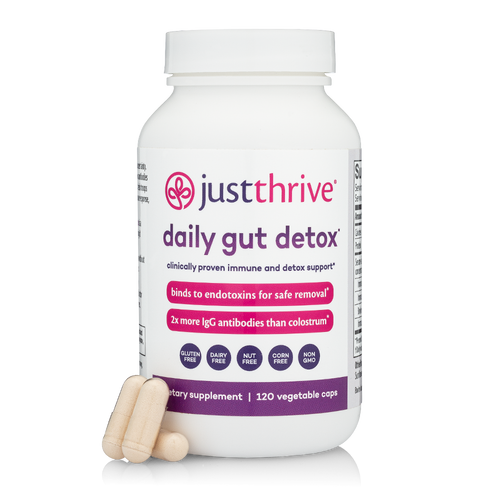

How Can You Support Gut Detox Every Day?
Unlike restrictive, short-term dietary approaches, immunoglobulins help support ongoing balance in the gut, working alongside your microbiome and immune system.
But when you’re faced with stress or immune challenges, your natural Ig levels may drop.
Daily Gut Detox offers clinically-proven support and promotes a healthy, balanced immune response by providing:
- IgG: with the highest concentration of IgG on the market, it binds to unwanted substances and supports immune memory
- IgA: the primary antibody in the gut lining, it helps bind microbes in the mucus layer
- IgM: often your body’s first responder, it helps support early immune activity and coordination
These three potent antibodies can help support a healthy immune response as part of a gentler, daily approach to gut detox.
>> Support your gut, immune, and overall health with Daily Gut Detox.
Not sure if Daily Gut Detox is right for you? We can help with that.
Every Just Thrive purchase is backed by our Bottom of the Bottle, 100% money back guarantee. So you can try Daily Gut Detox to see how it works for you.
But if for any reason you don’t feel a difference, you can ask for a full product refund at any time. Even if it’s been 3 weeks, 3 months, or 3 years… Even if the bottle is empty.

Sources
- Institute for Quality and Efficiency in Health Care (IQWiG). In brief: how does the liver work? In: InformedHealth.org [Internet]. Cologne, Germany: Institute for Quality and Efficiency in Health Care (IQWiG); 2006–. Updated February 28, 2023. Accessed March 16, 2026. https://www.ncbi.nlm.nih.gov/books/NBK279393/
- Institute for Quality and Efficiency in Health Care (IQWiG). In brief: how do the kidneys work? In: InformedHealth.org [Internet]. Cologne, Germany: Institute for Quality and Efficiency in Health Care (IQWiG); 2006–. Updated March 29, 2022. Accessed March 16, 2026. https://www.ncbi.nlm.nih.gov/books/NBK279385/
- Kuan WH, Chen YL, Liu CL. Excretion of Ni, Pb, Cu, As, and Hg in Sweat under Two Sweating Conditions. Int J Environ Res Public Health. 2022;19(7):4323. Published 2022 Apr 4. doi:10.3390/ijerph19074323
- Institute for Quality and Efficiency in Health Care (IQWiG). In brief: how does the stomach work? In: InformedHealth.org [Internet]. Cologne, Germany: Institute for Quality and Efficiency in Health Care (IQWiG); 2006–. Updated August 5, 2024. Accessed March 16, 2026. https://www.ncbi.nlm.nih.gov/books/NBK279304/
- Assimakopoulos SF, Triantos C, Maroulis I, Gogos C. The role of the gut barrier function in health and disease. Gastroenterol Res. 2018;11(4):261-263. doi:10.14740/gr1053w
- National Center for Complementary and Integrative Health. “Detoxes” and “cleanses”: what you need to know. Updated March 2025. Accessed March 16, 2026. https://www.nccih.nih.gov/health/detoxes-and-cleanses-what-you-need-to-know
- Wiertsema SP, van Bergenhenegouwen J, Garssen J, Knippels LMJ. The Interplay between the Gut Microbiome and the Immune System in the Context of Infectious Diseases throughout Life and the Role of Nutrition in Optimizing Treatment Strategies. Nutrients. 2021;13(3):886. Published 2021 Mar 9. doi:10.3390/nu13030886
- Shao T, Hsu R, Rafizadeh DL, Wang L, Bowlus CL, Kumar N, Mishra J, Timilsina S, Ridgway WM, Gershwin ME, Ansari AA, Shuai Z, Leung PSC. The gut ecosystem and immune tolerance. J Autoimmun. 2023;141:103114. doi:10.1016/j.jaut.2023.103114
- Patel P, Jamal Z, Ramphul K. Immunoglobulin. In: StatPearls [Internet]. Treasure Island, FL: StatPearls Publishing; 2026–. Updated August 28, 2023. Accessed March 16, 2026. https://www.ncbi.nlm.nih.gov/books/NBK513460/
- Cleveland Clinic. Immunoglobulin G (IgG). Published 2025. Accessed March 16, 2026. https://my.clevelandclinic.org/health/body/igg
- Palmeira P, Quinello C, Silveira-Lessa AL, Zago CA, Carneiro-Sampaio M. IgG placental transfer in healthy and pathological pregnancies. Clin Dev Immunol. 2012;2012:985646. doi:10.1155/2012/985646
- Maes M, Hendriks D, Van Gastel A, et al. Effects of psychological stress on serum immunoglobulin, complement and acute phase protein concentrations in normal volunteers. Psychoneuroendocrinology. 1997;22(6):397-409. doi:10.1016/s0306-4530(97)00042-5
- de Sousa-Pereira P, Woof JM. IgA: Structure, Function, and Developability. Antibodies (Basel). 2019;8(4):57. Published 2019 Dec 5. doi:10.3390/antib8040057
- Sathe A, Cusick JK. Biochemistry, immunoglobulin M. In: StatPearls [Internet]. Treasure Island, FL: StatPearls Publishing; 2026–. Updated December 19, 2022. Accessed March 16, 2026. https://www.ncbi.nlm.nih.gov/books/NBK555995/


