



You’re already familiar with some of the work your gut does, helping you digest food and eliminate waste.
But there’s other work that happens quietly in the background that often goes unnoticed. Most people don’t give their gut, or its function, much thought unless something feels…off. Maybe you’re bloated after a meal or dealing with embarrassing stomach issues. Maybe it’s just an unmistakable sense that something isn’t quite right.
When your gut is supported, and everything is running smoothly, there’s no reason for you to think about it. But when your gut is under strain, the effects can show up in ways that aren’t so obviously connected to your gut. Which is exactly why it’s so important to understand what’s happening behind the scenes.
Let’s take a closer look at the unseen work your gut does each day, what can disrupt it, and how you can support it in a way that feels realistic and sustainable, long-term.
Your Gut Does Way More Than Just Digest Food
Your gut may be easy to overlook because it works out of sight, but it handles some of the most complex and important functions in your body.
Day in and day out, your gut sorts through what you eat, decides what your body can use, and discards the rest. It helps absorb nutrients and sends signals that impact how you feel physically, emotionally, and mentally. Your gut even supports your immune system’s responses.
Here are some of the behind-the-scenes work happening in your gut.
Provides a Defensive Barrier
One of your gut’s most important roles might surprise you. The gastrointestinal tract’s lining, the mucosal barrier, is your body’s vital first line of internal defense.[1] As part of this protective system, your gut is constantly deciding what it will allow into your body and what needs to be kept out.
How does the mucosal barrier work?
Your digestive system is lined with a few key protective layers.[2]
- Mucosal layer: This is a thin coating of mucus that sits on top of the gut lining and traps unwanted substances.
- Epithelial cells: Beneath the mucosal layer, these cells are tightly packed together to form a physical wall, controlling what can pass through.
- Immune cells: These stay vigilant, ready to respond if something gets through that shouldn’t.
All of this adds up to a tightly woven filter. When your gut is healthy and this complex system is working as it should, this barrier allows nutrients to pass into your bloodstream while physically blocking toxins, bacteria, pathogens, partially digested food particles, and other substances that could cause damage.
 Want to listen instead of read? CLICK HERE
However, when the mucosal barrier is disrupted, even subtly, that filter can’t do its job properly. It becomes permeable, and substances that should be kept out of your bloodstream can start to slip through. Over time, this condition, often referred to as “leaky gut,” can contribute to inflammation, digestive issues, and other health concerns.[3]
Far from being a static barrier, the mucosal barrier stays active all day, responding and adjusting based on what you eat, the environment, and even your stress levels.
Because you don’t actually see your gut doing this work, it’s easy to overlook it. But it’s one of the most important ways your gut microbiome helps promote overall wellness.
Constant Filtering
Along with acting as a physical barrier, your gut has to constantly make decisions. Every time you take a bite or sip, it needs to sort through what’s entering your digestive tract, determine what might need a response, and send any necessary messages to your immune system.
Part of the process is nutrient absorption. Your gut allows vitamins, minerals, fats, and other beneficial compounds to move across the gut lining, where they eventually enter your bloodstream and get distributed throughout your body.
At the same time, potentially harmful substances are either blocked or flagged for the immune system, a highly selective process that happens without any conscious input. It’s a non-stop filtering process. In fact, your gut is doing it right now.
Round-the-Clock Signaling
Filtering is only part of it. Your gut also sends signals based on what it encounters, especially to the immune cells that form part of the mucosal barrier.[4] These immune cells are on standby, waiting to respond to any perceived threats from harmful substances. These responses don’t stay in your gut; they can trigger immune activity, including inflammation, throughout the body.
Some signals go even further, extending beyond your gut through the gut-brain axis.
The gut-brain axis (GBA) connects your central nervous system (the CNS, or brain and spinal cord) with the enteric nervous system (the “little brain” in your gut). This works as a two-way communication system, with messages constantly flowing back and forth through the vagus nerve, hormones, and neurotransmitters.[5] And the messages they exchange can influence mood, cognition, metabolism, and immune responses, which helps explain why emotions and digestive issues often go hand in hand.
Because of this link, when one system is healthy, it tends to support the other. Unfortunately, the reverse is also true. When one is off, the other usually feels it, too.[6]
This connection is so close and so often overlooked that you may have experienced it without even realizing it.
You’ve probably seen this play out in real life. Maybe you’ve been feeling nervous about a big presentation at work, and have stomach issues. Or you lose your appetite before an exciting event, like a first date or an important job interview. And sometimes, the signals go the other way. Ongoing stomach issues start to affect your mood, making you feel stressed or anxious about going out.
These messages, and many like them, are being exchanged constantly and consistently through the gut-brain axis. It’s part of what your gut does all day, every day.
What Can Quietly Disrupt Your Gut’s Daily Work?
When your gut is healthy and thriving, it helps your other body systems function optimally, supporting your overall health.
However, a few daily habits and experiences can disrupt your gut and compromise its well-being.
- Stress can throw your microbiome off balance. This state, known as dysbiosis, can weaken the gut lining.[7]
- Diets that are highly processed, high in fat, or contain added sugars can encourage the growth of pathogenic gut bacteria, throwing your gut and mucosal barrier off-balance.[8]
- Antibiotics, while sometimes necessary, can shift your microbiome’s bacterial balance and impact the mucosal barrier.[9]
Early signs are easy to miss. Things like occasional discomfort, food sensitivities, or changes in digestion can be subtle signals that your gut may be under strain.
Just Thrive Gut Health Products


Supporting the Gut’s Unseen Workload
These are a few ways to promote gut health without overcomplicating things.
Prioritize fiber and a diverse range of plant foods.[10] Fiber is a prebiotic, feeding the beneficial bacteria living in your gut. Prebiotics can help colonies of “good” bacteria thrive, balancing your microbiome and encouraging a healthier gut, which supports a stronger mucosal barrier.
Eat an organic diet high in nutrients and probiotics. Try to avoid, or at least limit, processed foods and drinks, alcohol, and sugary snacks.
Regulate stress through meditation, breathing techniques, journaling, moderate exercise, and similar practices. Stress can reduce beneficial bacteria, promote pathogenic bacteria, and compromise the mucosal barrier.[7] Add to that, when your mind is feeling stressed, the messages it sends your gut through the GBA can have a negative impact on gut health.[11]
Make sure your gut has the critical amino acids it needs to promote mucin synthesis and a strong, healthy mucosal barrier.[12,13]
- Threonine and serine to help form the protein core
- Proline to add structure
- Cysteine to support gut lining strength and protect it from oxidative stress
Add polyphenols to your daily routine. They can provide fuel for beneficial gut bacteria, support a healthy inflammatory response, encourage mucin production, and promote gut lining strength.[14]
Even small changes can go a long way in supporting your gut and the invisible work it does for your whole-body wellness.
Support Your Gut’s Invisible Work with Just Thrive
Promote a healthy microbiome and help your gut perform its daily work with Just Thrive.
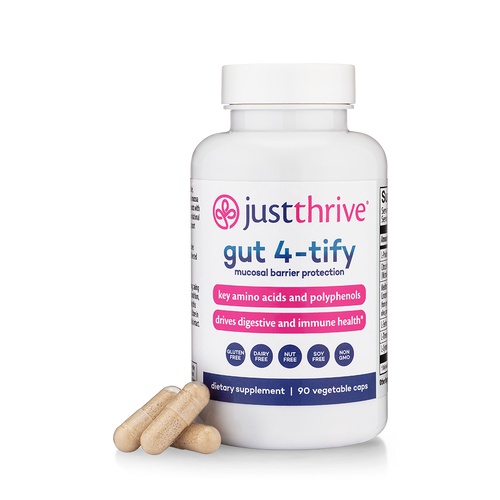
Gut 4-tify is specially designed with key ingredients that help support a healthy mucosal barrier, address leaky gut, promote healthy digestion, and encourage a balanced immune response.
- The amino acids L-proline, L-serine, L-cysteine, and L-threonine promote the production of collagen and proteins that help create a thick, robust mucosal barrier.
- Polyphenols Oxxynea® and MicrobiomeX®, two tested “superfood” blends that support the growth of beneficial bacteria and help maintain a healthy gut lining.
>> Support your gut’s behind-the-scenes work with Gut 4-tify.
Not sure whether Gut 4-tify will work for you? We can help.
Every single Just Thrive purchase is covered by our Bottom of the Bottle, 100% money back guarantee. So you can try Gut 4-tify to see if it works for you, and we’re confident you’ll love the way you feel.
But if for any reason you don’t notice a difference, simply ask for a full product refund at any time. Even if it’s been 3 weeks, 3 months, or 3 years… and even if the bottle is empty.

Sources
- Paone P, Cani PD. Mucus barrier, mucins and gut microbiota: the expected slimy partners? Gut. 2020 Dec;69(12):2232-2243. doi: 10.1136/gutjnl-2020-322260. Epub 2020 Sep 11. Erratum in: Gut. 2023 Nov 24;72(12):e7. doi: 10.1136/gutjnl-2020-322260corr1. PMID: 32917747; PMCID: PMC7677487.
- France MM, Turner JR. The mucosal barrier at a glance. J Cell Sci. 2017 Jan 15;130(2):307-314. doi: 10.1242/jcs.193482. Epub 2017 Jan 6. PMID: 28062847; PMCID: PMC5278669.
- Aleman, R. S., Moncada, M., & Aryana, K. J. (2023). Leaky Gut and the Ingredients That Help Treat It: A Review. Molecules, 28(2), 619. https://doi.org/10.3390/molecules28020619
- Foster JA, Baker GB, Dursun SM. The Relationship Between the Gut Microbiome-Immune System-Brain Axis and Major Depressive Disorder. Front Neurol. 2021 Sep 28;12:721126. doi: 10.3389/fneur.2021.721126. PMID: 34650506; PMCID: PMC8508781.
- Carabotti M, Scirocco A, Maselli MA, Severi C. The gut-brain axis: interactions between enteric microbiota, central and enteric nervous systems. Ann Gastroenterol. 2015 Apr-Jun;28(2):203-209. PMID: 25830558; PMCID: PMC4367209.
- Martin CR, Osadchiy V, Kalani A, Mayer EA. The Brain-Gut-Microbiome Axis. Cell Mol Gastroenterol Hepatol. 2018 Apr 12;6(2):133-148. doi: 10.1016/j.jcmgh.2018.04.003. PMID: 30023410; PMCID: PMC6047317.
- Madison A, Kiecolt-Glaser JK. Stress, depression, diet, and the gut microbiota: human-bacteria interactions at the core of psychoneuroimmunology and nutrition. Curr Opin Behav Sci. 2019 Aug;28:105-110. doi: 10.1016/j.cobeha.2019.01.011. Epub 2019 Mar 25. PMID: 32395568; PMCID: PMC7213601.
- Suriano F, Nyström EEL, Sergi D, Gustafsson JK. Diet, microbiota, and the mucus layer: The guardians of our health. Front Immunol. 2022 Sep 13;13:953196. doi: 10.3389/fimmu.2022.953196. PMID: 36177011; PMCID: PMC9513540.
- Sawaed J, Zelik L, Levin Y, Feeney R, Naama M, Gordon A, Zigdon M, Rubin E, Telpaz S, Modilevsky S, Ben-Simon S, Awad A, Harshuk-Shabso S, Nuriel-Ohayon M, Werbner M, Schroeder BO, Erez A, Bel S. Antibiotics damage the colonic mucus barrier in a microbiota-independent manner. Sci Adv. 2024 Sep 13;10(37):eadp4119. doi: 10.1126/sciadv.adp4119. Epub 2024 Sep 11. PMID: 39259805; PMCID: PMC11389797.
- Slavin J. Fiber and prebiotics: mechanisms and health benefits. Nutrients. 2013 Apr 22;5(4):1417-35. doi: 10.3390/nu5041417. PMID: 23609775; PMCID: PMC3705355.
- Hantsoo L, Zemel BS. Stress gets into the belly: Early life stress and the gut microbiome. Behav Brain Res. 2021 Sep 24;414:113474. doi: 10.1016/j.bbr.2021.113474. Epub 2021 Jul 16. PMID: 34280457; PMCID: PMC8380711.
- Faure M, Mettraux C, Moennoz D, Godin JP, Vuichoud J, Rochat F, Breuillé D, Obled C, Corthésy-Theulaz I. Specific amino acids increase mucin synthesis and microbiota in dextran sulfate sodium-treated rats. J Nutr. 2006 Jun;136(6):1558-64. doi: 10.1093/jn/136.6.1558. PMID: 16702321.
- Song Zh, Tong G, Xiao K, Jiao le F, Ke Yl, Hu Ch. L-cysteine protects intestinal integrity, attenuates intestinal inflammation and oxidant stress, and modulates NF-κB and Nrf2 pathways in weaned piglets after LPS challenge. Innate Immun. 2016 Apr;22(3):152-61. doi: 10.1177/1753425916632303. Epub 2016 Feb 25. PMID: 26921254.
- Li H, Gao J, Peng W, Sun X, Qi W, Wang Y. Dietary Polyphenols-Gut Microbiota Interactions: Intervention Strategies and Metabolic Regulation for Intestinal Diseases. Biology (Basel). 2025 Nov 30;14(12):1705. doi: 10.3390/biology14121705. PMID: 41463478; PMCID: PMC12730813.


