



Digestive bitters… it’s all in the name, right?
Yes, they make digestion smooth and easy, helping your body get the most out of every bite. Even when you eat more than you meant to. Or eat foods that are harder to digest.
They activate your digestive juices. They help you avoid those feelings of occasional heaviness, indigestion, and bloating after a meal.
But bitters do so much more than that. They affect your overall health, delivering benefits far beyond digestion.
Quick Answer: Digestive bitters are plant compounds known for activating bitter taste receptors (T2Rs) in the digestive system and throughout the body. Their best-known job is supporting digestion by encouraging stomach acid, bile, and enzyme release so food breaks down and absorbs well. But because T2Rs sit far beyond the gut, bitters can affect much more. Seven surprising benefits include supporting normal hunger and fullness signals, supporting healthy metabolism and blood sugar, kickstarting bile production, supporting the liver’s detox function, supporting immune balance, and calming the nervous system through the vagus nerve. Taking bitters before meals, including in capsule form, helps prepare the body for digestion and whole-body wellness.
What Are Digestive Bitters and How Do They Work?
Digestive bitters are bitter plant compounds that activate bitter taste receptors (T2Rs) in the digestive system and throughout the body. In the gut, they encourage stomach acid, bile, and enzyme release for better digestion, and because T2Rs sit elsewhere too, they can influence functions well beyond digestion.
Nature offers potent plant compounds designed to work with our bodies to help us digest food more efficiently and effectively. Digestive bitters contain many bitter compounds that interact with a system of T2R receptors in the digestive system and throughout the body.
When digestive bitters activate T2Rs, they trigger a series of processes, starting with the digestive system. They encourage the secretion of digestive supports like stomach acid, bile, and enzymes that make sure everything you’ve eaten gets broken down and absorbed completely.
Your body has T2Rs outside the digestive system too, in your brain and cardiovascular system, for example.[1,2] When bitter compounds activate those T2Rs, they create a chain reaction that affects specific hormones, peptides, and enzymes. These signaling proteins get the message to turn on or off from the T2Rs and go to work in their particular physiological system.
That’s how digestive bitters can affect more than just digestion. They play key roles in breathing, behavior, immunity, and thyroid function… just to name a few.
Here are seven surprising ways digestive bitters can help your whole body feel great.
 Want to listen instead of read? CLICK HERE
1. Support normal hunger and satiety signals
Your body produces a hormone called ghrelin that tells your brain when you’re hungry. Ghrelin stimulates your appetite to make you want to eat. And it’s so powerful that it can override feelings of fullness so your brain thinks you need to keep eating even when you don’t.[3]
Digestive bitters activate receptors in your gut that curb ghrelin levels, so you can tell when you actually feel full. One study found that people who took bitter compound capsules before meals ate 14% fewer calories.[4]

2. Naturally support healthy metabolism
Metabolic health refers to how your body converts food into energy. It includes a range of functions including blood sugar and insulin regulation and fat burning and storage. Many of these functions are regulated by a peptide called GLP-1 (glucagon-like peptide-1), making it a sort of master protein for your metabolism.
Digestive bitters including bitter melon help stimulate the release of GLP-1[5,6] and support its function to deliver a host of potential metabolic benefits including:[7,8,9]
- Promoting satiety (feeling full)
- Slowing digestion, which allows for proper nutrient absorption
- Supporting healthy after-meal insulin responses
- Regulating fat cell formation (adipogenesis)
- Encouraging fat burning (thermogenesis)
- Supporting healthy weight maintenance
Increasing intake of bitters leads to increased T2R activation, which triggers GLP-1 release for stable metabolic health.[10]
3. Support healthy blood sugar
Digestive bitters help support healthy blood sugar in more ways than stimulating GLP-1 release. Bitters also trigger the release of GIP (glucose-dependent insulinotropic polypeptide).[11] Its main job is maintaining steady blood sugar balance. GIP signals for normal insulin release to keep blood sugar moving into cells and keep glucose levels healthy. And when sugar levels are too low, GIP stimulates glucagon release to bring them back up.[12]
By notifying the T2Rs to signal GLP-1 and GIP, bitter substances contribute to balanced blood sugar management.
4. Kickstart bile production
When digestive bitters activate T2Rs, they promote bile production and secretion. That helps your body get ready to break down nutrients, especially fats, for easier digestion. Because bile increases fat absorption, it also increases the bioavailability of essential fat-soluble vitamins A, D, E, and K. Bile also promotes digestive comfort by neutralizing any stomach acid mixed in with partially digested food as it travels out of the stomach.[13]
Bile plays another key role: binding toxins and preparing them for elimination. It helps sweep out waste, including stubborn fat-soluble toxins that could otherwise end up in long-term fat storage.[14] Several traditional digestive bitters are well-known for encouraging bile production and flow including gentian root, dandelion root, and wormwood.[15]

5. Support your liver’s detox function
Your liver is your body’s main detoxifying organ. It’s responsible for processing toxins, filtering your blood, and transforming toxins and other harmful compounds into waste. Part of this function involves metabolizing nutrients and medications, separating the part your body needs from the parts it doesn’t.[16]
Digestive bitters activate T2R receptors that help detect toxins for isolation and elimination. Bitters such as hops also activate a peptide hormone called cholecystokinin, or CCK, needed for stimulating the release of bile and digestive enzymes and known to support the liver and a healthy inflammatory response.[17,18,19] This helps keep the liver fully functional and able to filter the blood and remove toxins.
Some digestive bitters lend support to your body’s natural detoxification pathways including:
- Dandelion root
- Artichoke
- Gentian root
6. Support immune balance
Digestive bitters support immune system function in several important ways. By supporting good digestive function, bitters help make nutrients more bioavailable and aid their absorption, including vitamins and minerals critical for immunity. By stimulating production of stomach acid and enzymes, digestive bitters support your immune system in effectively handling infectious microbes.
On top of that, many digestive bitters contain complex compounds that deliver antioxidant activity and immune-supporting properties. For example, barberry has strong antioxidant activity[20], and sweet wormwood helps fight free radicals.[21,22]
7. Calm your nervous system
Your vagus nerve is a critical part of your nervous system, responsible for delivering signals between your body and your brain. Its most important section connects to your gut, creating the gut-brain axis, plus the vagus nerve is lined with T2Rs, and when they’re activated by digestive bitters they stimulate the vagus nerve.[23]
Vagus nerve stimulation promotes relaxation and emotional well-being. That action is also associated with brighter moods, increased focus, and balanced stress responses.[24]
Research shows that by stimulating the vagus nerve, digestive bitters help the nervous system settle down and promote calm clarity. For example, hops support cognitive function, attention, and mood regulation in older adults.[25] Coptis root helps calm emotions and promote brighter moods.[26] And dong quai is used in traditional Chinese medicine to calm the nervous system.[27]
Because T2Rs are so plentiful throughout your body, digestive bitters can affect many different systems far beyond digestion.
Just Thrive Gut Health Products


Frequently Asked Questions About Digestive Bitters
What are digestive bitters?
Digestive bitters are plant compounds with a distinctly bitter taste that activate bitter taste receptors, called T2Rs, in the digestive tract and throughout the body. They have traditionally been used before meals to support healthy digestion.
How do digestive bitters work?
When bitters activate T2Rs in the gut, they encourage the release of stomach acid, bile, and enzymes that help break down and absorb food. Because T2Rs also exist in places like the brain and cardiovascular system, bitters can trigger effects well beyond digestion.
What are the benefits of digestive bitters beyond digestion?
Bitters may support normal hunger and fullness signals, healthy metabolism and blood sugar, bile production, the liver’s detox function, immune balance, and a calmer nervous system through vagus nerve stimulation.
Can digestive bitters help with appetite and metabolism?
Bitters can help curb the hunger hormone ghrelin so you can tell when you are full, and they help stimulate GLP-1 and GIP, which support metabolic functions like blood sugar balance, fat handling, and satiety.
How do you take digestive bitters?
Bitters are traditionally taken before meals. If you prefer to skip the harsh taste, capsule forms provide the same activation of your body’s bitter receptors without the bitter flavor.
Enjoy Whole Body Wellness with Just Thrive Digestive Bitters
If you want a balanced immune system, stable blood sugar, efficient detoxification, and consistent calmness, bitter compounds can deliver. By activating special receptors all over your body, digestive bitters offer whole body health benefits straight from nature.
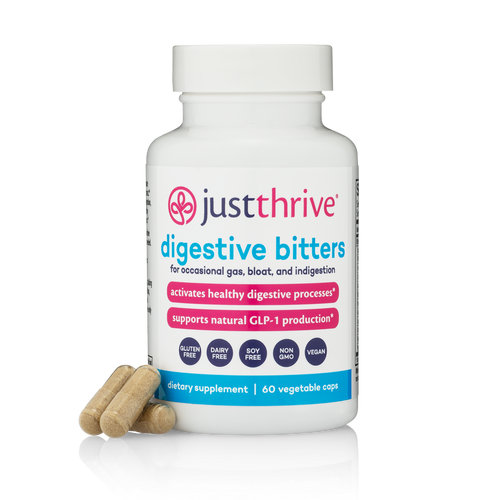
Just Thrive Digestive Bitters give you all the advantages of bitters in capsule form, so you don’t have to endure the harsh taste to stimulate your body’s bitter receptors.
Digestive Bitters deliver a comprehensive holistic blend of 12 time-tested bitters including:
- Dandelion root
- Artichoke leaf
- Sweet wormwood
- Dong quai
- Hops
- Bitter melon
>> Enjoy overall wellness with Just Thrive Digestive Bitters before every meal.
And if you’re not sure about trying Digestive Bitters… we can help with that.
EVERY Just Thrive purchase is covered by our Bottom of the Bottle, 100% money back guarantee.
So you can try Digestive Bitters to see if it works for you… and we’re confident that you’ll love the way you feel.
But if for any reason you don’t feel a difference, simply request a full refund at any time. Doesn’t matter if it’s 3 months or even 3 years later. It doesn’t even matter if the bottle is empty! You’ll get your money back any time, no matter what. All you have to do is ask.

Sources
- Hassan L, Newman L, Keast R, Danaher J, Biesiekierski JR. The effect of gastrointestinal bitter sensing on appetite regulation and energy intake: A systematic review. Appetite. 2023 Jan 1;180:106336.
- Harmon CP, Deng D, Breslin PAS. Bitter Taste Receptors (T2Rs) are Sentinels that Coordinate Metabolic and Immunological Defense Responses. Curr Opin Physiol. 2021;20:70-76. doi:10.1016/j.cophys.2021.01.006
- Micioni Di Bonaventura E, Botticelli L, Del Bello F, et al. Assessing the role of ghrelin and the enzyme ghrelin O-acyltransferase (GOAT) system in food reward, food motivation, and binge eating behavior. Pharmacol Res. 2021;172:105847. doi:10.1016/j.phrs.2021.105847
- Andreozzi P, et al. The Bitter Taste Receptor Agonist Quinine Reduces Calorie Intake and Increases the Postprandial Release of Cholecystokinin in Healthy Subjects. J Neurogastroenterol Motil. 2015 Oct 1;21(4):511-9.
- Kok BP, Galmozzi A, Littlejohn NK, et al. Intestinal bitter taste receptor activation alters hormone secretion and imparts metabolic benefits. Mol Metab. 2018;16:76-87. doi:10.1016/j.molmet.2018.07.013
- Chang CI, Cheng SY, Nurlatifah AO, et al. Bitter Melon Extract Yields Multiple Effects on Intestinal Epithelial Cells and Likely Contributes to Anti-diabetic Functions. Int J Med Sci. 2021;18(8):1848-1856. Published 2021 Feb 24. doi:10.7150/ijms.55866
- Astrup A. Reflections on the discovery GLP-1 as a satiety hormone: Implications for obesity therapy and future directions. Eur J Clin Nutr. 2024;78(7):551-556. doi:10.1038/s41430-024-01460-6
- Holst JJ. The physiology of glucagon-like peptide 1. Physiol Rev. 2007;87(4):1409-1439. doi:10.1152/physrev.00034.2006
- Bu T, Sun Z, Pan Y, Deng X, Yuan G. Glucagon-Like Peptide-1: New Regulator in Lipid Metabolism. Diabetes Metab J. 2024;48(3):354-372. doi:10.4093/dmj.2023.0277
- Chou WL. Therapeutic potential of targeting intestinal bitter taste receptors in diabetes associated with dyslipidemia. Pharmacol Res. 2021 Aug;170:105693.
- Dotson CD, Vigues S, Steinle NI, Munger SD. T1R and T2R receptors: the modulation of incretin hormones and potential targets for the treatment of type 2 diabetes mellitus. Curr Opin Investig Drugs. 2010 Apr;11(4):447-54. PMID: 20336593; PMCID: PMC4535793.
- Gasbjerg LS, Gabe MBN, Hartmann B, Christensen MB, Knop FK, Holst JJ, Rosenkilde MM. Glucose-dependent insulinotropic polypeptide (GIP) receptor antagonists as anti-diabetic agents. Peptides. 2018 Feb;100:173-181.
- Hundt M, Basit H, John S. Physiology, Bile Secretion. [Updated 2022 Sep 26]. In: StatPearls [Internet]. Treasure Island (FL): StatPearls Publishing; 2025 Jan-. Available from: https://www.ncbi.nlm.nih.gov/books/NBK470209/
- LiverTox: Clinical and Research Information on Drug-Induced Liver Injury [Internet]. Bethesda (MD): National Institute of Diabetes and Digestive and Kidney Diseases; 2012-. Bile Acids. [Updated 2017 Sep 25]. Available from: https://www.ncbi.nlm.nih.gov/books/NBK548626/
- McMullen MK, Whitehouse JM, Towell A. Bitters: Time for a New Paradigm. Evid Based Complement Alternat Med. 2015;2015:670504. doi: 10.1155/2015/670504. Epub 2015 May 14. PMID: 26074998; PMCID: PMC4446506.
- InformedHealth.org [Internet]. Cologne, Germany: Institute for Quality and Efficiency in Health Care (IQWiG); 2006-. In brief: How does the liver work? [Updated 2023 Feb 28]. Available from: https://www.ncbi.nlm.nih.gov/books/NBK279393/
- Yamazaki T, Takahashi C, Taniguchi Y, Narukawa M, Misaka T, Ano Y. Bitter taste receptor activation by hop-derived bitter components induces gastrointestinal hormone production in enteroendocrine cells. Biochem Biophys Res Commun. 2020 Dec 17;533(4):704-709.
- Chen MC, Wu SV, Reeve JR Jr, Rozengurt E. Bitter stimuli induce Ca2+ signaling and CCK release in enteroendocrine STC-1 cells: role of L-type voltage-sensitive Ca2+ channels. Am J Physiol Cell Physiol. 2006 Oct;291(4):C726-39
- Zhang Y, Zhu J, Guo L, Zou Y, Wang F, Shao H, Li J, Deng X. Cholecystokinin protects mouse liver against ischemia and reperfusion injury. Int Immunopharmacol. 2017 Jul;48:180-186.
- Mohammadi A, Sahebkar A, Kermani T, Zhilaee M, Tavallaie S, Ghayour Mobarhan M. Barberry administration and pro-oxidant-antioxidant balance in patients with metabolic syndrome. Iran Red Crescent Med J. 2014 Dec 14;16(12):e16786.
- Gavarić N, Aćimović M, Kladar N, Hitl M, Drljača Lero J, Milić N, Radovanović K. Unlocking the Bioactivity of Sweet Wormwood (Artemisia annua L., Asteraceae) Ethanolic Extract: Phenolics, Antioxidants, and Cytotoxic Effects. Pharmaceutics. 2025; 17(7):890. https://doi.org/10.3390/pharmaceutics17070890
- Kim WS, Choi WJ, Lee S, et al. Anti-inflammatory, Antioxidant and Antimicrobial Effects of Artemisinin Extracts from Artemisia annua L. Korean J Physiol Pharmacol. 2015;19(1):21-27. doi:10.4196/kjpp.2015.19.1.21
- Liddle RA. Interactions of Gut Endocrine Cells with Epithelium and Neurons. Compr Physiol. 2018 Jun 18;8(3):1019-1030.
- Goggins E, Mitani S, Tanaka S. Clinical perspectives on vagus nerve stimulation: present and future. Clin Sci (Lond). 2022 May 13;136(9):695-709. doi: 10.1042/CS20210507. PMID: 35536161; PMCID: PMC9093220.
- Fukuda T, Ohnuma T, Obara K, Kondo S, Arai H, Ano Y. Supplementation with Matured Hop Bitter Acids Improves Cognitive Performance and Mood State in Healthy Older Adults with Subjective Cognitive Decline. J Alzheimers Dis. 2020;76(1):387-398.
- Qi Y, Ni S, Heng X, Qu S, Ge P, Zhao X, Yao Z, Guo R, Yang N, Zhang Q, Zhu H. Uncovering the Potential Mechanisms of Coptis chinensis Franch. for Serious Mental Illness by Network Pharmacology and Pharmacology-Based Analysis. Drug Des Devel Ther. 2022 Feb 9;16:325-342.
- Shen J, Zhang J, Deng M, Liu Y, Hu Y, Zhang L. The Antidepressant Effect of Angelica sinensis Extracts on Chronic Unpredictable Mild Stress-Induced Depression Is Mediated via the Upregulation of the BDNF Signaling Pathway in Rats. Evid Based Complement Alternat Med. 2016;2016:7434692.