



The key to lifetime of pet health and happiness
Whether you have a pug, a pig, a parakeet, or a purebred Persian, you love your pet. You want them to have a long, happy, healthy life. And you do your best to make that happen.
Unfortunately, your pet faces many everyday challenges to their health and well‑being. From exposure to pesticides on neighboring lawns, to air pollution, to poisonous plants to processed foods, your beloved pet comes into contact with a lot of things that can harm their health.
But you can help protect them and keep them healthy for the long haul. To do that, you need to make sure the centerpiece of their health—the gut microbiome—is well taken care of.
The Gut-Health-First Approach to Pet Well-Being
Just like with people, your pet’s gut microbiome plays a key role in their overall health throughout their life.[1]
It houses around 70% to 80% of their immune system, actively training immune cells and managing balanced immune function. It connects directly to virtually every core body system, influencing the health and function of vital organs.
When your pet’s gut microbiome is in healthy balance, trillions of diverse beneficial probiotic bacteria work to keep all systems running smoothly.
As animals age, the composition of their gut microbiome can change. The most common change is a reduction in bacterial diversity, and over time that shifts gut microbiome activity. That works both ways: A less diverse gut can impact aging… and aging can make the gut less diverse.[2]
Supporting a balanced, diverse gut microbiome helps maintain your pet’s digestive health, overall well-being, and vitality, and can even help maintain an active, playful lifestyle.
Unfortunately, it’s pretty easy to knock that microbiome out of balance.
 Want to listen instead of read? CLICK HERE
Hidden Harms Damage Your Pet’s Gut Health
A lot of things can upset the balance in your pet’s gut microbiome. Common culprits include:
- Antibiotics
- Medications including steroids and NSAIDs
- Pesticides
- Glyphosate
- Heavily processed foods
- Food additives and hidden sugars
- Stress
- Environmental toxins, like household cleaners or heavy metals
When your pet’s gut gets knocked out of balance, it creates a condition called dysbiosis where pathogens outnumber and crowd out beneficial probiotic bacteria. That can cause gastrointestinal issues including occasional diarrhea and foul gas. It may also be linked to far-reaching issues including allergies, changes in energy, mood/behavior, and more[3].
Luckily, you can help maintain your pet’s gut balance with appropriately formulated probiotics, which support digestive health and overall well‑being.
How Your Pet’s Gut Health Affects Their Whole Life
Your pet’s gut health can affect every aspect of their life, from energy levels to mood to immune system function.
Research shows that a healthy, balanced gut microbiome can help:[4,5,6,7,8]
- Support optimal immune function
- Regulate gut motility
- Support the gut barrier strength and function
- Promote nutrient absorption
- Provide energy
- Encourage positive mood and behavior via the gut-brain axis
- Support overall cardiovascular health
- Support a health inflammatory response
- Maintain healthy weight
We all want as much time with our pets as possible. A healthy gut microbiome can make a big difference in their health and is the foundation for a long and happy life.

The Best Way to Keep Your Pet’s Gut Healthy
You can help keep your pet’s gut in healthy balance with probiotic supplements, but they need to be animal-focused strains. Human probiotics won’t do the job.
The best strains for pets include Pediococcus acidilactici, Bacillus subtilis, and Bacillus licheniformis, which are known as universal animal microbiome colonizers.[9,10] And those animal-appropriate strains will work for any pet from rabbits to parrots to calico cats to Great Danes.
When you give your pet these specifically formulated probiotics for animal microbiomes, their gut health can benefit in several positive ways.
One clinical study that looked at healthy dogs and dogs with digestive issues found that animal-friendly spore probiotics made a remarkable difference.[11] The dogs were all given a probiotic formula that contained Bacillus subtilis HU58™, Bacillus licheniformis, and Pediococcus acidilactici for 30 days. By the end of the study, the digestive issues were dramatically reduced or disappeared. And the healthy pets remained healthy.
Another study with cats[12] found that a multi-strain formula including Pediococcus acidilactici was associated with increases in beneficial gut bacteria, microbiota-derived SCFAs, and antioxidants which help support normal digestive function and overall health.
Just Thrive Pet Health Products
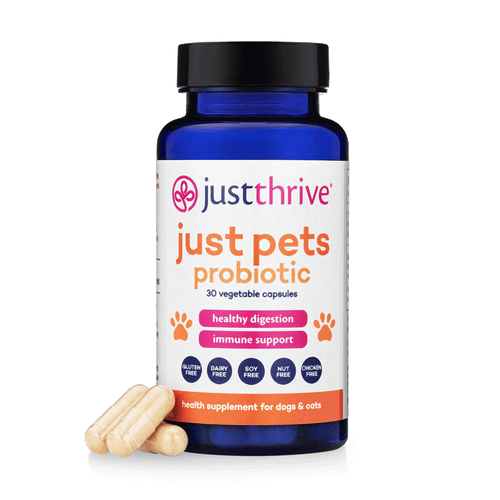
Support Your Pet’s Longevity with Just Pets Probiotic
You want to keep your pet with you… happy and healthy… as long as you possibly can. You want them to be youthful, calm, bursting with wellness.
All of that starts in their gut microbiome. And no matter what type of pet you have, the right probiotics can help keep their gut microbiome in healthy balance.
Just Pets Probiotic contains three strains of probiotics known to support the gut microbiomes of pets:
- Bacillus subtilis HU58™
- Bacillus licheniformis SL-307
- Pediococcus acidilactici
Adding one capsule to your pet’s food every day helps maintain healthy balance in their gut microbiome and support healthy immunity. This formula is designed so that one capsule is appropriate for most companion pets, regardless of size (but we encourage you to follow your veterinarian’s guidance for your pet’s specific needs). Every gut microbiome contains trillions of native bacteria species. Probiotic supplements contain billions of bacteria, and that’s just a small fraction of your pet’s total microbiome population. So the dose for a cockatiel is the same as a Cocker spaniel or a calico cat.
>> Keep your pet’s gut microbiome in healthy balance for a healthy life with Just Pets Probiotic.
Still on the fence? We’re confident that you’ll notice a positive difference in your pet with Just Pets.
But if you’re not 100% happy, we’ve got your back.
If you’re not completely satisfied with your Just Thrive purchase for ANY reason, you can take advantage of our “Bottom of the Bottle” money back guarantee.
Love your Just Thrive purchase, or request a full product refund at any time… Whether it’s 3 days, 3 weeks, or 3 months later… Even if the bottle is empty!

Sources
- Ma LC, Zhao HQ, Wu LB, Cheng ZL, Liu C. Impact of the microbiome on human, animal, and environmental health from a One Health perspective. Sci One Health. 2023 Aug 25;2:100037.
- Kim M, Benayoun BA. The microbiome: an emerging key player in aging and longevity. Transl Med Aging. 2020;4:103-116. Epub 2020 Jul 21. PMID: 32832742; PMCID: PMC7437988.
- Mondo E, Marliani G, Accorsi PA, Cocchi M, Di Leone A. Role of gut microbiota in dog and cat's health and diseases. Open Vet J. 2019;9(3):253-258. doi:10.4314/ovj.v9i3.10
- Chen S, Luo S, Yan C. Gut Microbiota Implications for Health and Welfare in Farm Animals: A Review. Animals (Basel). 2021 Dec 31;12(1):93.
- Creech R. The link between gut microbiome and behavior in dogs. dvm360. November 2024;Volume 55: Issue 11,page 15.
- Rindels JE, Loman BR. Gut microbiome - the key to our pets' health and happiness? Anim Front. 2024 Jun 20;14(3):46-53.
- Kieler IN, Shamzir Kamal S, Vitger AD, Nielsen DS, Lauridsen C, Bjornvad CR. Gut microbiota composition may relate to weight loss rate in obese pet dogs. Vet Med Sci. 2017 Nov 3;3(4):252-262.
- Sacoor C, Marugg JD, Lima NR, Empadinhas N, Montezinho L. Gut-Brain Axis Impact on Canine Anxiety Disorders: New Challenges for Behavioral Veterinary Medicine. Vet Med Int. 2024 Jan 23;2024:2856759.
- Melara EG, Avellaneda MC, Valdivié M, García-Hernández Y, Aroche R, Martínez Y. Probiotics: Symbiotic Relationship with the Animal Host. Animals (Basel). 2022 Mar 12;12(6):719.
- Anee, I.J., Alam, S., Begum, R.A. et al. The role of probiotics on animal health and nutrition. JoBAZ 82, 52 (2021).
- Matei MC, et al. Natural Endotoxemia in Dogs-A Hidden Condition That Can Be Treated with a Potential Probiotic Containing Bacillus subtilis, Bacillus licheniformis and Pediococcus acidilactici: A Study Model. Animals (Basel). 2021 May 11;11(5):1367.
- Li Y, Ali I, Lei Z, et al. Effect of a Multistrain Probiotic on Feline Gut Health through the Fecal Microbiota and Its Metabolite SCFAs. Metabolites. 2023;13(2):228. Published 2023 Feb 3. doi:10.3390/metabo13020228