



Sort out the hype from the facts.
Thinking about trying apple cider vinegar to get your gut in shape?
You may have heard that apple cider vinegar (ACV) is rich in probiotic bacteria, that it contains prebiotic fiber, and that it’s a complete natural gut solution.
The internet is full of hype about ACV. Claiming it can help you lose weight… manage blood sugar… and cure reflux.
The truth: ACV may offer some general health benefits, but research into more specific claims doesn’t really bear out.[1]
And when it comes to gut health, ACV is not enough on its own. For a truly healthy, balanced gut, you’ll need proven support you can count on.
Quick Answer: Apple cider vinegar (ACV) offers some general health support, but it is not a complete gut solution. Its probiotics are largely killed off during digestion, so they do not colonize the gut, though ACV does contain antioxidants and has some direct antimicrobial action against certain pathogens. What ACV cannot do is rebalance the gut microbiome, repair the mucosal gut barrier, or build a diverse, healthy gut. For that, a three-part approach works better: spore probiotics that arrive in the gut alive, well-chosen prebiotics like GOS, FOS, and XOS, and targeted gut-barrier support. In short, ACV can play a small role, but it is not enough on its own.
What Is Apple Cider Vinegar?
Apple cider vinegar is apple juice that has been fermented twice: first into alcohol, then into acetic acid. The cloudy "mother" you see in the bottle is the yeast and bacteria created during fermentation.
Apple cider vinegar is apple juice that’s been fermented two times. The juice gets combined with sugar and yeast to kick off the fermentation process.
After a couple of weeks, the carbohydrates in the juice transform into alcohol. Then the second fermentation, involving bacteria called acetobacter, turns the alcohol into acetic acid, a key component of vinegar. During this whole fermentation process, the yeast and bacteria combine to create the “mother,” the cloudy stuff floating around in the bottle of ACV.
Technically, the bacteria in ACV is considered probiotic bacteria, meaning beneficial rather than harmful. But that doesn’t mean it’s the kind of bacteria that thrives and colonizes in your gut microbiome.
 Want to listen instead of read? CLICK HERE
What Can and Can’t Apple Cider Vinegar Do for Your Gut?
ACV offers some support: it contains antioxidants and has direct antimicrobial action that can reduce certain pathogens. What it cannot do is rebalance the gut microbiome, repair the mucosal gut barrier, or build a healthy gut.
ACV does offer some health support. It contains some healthful compounds including:
- antioxidants
- acetic acid
- prebiotics, the preferred food for gut bacteria
- some probiotic bacteria
Some of those components can indirectly support gut health, but not in the way you’d expect. Like the probiotics found in many foods like yogurt and kimchi, the probiotics in ACV don’t make it all the way to your gut alive. They get killed off during the digestive process. But they may still offer some nourishment for the gut microbiome. The antioxidants in ACV also provide some general health benefits by fighting free radicals.
Some people claim ACV may help resolve heartburn and reflux because of its probiotic content, but there’s no science to back that up. And it’s possible the acidity could make a sensitive upper digestive system feel worse.
What ACV can do for your gut: ACV does have some direct antimicrobial powers. It can kill off some pathogens, like salmonella, that it comes in direct contact with.[2] So consuming it can reduce the pathogen burden on your gut.
What ACV can’t do: Restore and maintain balance in the gut microbiome, repair and strengthen the protective mucosal gut barrier, or build a healthy gut microbiome.
Can Apple Cider Vinegar Solve Gut Problems?
No. Serious gut issues like dysbiosis and leaky gut need real, ongoing support to resolve and stay healthy, which is more than ACV can provide.
A healthy gut includes a balanced microbiome and a strong mucosal gut barrier. A healthy gut microbiome contains trillions of beneficial bacteria along with some pathogens that are kept well under control. A strong mucosal gut barrier allows nutrients to pass into the bloodstream but stops pathogens and toxins from getting through.
When the gut microbiome falls out of balance, pathogens outnumber probiotic bacteria… a condition called dysbiosis. That can lead to local symptoms like diarrhea, constipation, bloating, and gas, and also cause problems throughout the whole body.
The pathogen overload also attacks the mucosal gut barrier, triggering leaky gut. A weakened gut barrier can’t stop pathogens and toxins from escaping into the bloodstream. And once they enter circulation, those pathogens can go anywhere, setting off immune system overreactions, and causing symptoms anywhere in the body.
Major gut problems like dysbiosis and leaky gut need serious support to resolve, and ongoing support to stay strong and healthy. And that takes something more effective than apple cider vinegar.

What Does Your Gut Need to Stay Healthy?
A healthy gut needs a balanced, diverse microbiome and a strong mucosal barrier. The most effective approach is three-pronged: quality spore probiotics, the right prebiotics (GOS, FOS, XOS), and dedicated gut-barrier support.
A healthy gut calls for a balanced gut microbiome full of diverse probiotic bacteria and a strong, resilient mucosal gut barrier. Unfortunately, a lot of things can disrupt gut health such as antibiotics, pesticides and other toxins, poor diet, and chronic stress.
That’s why a healthy gut calls for consistent maintenance and support, more than ACV can possibly provide.
| For your gut | Apple cider vinegar | Spore probiotics |
|---|---|---|
| Reach the gut alive | Probiotics largely killed during digestion | Arrive 100% alive every time |
| Rebalance the microbiome | No | Yes, help build a diverse population |
| Support the gut barrier | No | Part of a complete gut-support approach |
| Other support | Antioxidants; some antimicrobial action | Crowd out pathogens, foster diversity |
Your three-pronged approach to complete gut health includes…
1. Probiotics
High quality spore probiotics work quickly and effectively to create a nurturing environment for a diverse population of beneficial bacteria. Unlike ACV and other probiotic foods or standard probiotics, spore probiotics arrive 100% alive in the gut every time. That gives them a clear advantage when it comes to creating a well-balanced, highly diverse gut microbiome.[3]
2. Prebiotics
Probiotic bacteria love to eat prebiotic fiber, but not all prebiotics are the same. Some feed both probiotics and pathogens, so you’ll want to prioritize prebiotics that nourish only beneficial gut bacteria and encourage bacterial diversity. Those include fructooligosaccharides (FOS), galactooligosaccharides (GOS), and xylooligosaccharides (XOS).[4,5]
3. Mucosal gut barrier support
Building, protecting, and maintaining a robust mucosal gut barrier requires specialized support:
- Key amino acids including L-proline, L-serine, L-cysteine, and L-threonine that increase mucus production for a thicker, stronger mucosal barrier[6]
- Antioxidant protection to stop free radicals from attacking the gut barrier[7]
- Polyphenols to nourish the gut barrier and promote healthy inflammatory responses[8,9]
Complete gut health takes more than a tangy salad dressing or ACV shots. Don’t rely on apple cider vinegar rumors to keep your gut in top shape. Take the comprehensive, science-backed approach that really works.
Just Thrive Gut Health Products


Frequently Asked Questions About Apple Cider Vinegar and Gut Health
Is apple cider vinegar good for your gut?
ACV offers some general support through antioxidants and mild antimicrobial action, but it is not a complete gut solution. Its probiotics are mostly killed during digestion, so they do not colonize the gut.
Does apple cider vinegar contain probiotics?
The bacteria in ACV are technically probiotic, but like the probiotics in many fermented foods they do not survive digestion to reach the gut alive. They may offer some nourishment but do not establish themselves.
Can ACV help with heartburn or reflux?
Some people claim it does, but there is no science to back that up, and the acidity could make a sensitive upper digestive system feel worse.
What is better than ACV for gut health?
A three-part approach works better: spore probiotics that arrive in the gut alive, well-tolerated prebiotics like GOS, FOS, and XOS, and targeted mucosal gut-barrier support.
Why do spore probiotics work when ACV does not?
Spore probiotics survive digestion and reach the gut 100% alive, where they help build a diverse, balanced microbiome. ACV’s probiotics are largely destroyed before they get there.
Get Effective Gut Health Support with Just Thrive
Apple cider vinegar gets a lot of internet hype, but it won’t get the job done when you’re looking for complete gut support.
A healthy gut needs a well-balanced gut microbiome full of diverse probiotic bacteria and a strong, thick mucosal gut barrier to lock in unwanted substances. And while you can’t count on ACV for that, you can count on Just Thrive.
Just Thrive Probiotic & Antioxidant contains four clinically studied spore probiotics:
- Bacillus indicus HU36™
- Bacillus subtilis HU58™
- Bacillus coagulans (SC-208)
- Bacillus clausii (SC-109)
This well-researched combination of spore probiotics supports a healthy, diverse gut microbiome and delivers extra support for the gut barrier. Studies have also proven that Bacillus indicus HU36™ also creates 15 of the most potent and protective antioxidants including, Lycopene, Zeaxanthin, Lutein, and Astaxanthin.
Just Thrive PREbiotic contains FOS, GOS, and XOS, three types of prebiotic fiber proven to nourish only beneficial gut bacteria.
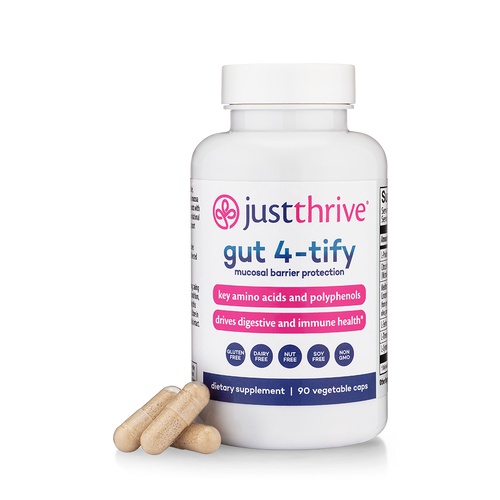
Gut 4-tify helps create a strong, healthy mucosal barrier by supplying four amino acids, L-proline, L-serine, L-cysteine, and L-threonine, that promote mucus production, powerful polyphenols that soothe and strengthen the intestinal lining, and a potent blend of antioxidants to counteract free radicals.
>> Embrace complete, effective gut health today with Just Thrive Probiotic, PREbiotic, and Gut 4-tify.
Not sure if Just Thrive Probiotic, PREbiotic, and Gut 4-tify are right for you? We've got your back!
We’re confident that when you take each of these gut health heroes as directed, you’ll notice positive benefits to your overall health.
But if you aren’t completely happy, let us know. Every Just Thrive purchase comes with our Bottom of the Bottle, 100% money back guarantee. So, if you’re not satisfied with your purchase for any reason, you can request a full product refund at any time. Even if it’s been 3 days… 3 weeks… or 3 months. Even if the bottle is empty!
>> Try Just Thrive Probiotic, PREbiotic, and Gut 4-tify RISK-FREE today, and save 30% on your first month’s subscription with code SUB30.

Sources
- Launholt TL, Kristiansen CB, Hjorth P. Safety and side effects of apple vinegar intake and its effect on metabolic parameters and body weight: a systematic review. Eur J Nutr. 2020 Sep;59(6):2273-2289.
- Yucel Sengun I, Karapinar M. Effectiveness of household natural sanitizers in the elimination of Salmonella typhimurium on rocket (Eruca sativa Miller) and spring onion (Allium cepa L.). Int J Food Microbiol. 2005 Feb 15;98(3):319-23.
- Marzorati M, Van den Abbeele P, Bubeck S, Bayne T, Krishnan K, Young A. Treatment with a spore-based probiotic containing five strains of Bacillus induced changes in the metabolic activity and community composition of the gut microbiota in a SHIME® model of the human gastrointestinal system. Food Res Int. 2021 Nov;149:110676.
- Mao B, Gu J, Li D, Cui S, Zhao J, Zhang H, Chen W. Effects of Different Doses of Fructooligosaccharides (FOS) on the Composition of Mice Fecal Microbiota, Especially the Bifidobacterium Composition. Nutrients. 2018 Aug 16;10(8):1105.
- Azcarate-Peril MA, Ritter AJ, Savaiano D, Monteagudo-Mera A, Anderson C, Magness ST, Klaenhammer TR. Impact of short-chain galactooligosaccharides on the gut microbiome of lactose-intolerant individuals. Proc Natl Acad Sci U S A. 2017 Jan 17;114(3):E367-E375.
- Faure M, Mettraux C, Moennoz D, Godin JP, Vuichoud J, Rochat F, Breuillé D, Obled C, Corthésy-Theulaz I. Specific amino acids increase mucin synthesis and microbiota in dextran sulfate sodium-treated rats. J Nutr. 2006 Jun;136(6):1558-64.
- Dryden GW, Song M, McClain C. Polyphenols and gastrointestinal diseases. Curr Opin Gastroenterol. 2006 Mar;22(2):165-70.
- Stevens Y, Rymenant EV, Grootaert C, Camp JV, Possemiers S, Masclee A, Jonkers D. The Intestinal Fate of Citrus Flavanones and Their Effects on Gastrointestinal Health. Nutrients. 2019 Jun 27;11(7):1464.
- Nakajima VM, Moala T, Caria CREP, Moura CS, Amaya-Farfan J, Gambero A, Macedo GA, Macedo JA. Biotransformed citrus extract as a source of anti-inflammatory polyphenols: Effects in macrophages and adipocytes. Food Res Int. 2017 Jul;97:37-44.


