



By Joanie Blaxter, National Sales Manager for Just Thrive
Quick Answer: The main difference between regular and spore probiotics is survivability. Regular (conventional) probiotics are usually Lactobacillus or Bifidobacterium strains with no protective shell, so most are killed by stomach acid and bile before reaching the gut. Spore-based Bacillus strains have a natural endospore shell that lets them survive digestion and arrive in the gut alive, where they help clean up and rebalance the microbiome. When choosing a probiotic, four questions help separate quality products: What is the third-party gastric survivability rate (tested at pH 1.3)? Has a gut-model colonization study been done? Is the product DNA verified? And in multi-strain formulas, is each strain grown in its own vat to prevent cross-contamination?
What Is the Difference Between a Spore Probiotic and a Regular Probiotic?
The key difference is survivability. Regular probiotics are usually Lactobacillus or Bifidobacterium strains with no protective shell, so most are killed before reaching the gut, while spore-based Bacillus strains have a natural endospore shell that lets them arrive in the gut alive.
When I say "regular" or “conventional,” it is short-hand for what has been sold at the retail level for decades, 95+% of which are multi-strain, Lactobacillus- and/or Bifidobacterium-based formulas.
The way you tell the difference between these two kinds of bacteria is that only spore strains begin with the word "Bacillus." If a strain listed on a label begins with anything else, it is one of the non-spore, more fragile bacteria.
What all regular probiotics have in common is that their bacteria lack any kind of protective shell, making them very delicate and easily killed.
In contrast, the spore Bacillus strains used in Just Thrive evolved over eons to naturally have an endospore shell, the purpose of which is to help the bacteria survive in the extremes of the outer environment. Furthermore, all four strains in Just Thrive have been well studied by microbiologists and categorized as “human gut commensal," meaning they are beneficial to our gut microbiome.
 Want to listen instead of read? CLICK HERE
In a “perfect” world, the earth would always be microbially loaded with these gut commensal spores which, alive but inactive within their shell, would then catch a ride from the soil onto a growing plant to be eaten by an animal… like you and me.
Arriving safely in their home, the intestines, these gut commensal strains immediately remove their shell and spend the next three to four weeks as our gut-cleaners. Slowly moving from the top down, these bacteria kill pathogens and bring balance to the microbial population all along the entire length of the intestinal tract. They literally live to clean up our gut!
Then, just before being excreted, they re-sporulate and, again, in a “perfect” world, would be returned to the soil to start the cycle all over.
Because we are designed by nature to be consuming these strains every day, that is how peak benefits are received: consistent, preferably daily, consumption.
Unfortunately, because we have sterilized our environment, inside and out, including all our food growing and processing systems, the best guarantee for receiving maintenance levels of these critically important strains is currently through supplementation, not plant food.

But don’t non-spore strains survive and colonize?
Generally, no. The strains used in clinical studies are often much stronger than the versions sold commercially, and microbiologists have noted that the bacteria in most conventional Lactobacillus and Bifidobacterium products are largely killed by bile and stomach acid.
People have questioned the idea that conventional probiotic strains are killed, saying they have read studies and articles that contradict that assertion.
Kiran Krishnan, the research microbiologist behind Just Thrive, clarified that question for me. He said that the strains used in clinical studies are generally much stronger than those found in commercial probiotics.
This has to do with both expense and how mass production affects bacteria over time. Technically, the information in those studies is probably accurate, just not transferable to commercially produced strains available for purchase.
That clarification reinforced what I had heard in May of 2016 at a panel discussion at UCLA consisting of two research microbiologists and Sandor Katz, author of the extremely popular DIY fermentation book, Wild Fermentation. All three agreed that the bacteria in both fermented foods and commercial Lactobacillus and Bifidobacterium probiotics were virtually entirely killed by bile and stomach acids.
Then how do regular probiotics provide any benefit at all?
Even when conventional strains do not colonize, the microRNA inside the bacterial cells, whether alive or dead, can be picked up by the living bacteria already in your gut, providing a temporary benefit. That is why a heat-killed strain was found to work as well as a live one against diarrhea in one study.
If conventional strains do not, for the most part, colonize the gut microbiome, how can they help us feel better? Because we have all seen, or experienced, getting some benefit from these strains under some conditions.
To answer that question, in 2009 NIH researchers tested the non-spore strain, Lactobacillus rhamnosus, commonly found in many popular brands because it can be effective against diarrhea.
Surprisingly, when these microbiologists heat-killed the Lactobacillus rhamnosus it was just as effective dead at stopping diarrhea as it was alive.[1]
Why?
When we consume conventional probiotics and fermented foods, our live, permanent microbial residents are clinging to the gut wall and constantly examining the contents of the river of nutrients moving past over the six to eight hours it takes food to travel through the entire digestive tract.
Dead or alive, all bacteria contain microRNA within their body, each strain having its own unique RNA qualities and specific benefits. When the live bacteria see their dead cousins floating by, if they perceive something of benefit, there is a genetic exchange from the dead to the live.
How Do Regular and Spore Probiotics Work Differently in the Gut?
Think of regular probiotics as fertilizer for your gut garden, offering a temporary boost through their microRNA, while spore probiotics act like live gardeners that move through and clean up the whole length of the gut over three to four weeks.
Since it’s the microRNA within the dead microbial bodies that provides the temporary immune benefit, I think of the bacteria in regular probiotics and fermented food as fertilizer for my gut garden.
Consuming Just Thrive Probiotic, however, is like putting live, intelligent, gut-cleaning gardeners in my microbiome. They clean up the entire length of the garden over three to four weeks, killing weeds while also nurturing and increasing the plants we want to thrive.
In contrast to the strains in conventional probiotics, spore Bacillus strains are unbelievably hardy…
- Just Thrive’s strains survived being heated up to 455 F degrees in a clinical study. Yes, you can open the capsule and dump the flavorless powder in your morning joe or bake them into lasagna, and they’ll still survive to colonize your intestines.
- One of the strains in Just Thrive was found in an insect fossilized in amber 25 million years old, still alive! That’s 10x longer than humans have been in existence on the planet!
- Another strain took a ride on the inside of the lens of a NASA spacecraft and survived years in the frigidity of deep space as well as the fiery temps of exiting and re-entering earth’s atmosphere.
Why Is Just Thrive Considered "First" and "Best"?
Just Thrive was the first 100% spore-based Bacillus probiotic brought to the retail market, built on research from the Human Microbiome Project. Its four strains are licensed from a leading spore Bacillus researcher and selected for unusually high gastric survivability.
Just Thrive is based directly on the newest technology and science emerging from the Human Microbiome Project.
However, because the research microbiologist behind Just Thrive was already studying spore Bacillus when that project began in 2008, despite being a full 10 years into research and development, Just Thrive was still the first 100% spore-based Bacillus probiotic to be introduced to the retail market. On the shelves of natural food stores in the Chicago area beginning in 2014, Just Thrive is now carried by select retailers nationwide.
Being ahead of the curve enabled the formulator behind Just Thrive to obtain the licensing rights for all four strains used in Just Thrive from the top spore Bacillus researcher in the world, Dr. Simon Cutting in the U.K. As a result, Just Thrive’s strains are unusually hardy, even compared to other commercial spore Bacillus probiotics, as shown by our unique gastric survival rate of 100% across the board.
This includes the patented, antioxidant-producing Bacillus indicus HU36, possibly the most important of the four because it produces seven antioxidants at far greater levels than can be consumed from food.
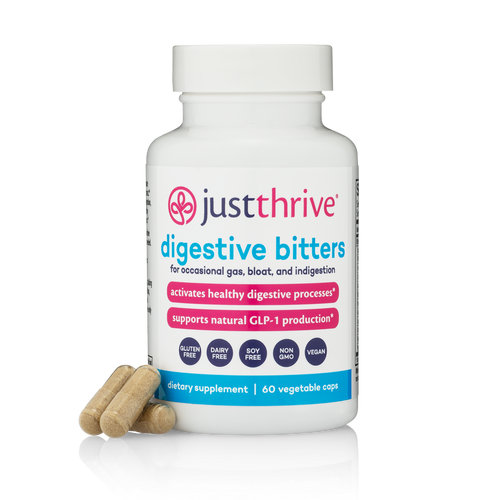
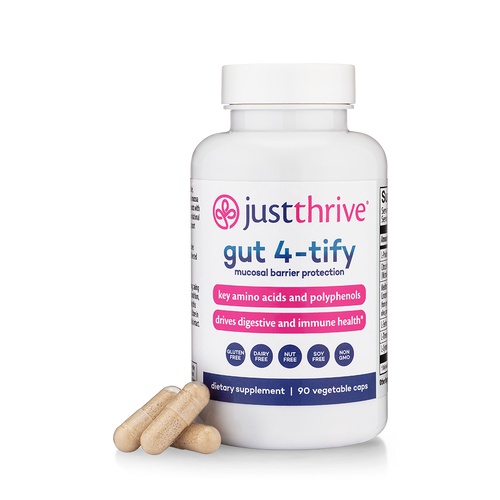
Just Thrive Gut Health Products


What Questions Should You Ask Before Choosing a Probiotic?
Before choosing any probiotic, ask four questions: What is the third-party gastric survivability rate (tested at pH 1.3)? Has a gut-model colonization study been done? Is the product DNA verified? And in multi-strain formulas, is each strain grown in its own vat to prevent cross-contamination?
1. What is your product's third party gastric survivability rate?
You want to make sure that the pH used is 1.3, which is the pharmacopeia standard for gastric survivability. (Some companies try to get around this by using a more alkaline 2 or 3 range which would allow for greater survivability.) Testing at a pH of 1.3 will tell you the exact survival rate of the bacteria through normal stomach and bile acidity.
2. Has a gut model study been done on the strains?
That will clarify whether any bacteria surviving gastric acidity can also successfully adhere to the intestinal wall and colonize. In order to remain in the microbiome, bacteria must be able to bind tightly to particular receptor sites. Lacking that ability, even if alive, they will simply be swept out of the intestines by peristalsis in a matter of a few hours. Simply finding live bacteria in feces is not a guarantee of colonization.
3. Is your product DNA verified?
If so, how often? That will guarantee that the label matches the contents. At that same UCLA panel in 2016 previously mentioned, microbiologist Elaine Hsiao cautioned the audience that when UC researchers tested 16 different probiotics pulled off the shelves in southern CA, only one had contents that actually matched the label.[2]
4. If it is a multi-strain formula, are all the strains grown in the same vat?
Strains grown in a single vat can genetically cross-contaminate. This occurs when different strains grow together, exchange genes, and create a brand-new strain. This previously unseen strain of bacteria would be neither listed on the label, nor ever tested for safety in the human body. The UC testing mentioned above did find this in some of the probiotics they examined, according to Hsiao.
Just Thrive can provide both third party gastric survivability and DNA test results. Furthermore, gut model testing on Bacillus subtilis HU58 and Bacillus Indicus HU36 showed that these strains not only colonized, but also created a 30% improvement in the gut microbiome population in just 14 days at one capsule daily. And all four of our strains are grown in their own separate vats to prevent cross-contamination.
| Feature | Regular (conventional) probiotics | Spore-based (Bacillus) probiotics |
|---|---|---|
| Typical strains | Lactobacillus and/or Bifidobacterium | Bacillus (strain names begin with "Bacillus") |
| Protective shell | None; delicate and easily killed | Natural endospore shell |
| Surviving stomach acid and bile | Largely killed before reaching the gut | Survive to arrive in the gut alive |
| How they help | Temporary benefit, in part via microRNA from dead cells | Colonize, clean up, and rebalance the gut over 3 to 4 weeks |
Frequently Asked Questions About Regular vs. Spore Probiotics
What is the difference between spore and regular probiotics?
Regular probiotics are usually Lactobacillus or Bifidobacterium strains with no protective shell, so most are killed by stomach acid before reaching the gut. Spore-based Bacillus strains have a natural endospore shell that lets them survive digestion and arrive in the gut alive.
How can I tell if a probiotic is spore-based?
Look at the strain names on the label. Spore strains begin with the word "Bacillus." If a strain starts with anything else, such as Lactobacillus or Bifidobacterium, it is a non-spore, more fragile type.
Do conventional probiotics provide any benefit?
They can offer a temporary benefit. Even when the bacteria do not colonize the gut, the microRNA inside the cells can be picked up by living bacteria already there. In one study, a heat-killed strain worked as well as a live one against diarrhea.
What gastric survivability rate should I look for?
Ask for the third-party survivability rate tested at a pH of 1.3, the pharmacopeia standard. Some companies test at a more alkaline pH of 2 or 3 to inflate survivability numbers, so the pH used matters.
Why does it matter if strains are grown in the same vat?
In multi-strain formulas, strains grown together in one vat can exchange genes and create a new, untested strain that is not listed on the label. Growing each strain in its own vat prevents that cross-contamination.
Feel the Just Thrive Difference
Finding the right probiotic can be a lot of work, but now that you know what to look for, you can stop searching and start reaping the benefits of the first and best spore probiotic!
Just Thrive Probiotic is the only probiotic on the market containing not one, but four of the most well-researched, proprietary spore Bacillus strains available that work together synergistically:
- Bacillus indicus HU36™
- Bacillus coagulans (SC-208)
- Bacillus clausii (SC-109)
- Bacillus subtilis HU58™
When it comes to Just Thrive, every bottle, every capsule, contains what the label says it does, so you can trust that you know what you’re getting in every dose.
With their high survivability rate, 1000x better survivability vs. leading probiotics, the Just Thrive spore strains will make it to your gut strong and intact where they get to work cleaning up your gut, ridding it of bad bacteria and nourishing and increasing your good bacteria.
>> Switch to the spore-based Just Thrive Probiotic, and start living your healthiest life.
But if you’re still not sure about trying them… we can help with that.
EVERY Just Thrive purchase is covered by our Bottom of the Bottle, 100% money back guarantee.
So you can try Just Thrive Probiotic to see if it works for you… and we’re confident that it will.
But if for any reason you don’t feel a difference, simply request a full product refund at any time. It doesn’t matter if it’s 3 months or even 3 years later. It doesn’t even matter if the bottle is empty! You’ll get your money back any time, no matter what.

Sources
- Li N, Russell WM, Douglas-escobar M, Hauser N, Lopez M, Neu J. Live and heat-killed Lactobacillus rhamnosus GG: effects on proinflammatory and anti-inflammatory cytokines/chemokines in gastrostomy-fed infant rats. Pediatr Res. 2009;66(2):203-207. doi:10.1203/PDR.0b013e3181aabd4f
- Richards L. Quality control of probiotics is lacking, study suggests. NutraIngredients. November 20, 2015. Accessed April 22, 2025. https://www.nutraingredients.com/Article/2015/11/20/quality-control-of-probiotics-is-lacking-study-suggests/


