




Find out if your probiotic can survive real-life conditions beyond the lab.
With so many probiotic brands and strains available, it can be hard to figure out which one is best for you. Some companies hype up the number of strains… others focus on the billions of CFUs (colony forming units)… and still others highlight “clinically studied” strains.
What matters most though is survivability.
Because it doesn’t matter what kind or how many trillions of probiotics are in the bottle if they’re DOA. You need your probiotics to arrive in your gut alive and able to work. And that makes all the difference.
Quick Answer: The main difference between Lactobacillus and spore-based Bacillus probiotics is survivability. Most store-shelf probiotics use Lactobacillus strains, which can survive digestion under pristine lab conditions but often arrive in the gut weakened or dead after real-world production, shipping, and storage. Spore-based Bacillus probiotics have a protective shell that shields them from heat, cold, acid, and moisture, so they reach the gut alive and intact, then activate and go to work. Studies have found Bacillus strains far more resilient than Lactobacillus, and a four-strain Bacillus combination has shown benefits in human clinical trials. For a probiotic to help, it has to arrive in your gut alive, and that is where spore-based strains stand out.
How Are Lactobacillus and Spore-Based Bacillus Probiotics Different?
Lactobacillus and spore-based Bacillus are both probiotics, but they behave very differently. Lactobacillus strains are the standard probiotics found in most stores, while spore-based Bacillus strains carry a protective shell that helps them survive harsh conditions and reach the gut alive.
Though the names are similar, both containing “bacillus,” Lactobacillus probiotics and spore-based Bacillus probiotics are distinctly different.
The vast majority of probiotics you’ll see in stores contain Lactobacillus strains, also referred to as regular or standard probiotics. Many Lactobacilli have been shown in studies to support gut health and relieve some digestive issues. Many strains of Lactobacillus bacteria exist in your gut microbiome naturally, so it seems like it would make sense to take these strains in supplement form. But in real-life settings, many people don’t get the same results.
Spore-based Bacillus probiotics have protective shells that shield them against harsh conditions to ensure their survival. Once they reach the gut, their shells break down and the probiotics activate and go to work to benefit the gut microbiome, creating a safe environment for other beneficial bacteria to flourish.
The most important difference between these types comes down to one thing… survivability.
 Want to listen instead of read? CLICK HERE
Why Is Probiotic Survival So Important?
Survival matters because a probiotic only works if it reaches your gut alive. The bacteria have to live through production, shipping, and storage, then survive your body temperature, digestion, and stomach acid before they can do anything.
Probiotic bacteria have to be living to be effective. Not just when they’re put into capsules or added to foods. They have to arrive in the gut microbiome alive in order to work their magic.
That means they have to live through production processes, shipping, and storage. Then they have to survive your body temperature, digestion, and stomach acid. Those can be deadly conditions for most probiotics.
So you’ll want to make sure any probiotics you take are proven to survive all of that, and arrive at the gut microbiome alive, intact, and able to work.
But there’s a problem with that: Study results don’t always translate to real life.
Why Do Lactobacillus Probiotics Work in the Lab but Not in Real Life?
Some Lactobacillus strains survive stomach acid in studies, but only under pristine lab conditions. The commercial versions you buy are produced, shipped, and stored for long periods, so by the time they reach you many are weakened or no longer alive.
Some brands of Lactobacillus probiotics are backed by research that shows the strains are resistant to stomach acid. And that may be correct, but only under pristine study conditions.
Standard Lactobacillus probiotic studies often test one probiotic strain at a time. That strain is created in specialized lab conditions. Then, it’s freshly harvested from the fermenter and given to study participants. Under those conditions Lactobacillus probiotics can often survive stomach acid and digestion, making their way to the gut microbiome alive.
But that’s not how things work in everyday life. The Lactobacillus probiotics you buy off the shelf are not fresh from the fermenter. They haven’t been maintained in strict lab conditions. These commercial strains have a very different life cycle.
Commercial Lactobacillus probiotics are produced in large quantities by commodity suppliers, often based in Asia. They’re then stored in a warehouse onsite until they’re transported internationally to manufacturers. Once they reach the manufacturing plant, they’re put in storage again until they’re put into capsules. The probiotics are then stored until they’re shipped to distributors, only to be warehoused again. Eventually, the probiotics make their way to a retail store where they sit on a shelf until you buy them.[1]
By the time you’ve brought them home, it’s unlikely that all of those Lactobacillus probiotics are at full fighting strength. Let alone alive. When these bacteria are tested off the shelf, the results can be disappointingly different… with near zero probiotics surviving. And a scientific study found that most of the probiotic supplements tested off the shelf “do not fulfill the offer of a probiotic supplement” as found on their labels.[2]
Why Do Spore-Based Bacillus Probiotics Outperform the Rest?
Spore-based Bacillus probiotics outperform other types because their protective shells shield them from heat, cold, acid, salt, and moisture. Research has found Bacillus strains far more resilient than Lactobacillus, surviving conditions that kill most other bacteria.
Spore-based probiotics have a distinct advantage over all other probiotics. Their protective shells offer shelter from every kind of harsh environment: excessive heat, below zero temperatures, acid, salt, moisture… the kinds of extremes that kill other types of bacteria. Once the danger passes, the spore shell breaks down and the probiotic bacteria inside spring back to life.
This biological advantage gives spore probiotics the ability to survive almost anything, including the hazards of digestion.[3] Other probiotics, like Lactobacillus bacteria, don’t have the same endurance.
One study looked at Bacillus and Lactobacillus survivability once exposed to simulated digestive tracts.[4] The researchers found that Bacillus strains showed greater viability than the Lactobacillus. They also reported that Bacillus survival rates were always at least 83% under all conditions, including storage and gastrointestinal exposure.
And a cutting-edge study found that Bacillus subtilis was the only probiotic strain that survived a trip to Mars, while the others, including Lactobacillus strains, died.[5]
Even better, a combination of Bacillus probiotics delivers positive results in human clinical trials. The four spore probiotic strains tested included:
- Bacillus indicus HU36™
- Bacillus subtilis HU58™
- Bacillus coagulans (SC-109)
- Bacillus clausii (SC-208)
In one study, participants who got these four spore probiotics saw a 42% reduction in leaky gut markers… while the other group saw a 36% increase.[6]
Another study showed that taking this combination of Bacillus probiotics helped balance after-meal immune responses.[7] Immune system reactions are common after eating, even in healthy young individuals. The probiotics helped the immune system stay calm after meals, improving gastrointestinal and overall health.
Bottom line: Spore probiotics survive. They arrive in your gut microbiome alive and intact. And once there, they get to work cleaning up the entire length of the intestinal tract, killing pathogens while also increasing microbial diversity and promoting the growth of beneficial bacteria.
| Lactobacillus (standard) probiotics | Spore-based Bacillus probiotics | |
|---|---|---|
| Protective shell | No shell | Yes, a tough spore shell |
| Survival through shipping and storage | Often weakened or no longer alive | Stay viable through harsh conditions |
| Surviving stomach acid and digestion | Mostly in lab conditions; results vary off the shelf | Survival rates reported at 83% or higher |
| Arriving in the gut alive and active | Inconsistent in real life | Reach the gut intact, then activate |
Frequently Asked Questions About Lactobacillus and Spore-Based Bacillus
What is the difference between Lactobacillus and Bacillus probiotics?
Lactobacillus strains are the standard probiotics found in most stores, while spore-based Bacillus strains have a protective shell. The biggest practical difference is survivability: Bacillus strains are far more likely to reach the gut alive and intact.
Why do Lactobacillus probiotics often fail in real life?
Lactobacillus strains can survive in pristine lab conditions, but the commercial versions are produced, shipped, and stored for long stretches. By the time they reach you, many are weakened or no longer alive, so they may not deliver the results seen in studies.
Why are spore-based probiotics more resilient?
Spore-based Bacillus probiotics carry a tough shell that protects them from heat, cold, acid, salt, and moisture. Once the harsh conditions pass, the shell breaks down and the bacteria inside spring back to life and go to work in the gut.
What does survivability mean for a probiotic?
A probiotic only works if it arrives in your gut alive. Survivability is the ability to live through manufacturing, shipping, storage, and digestion so the bacteria can reach the gut microbiome intact and active.
Which Bacillus strains are in Just Thrive Probiotic?
Just Thrive Probiotic contains four clinically studied spore strains: Bacillus indicus HU36, Bacillus subtilis HU58, Bacillus coagulans, and Bacillus clausii. This combination supports a balanced, diverse gut microbiome.
Support your best gut health. Try Just Thrive Probiotic today!
Just Thrive Probiotic (30/90)
The only probiotic guaranteed to arrive 100% alive
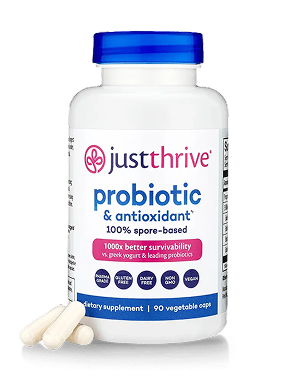


Just Thrive: Probiotics You Can Count on Every Time
Spore probiotics provide what other types of probiotics can’t: 100% survivability. That advantage means Just Thrive Probiotic arrives in your gut microbiome alive and ready to work every time you take them.
Just Thrive Probiotic contains four clinically-studied spore probiotics:
- Bacillus indicus HU36™
- Bacillus subtilis HU58™
- Bacillus coagulans (SC-208)
- Bacillus clausii (SC-109)
This reliable combination supports a balanced gut microbiome full of a diverse population of beneficial bacteria for superior gut health.
Just Thrive Probiotic is available in two convenient forms: classic capsules and tasty fruit-flavored gummies. Both forms contain the same four proven strains so you’ll enjoy the same effectiveness no matter which you choose.
But if you’re not quite sure about trying Just Thrive Probiotic, we can help with that.
EVERY Just Thrive purchase is covered by our Bottom of the Bottle, 100% money back guarantee.
That means you can try Just Thrive Probiotic in either form to see how well it works for you… and we’re betting that you’ll notice a positive difference.
But if for any reason you don’t feel a change, you can ask for a full product refund at any time. Even if it’s 3 months or 3 years later. And even if the bottle is empty!

Sources
- Wendel U. Assessing Viability and Stress Tolerance of Probiotics-A Review. Front Microbiol. 2022 Jan 27;12:818468. doi: 10.3389/fmicb.2021.818468. PMID: 35154042; PMCID: PMC8829321.
- Naissinger da Silva M, Tagliapietra BL, Flores VDA, Pereira Dos Santos Richards NS. In vitro test to evaluate survival in the gastrointestinal tract of commercial probiotics. Curr Res Food Sci. 2021 May 12;4:320-325. doi: 10.1016/j.crfs.2021.04.006. PMID: 34095855; PMCID: PMC8165489.
- Elshaghabee FMF, Rokana N, Gulhane RD, Sharma C, Panwar H. Bacillus As Potential Probiotics: Status, Concerns, and Future Perspectives. Front Microbiol. 2017 Aug 10;8:1490.
- Soares MB, et al. The resistance of Bacillus, Bifidobacterium, and Lactobacillus strains with claimed probiotic properties in different food matrices exposed to simulated gastrointestinal tract conditions. Food Res Int. 2019 Nov;125:108542.
- Fajardo-Cavazos P, Nicholson WL. Shelf Life and Simulated Gastrointestinal Tract Survival of Selected Commercial Probiotics During a Simulated Round-Trip Journey to Mars. Front Microbiol. 2021 Oct 7;12:748950.
- McFarlin BK, Henning AL, Bowman EM, Gary MA, Carbajal KM. Oral spore-based probiotic supplementation was associated with reduced incidence of post-prandial dietary endotoxin, triglycerides, and disease risk biomarkers. World J Gastrointest Pathophysiol. 2017 Aug 15;8(3):117-126. doi: 10.4291/wjgp.v8.i3.117. PMID: 28868181; PMCID: PMC5561432.
- McFarlin BK, Deemer SE, Bridgeman EA. Oral Spore-Based Probiotic Supplementation Alters Post-Prandial Expression of mRNA Associated with Gastrointestinal Health. Biomedicines. 2024 Oct 18;12(10):2386. doi: 10.3390/biomedicines12102386. PMID: 39457699; PMCID: PMC11504401.


