



Digestive bitters have been used for centuries to help support healthy digestion. Traditionally, they’ve been taken as bitter-tasting herbal tinctures taken before a meal. But that tradition has led to a common question: do you actually need to taste the bitter flavor for them to work?
While the bitter taste itself can help trigger digestive responses, it’s not the only way bitter compounds interact with the body.
Capsules and tinctures each have their own strengths, and while they work a little differently, tasteless capsules can also contribute to healthy digestion. The best choice for you depends on a combination of factors, including the formula, your goals, and what you’ll actually take consistently.
Here’s what the science says about digestive bitters, whether you need to taste them to experience their benefits, and what might work best for your body.
Quick Answer: Digestive bitters can support healthy digestion whether they're taken as traditional liquid tinctures or convenient capsules. While tasting bitter herbs may help trigger early digestive responses through receptors on the tongue, similar bitter receptors are also found throughout the digestive tract, allowing capsules to interact with the body after they're swallowed. Both delivery methods may help support the release of digestive enzymes, stomach acid, and bile, contributing to healthy digestion and nutrient absorption. The best digestive bitters are those with well-studied herbal ingredients in a format you'll take consistently as part of your daily routine.
Why Do People Think You Have to Taste Bitters for Them to Work?
The idea that these digestive supporters have to be tasted to be effective comes from their very name: bitters. These herbal formulas are made with naturally bitter plants and herbs, including gentian, dandelion, and dong quai. For centuries, digestive bitters have been taken as a liquid tincture, or occasionally in a tea, shortly before a meal so the bitter taste comes into contact with receptors on the tongue.1
The body’s reaction to bitter flavors is often noticeable: a quick increase in saliva. This early response, known as the cephalic phase of digestion, may help stimulate the digestive process even before you take your first bite.2 It’s also one of the reasons why so many people believe the bitter taste itself is essential to unlocking their benefits.
But while tasting bitters may be one way to support digestion, it isn’t necessarily the only way…
 Want to listen instead of read? CLICK HERE
Do Bitter Compounds Only Work in the Mouth?
No! Bitter taste receptors on the tongue might be the first to detect bitterness, and they certainly play an important role in preparing the body for digestion.
However, these receptors (known as taste receptors type 2 or TAS2Rs) can be found throughout the digestive tract, including in the stomach and intestines.3 This means that bitters may continue interacting with the body after they’ve been swallowed.
How do these receptors respond to bitters?
Research indicates that digestive bitters can:4,5
- Stimulate the production of stomach acid, digestive enzymes, and bile, which help break down food
- Aid healthy digestion and may help ease occasional digestive discomforts such as bloating and indigestion
- Contribute to nutrient absorption by breaking down food so your body can easily access essential vitamins, minerals, and other nutrients
- Promote feelings of satiety (fullness) after meals
- Supports healthy bile production in the liver, which plays an important role in digesting dietary fats
Of course, this doesn’t mean that every bitter supplement works the same way.
Different herbs have different results. The bitter flavor can contribute to early digestive signaling, but it's only one part of a much larger picture. The delivery method also plays a role in how digestive bitters support digestive health.
How Can Bitter Capsules Support Digestion?
Bitter capsules support digestion by delivering bitter herbs directly to the digestive tract. Once there, they may interact with receptors in the digestive tract without first being tasted.
Because they don’t trigger the same initial taste response as a liquid tincture, it’s easy to think that bitter capsules aren’t working. However, they may still support digestion, just in a different way.
Digestive bitter capsules bypass the TAS2Rs on your tongue. Instead, they work through the gastrointestinal receptors in your digestive system. While traditional tinctures stimulate a response through taste, bitter capsules stimulate a response when they dissolve.
So while tasting bitters is one potential pathway to experience their benefits, it’s not the only one.
Instead of thinking capsules can't work because you don’t taste them, it's more helpful to view tinctures and capsules as two different, yet effective, approaches to delivering bitter herbs. Understanding those differences starts with looking at what each format is designed to do.

Tinctures vs. Capsules: What’s The Real Difference?
The biggest difference between tinctures and capsules is how they deliver bitter herbs to the body. Neither one of these is “better” than the other, and each offers unique advantages.
If you’re trying to choose the best digestive bitter supplement for you, there are distinctions between the two you might want to consider.6
Bitter Tinctures:
- Are the more traditional form of bitters
- Interact with your taste buds even before they are swallowed
- May help stimulate early digestive signaling, through bitter taste receptors on the tongue
- Are typically taken shortly before a meal
Bitter Capsules:
- Deliver bitter herbs without exposing them to the taste buds
- Interact with the digestive tract after they are swallowed and broken down
- May take longer to process
- Are often a more convenient option that fits easily into a daily routine
While they may not work in exactly the same way, it’s important to choose the option that fits your needs and that you’ll actually take.
When Might Bitter Capsules Be a Better Option?
The best digestive bitters supplement for you is the one that you’ll use consistently. Many people dislike the bold, bitter flavor of a tincture, finding it unpleasant enough to leave in the medicine cabinet, untouched. And when it comes to digestive support, consistency matters.
Bitter capsules might be a better option if you:
- Are put off by intensely bitter or herbal flavors
- Want a pre-measured, easy-to-take supplement
- Need something that’s convenient for travel
Regardless of whether you choose a tincture or a capsule, the formula itself also matters. The specific herbs and how they’re combined can have just as much impact as the delivery method itself.
How to Choose the Right Bitter Supplement
The best bitter supplement for you is one that you’ll take regularly and contains effective, clinically studied ingredients. Sure, the delivery method matters, but that’s only one piece of the puzzle. There’s much more to consider when choosing a bitters supplement.
When comparing options, here are some things to keep in mind:
- Taste: Unless you enjoy intensely herbal flavors, a tincture might not be your best option.
- Ingredients: Look for quality formulas with traditional bitter herbs that have long been used to support digestion. This could include dandelion root, ginger, dong quai, hops flower, gentian root, peppermint, and bitter melon.7-11
- Formula: Supplements that contain a wider variety of complementary herbs might offer broader digestive support than those with a single ingredient.
- Purpose: Some bitters are designed to prepare the digestive system for food. Others might offer more general digestive support. Choose a supplement that is best aligned with your health goals.
- Your preferences and lifestyle: Digestive bitters, like any other supplement, will only become part of your daily routine if they fit into your life. Convenience, taste, and other factors can help you determine whether a particular supplement is truly the best fit.
If you prefer the convenience of capsules, a thoughtfully formulated bitter supplement can fit easily into a daily digestive wellness routine without the strong taste of a traditional tincture.
Frequently Asked Questions
Just Thrive Gut Health Products


How to Add Digestive Bitters to Your Daily Routine
Adding digestive bitters to your daily routine doesn’t have to mean measuring out a tincture before every meal. And it certainly doesn’t have to mean struggling through an unpleasant bitter taste!
The best bitter supplement? The one you’ll stick with consistently, so you can support your digestive health every day.
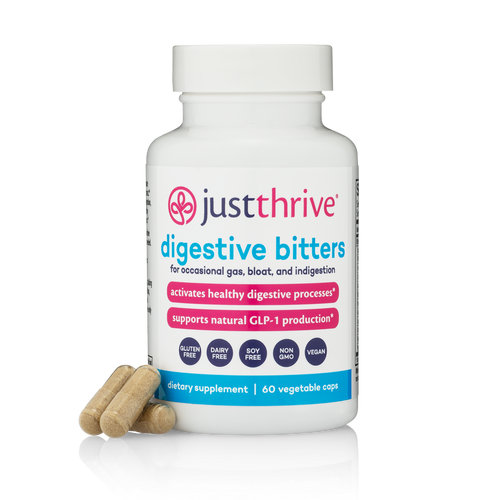
Just Thrive Digestive Bitters helps support healthy digestion, promote nutrient absorption, and ease occasional digestive discomfort, without the bitter flavor of a tincture.
Every Digestive Bitters capsule contains not one, not two, but 12 clinically studied herbs, including:
- Bitter Melon
- Dandelion Root
- Dong Quai (root)
- Chinese Gentian Root Extract
- Ginger Root/Rhizome Extract
- Hops Flower Extract
- Peppermint (leaf)
- And other widely studied traditional bitter herbs
All in a convenient capsule. No measuring, no risk of spills. Just a supplement that you can easily take with you even when you’re traveling or eating out, keeping you on track and consistent.
>> Support healthy digestive function with Digestive Bitters.
Not sure if Digestive Bitters will work for you? We can help.
Every Just Thrive purchase is backed by our Bottom of the Bottle, 100% money back guarantee. So you can try Digestive Bitters to see if it works for you.
But if for any reason you don’t feel a difference, you can ask for a full product refund at any time. Even if it’s been 3 weeks, 3 months, or 3 years… Even if the bottle is empty.

Sources
- Czerwony B. What to Know Before You Try Digestive Bitters. Cleveland Clinic. Published March 7, 2022. Accessed July 20, 2026. https://health.clevelandclinic.org/digestive-bitters
- Martin LE, Nikonova LV, Kay KE, Torregrossa AM. Altering salivary protein profile can increase acceptance of a novel bitter diet. Appetite. 2019;136:8-17. doi:10.1016/j.appet.2019.01.011.
- National Institutes of Health. Detailed structure of bitter taste receptor revealed. NIH Research Matters. Published April 30, 2024. Accessed July 20, 2026.
- Rezaie P, Bitarafan V, Horowitz M, Feinle-Bisset C. Effects of Bitter Substances on GI Function, Energy Intake and Glycaemia-Do Preclinical Findings Translate to Outcomes in Humans?. Nutrients. 2021;13(4):1317. Published 2021 Apr 16. doi:10.3390/nu13041317
- Zuluaga G. Potential of Bitter Medicinal Plants: A Review of Flavor Physiology. Pharmaceuticals (Basel). 2024;17(6):722. Published 2024 Jun 3. doi:10.3390/ph17060722
- Li L, Dong R, Feng S, Huang Y, Li X, Que H, Li H, Wang P, Fey L-K, Zhang Y, et al. Bitter Chinese Herbal Medicine Exerts Pharmacological Effects via TAS2Rs: A Systematic Review from Natural Ligands to Therapeutic Potential. International Journal of Molecular Sciences. 2026; 27(7):3073.
- Li Y, Chen Y, Sun-Waterhouse D. The potential of dandelion in the fight against gastrointestinal diseases: A review. J Ethnopharmacol. 2022;293:115272. doi:10.1016/j.jep.2022.115272
- Aregawi LG, Zoltan C. Ginger's nutritional implication on gastrointestinal health. Clin Nutr Open Sci. 2025;61:1-13. doi:10.1016/j.nutos.2025.02.008
- Fang L, Xiao XF, Liu CX, He X. Recent advance in studies on Angelica sinensis. Chin Herb Med. 2012;4(1):12-25. doi:10.3969/j.issn.1674-6384.2012.01.004
- Chumpitazi BP, Kearns GL, Shulman RJ. Review article: the physiological effects and safety of peppermint oil and its efficacy in irritable bowel syndrome and other functional disorders. Aliment Pharmacol Ther. 2018;47(6):738-752. doi:10.1111/apt.14519
- Chang CI, Cheng SY, Nurlatifah AO, et al. Bitter Melon Extract Yields Multiple Effects on Intestinal Epithelial Cells and Likely Contributes to Anti-diabetic Functions. Int J Med Sci. 2021;18(8):1848-1856. Published 2021 Feb 24. doi:10.7150/ijms.55866


