



Here’s what you need to know before you buy
There’s a new trend in gut health: synbiotics. These combo products include probiotics and prebiotics, both foundational for a healthy gut microbiome.
The idea is that the combination makes the individual ingredients work better. And that you’ll have fewer supplements to take.
Sounds like a great idea…
But just because two products are used similarly doesn’t mean they’re a perfect pairing. Like shampoo plus conditioner. Or combination washer-dryers. The standalone products just work better.
As for synbiotics? Let’s take a closer look.
Quick Answer: A synbiotic is a single supplement that combines probiotics and prebiotics, on the theory that pairing them makes both work better. In practice, the research does not back that up. Studies that compare synbiotics against the separate ingredients tend to find that probiotics and prebiotics taken on their own deliver stronger, more consistent results. Common reasons include too little prebiotic in the capsule, not enough room for therapeutic levels of both, and poorly matched ingredient pairs. The takeaway: separate, high-quality probiotics and prebiotics generally work better than a combined synbiotic, and you can still take them at the same time.
What Is a Synbiotic?
Quick Answer: A synbiotic is a supplement that includes both probiotics and prebiotics in a single capsule, on the theory that combining them gives your gut the benefits of both at once.1 Whether that theory holds up in practice is the real question.
Another supposed benefit: Combining the two gives the probiotics a better shot at survival. And since most commercial probiotics die off before they ever get to your gut, this strategy could help change that. At least in theory.
But a lot depends on exactly what’s in the capsule.
There are two main kinds of synbiotics: complementary and synergistic.2
Complementary synbiotics dominate the field. This is a combination of probiotics and prebiotics that work well independently and hopefully work well together.
Synergistic synbiotics, much rarer (at least so far) try to include prebiotics that are known to support the particular probiotics.
Either way, the point is for everything in the capsule to work at least as well in the gut as if they’d been taken separately. And hopefully even more effectively.
 Want to listen instead of read? CLICK HERE
Why Do You Need Both Probiotics and Prebiotics?
Quick Answer: Your gut needs probiotics to supply beneficial bacteria and prebiotics to feed them. Probiotics create a positive environment for good bacteria, while prebiotics provide their preferred food, so the two work best as a pair.
Your gut microbiome contains trillions of bacteria. In a healthy gut, a diverse population of beneficial probiotic bacteria vastly outnumbers harmful pathogens.
But when the gut becomes imbalanced, pathogens overgrow and dominate, a condition called dysbiosis. They interfere with all of the benefits of probiotic bacteria, and at the same time damage your health. The longer your gut stays out of balance, the higher your risk of developing longer lasting issues.
To keep beneficial bacteria in control, your gut microbiome needs constant support. That comes in the form of supplemental probiotics and prebiotics.
Probiotic supplements help create a positive environment for a variety of beneficial bacteria in your gut.
Prebiotics nourish probiotics, providing them with their favorite food.
That’s why your gut needs both probiotics and prebiotics to stay in optimal balance.
Where Do Synbiotics Fall Short?
Quick Answer:Synbiotics often fall short because a single capsule rarely has room for therapeutic levels of both ingredients, the prebiotic amount can be too small to help, and the probiotic and prebiotic may not be matched to work together.
Synbiotics are new on the gut health scene. And they still have a long way to go to prove themselves. While the idea of combining probiotics and prebiotics seems sound, there are problems that still need to be solved.
Here are some of the ways synbiotics fall short of the effectiveness of probiotics and prebiotics taken separately:3
- Some prebiotic and synbiotic products include only small amounts of prebiotic ingredients, likely too little to offer real health benefits. This is often done to minimize digestive discomfort and possibly to cut costs.4
- There’s not enough room to include therapeutic levels of both probiotics and prebiotics.
- Many synbiotics mix probiotics and prebiotics that don’t work well together. If the prebiotic isn’t the right food for the probiotic, they won’t help each other, or you, very much. True synergy requires careful matching and scientific rationale, which is often lacking in commercial formulations.3
Most of the research into synbiotics doesn't compare their effectiveness against their individual ingredients. And the studies that do consistently show that the individual components are far more effective than the synbiotic combinations.
For example, research shows that probiotics have a positive effect on IBS (irritable bowel syndrome), but synbiotics “did not appear to reduce symptoms.”5
One study found that probiotics helped ease constipation, while synbiotics that contained the same probiotic species did not.2 Another study showed that individual probiotics and prebiotics improved gut barrier function in obese adults but not when they were combined in a synbiotic formula.6
And a 6-month clinical trial that included 120 pre-diabetes patients found that probiotics improved gut microbiome balance but synbiotics had no significant effect.7
Bottom line: Separate probiotics and prebiotics deliver positive health benefits. Synbiotics need more work to get there.

Why Do Probiotics and Prebiotics Work Better Separately?
Quick Answer: Taken separately, you can dose each at effective levels and choose the best types of both, such as spore probiotics paired with prebiotic fibers that feed only beneficial bacteria. That flexibility is hard to achieve inside one combined capsule.
Both probiotics and prebiotics have a long history of proven effectiveness. There are literally thousands of studies demonstrating the many health benefits of probiotics and prebiotics.
And while probiotics and prebiotics do work better together, they actually work better when taken separately. Especially if you choose the most effective types of both.
Spore probiotics, such as Bacillus subtilis and Bacillus coagulans, have a distinct advantage over other probiotics. Their protective endospore shells allow them to survive extremely harsh environments like the fluctuating temperatures during transit to stores (or to you) and your digestive system (including stomach acid). These probiotics only shed their shells once they reach the specific conditions they find favorable, your gut microbiome, arriving 100% alive and ready to spring into action.
When they arrive in your gut, spore probiotics quickly begin to claim space, crowding out unwanted bacteria strains. They create a safe environment where diverse strains of native probiotic bacteria can flourish.
To function at their peak though, the probiotic bacteria in your gut need nourishment, and they get that from prebiotics. The trick is to supply them with prebiotics that undesirable bacteria won’t eat, but probiotics love. That includes these specific types:
- Kiwifruit powder (pectic polysaccharide and complex dietary fiber)
- Galactooligosaccharides (GOS)
- Xylooligosaccharides (XOS)
These prebiotics preferentially feed only probiotic bacteria, giving them their best chance to grow and multiply.
With the right spore probiotics and prebiotics, your gut microbiome has its best chance of remaining healthy and balanced. And while you don’t want them to be together in a single capsule, you can take them at the same time.
| Consideration | Synbiotic (combined capsule) | Separate probiotic + prebiotic |
|---|---|---|
| Room for therapeutic amounts of both | Limited; often too little prebiotic | Each can be dosed at meaningful levels |
| Ingredient matching | Pairs may not work well together | You can choose strains and fibers that fit |
| Research support vs. the alternative | Studies often show no added benefit | Separate components tend to perform better |
| Taking them at the same time | Built into one capsule | Still possible; just two products |
Just Thrive Core Health Products

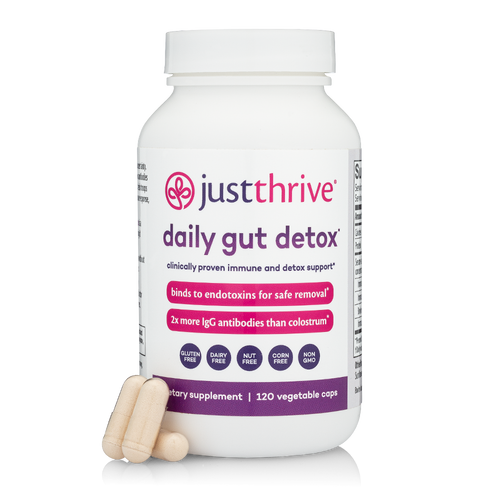
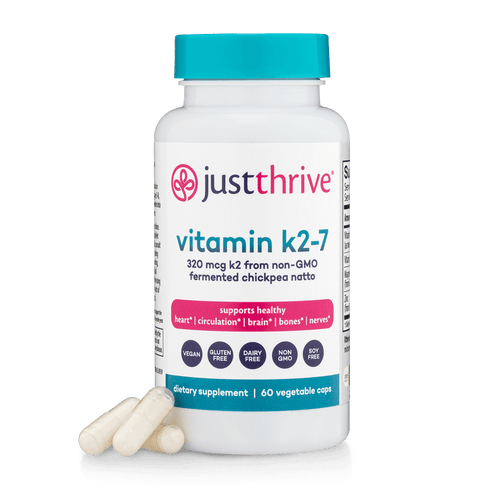

Get Superior Probiotic and PREbiotic Support with the Core Health Bundle
A healthy gut needs constant maintenance. Probiotics and prebiotics supply just what your gut needs to host a diverse population of beneficial bacteria. And you can get that with Just Thrive Probiotic and PREbiotic… the two supplements in our Core Health bundle.
The Core Health bundle includes:
Just Thrive Probiotic, which contains four spore probiotics, proven to work together to encourage a diverse population of beneficial gut bacteria. These clinically studied strains include:
- Bacillus subtilis HU58™
- Bacillus indicus HU36™
- Bacillus coagulans
- Bacillus clausii
Just Thrive PREbiotic, which contains organic kiwifruit powder (Actazin®), GOS (Bimuno®), and XOS (PretiX™), three types of prebiotic fiber proven to nourish only beneficial gut bacteria.
And if you’re not quite sure Core Health is right for you? We've got you covered!
We’re confident that when you use our probiotic and prebiotic as directed, you’ll notice a positive difference.
But if you aren’t completely happy, let us know.
Every Just Thrive purchase comes with our Bottom of the Bottle, 100% money back guarantee. If you’re not satisfied with your purchase for any reason, you can request a full product refund at any time.
Even if it’s been 3 days… 3 weeks… or 3 months. Even if the bottle is empty!

Sources
- Yadav M, Sehrawat N, Sharma AK, et al. Synbiotics as potent functional food: recent updates on therapeutic potential and mechanistic insight. J Food Sci Technol. 2024;61(1):1-15. doi:10.1007/s13197-022-05621-y
- Kleerebezem M, Führen J. Synergistic vs. complementary synbiotics: the complexity of discriminating synbiotic concepts using a Lactiplantibacillus plantarum exemplary study. Microbiome Res Rep. 2024;3(4):46. Published 2024 Sep 4. doi:10.20517/mrr.2024.48
- Gomez Quintero DF, Kok CR, Hutkins R. The Future of Synbiotics: Rational Formulation and Design. Front Microbiol. 2022;13:919725. Published 2022 Jul 22. doi:10.3389/fmicb.2022.919725
- Roy S, Dhaneshwar S. Role of prebiotics, probiotics, and synbiotics in management of inflammatory bowel disease: Current perspectives. World J Gastroenterol. 2023;29(14):2078-2100. doi:10.3748/wjg.v29.i14.2078
- Keulers L, Dehghani A, Knippels L, et al. Probiotics, prebiotics, and synbiotics to prevent or combat air pollution consequences: The gut-lung axis. Environ Pollut. 2022;302:119066. doi:10.1016/j.envpol.2022.119066
- Krumbeck JA, Rasmussen HE, Hutkins RW, et al. Probiotic Bifidobacterium strains and galactooligosaccharides improve intestinal barrier function in obese adults but show no synergism when used together as synbiotics. Microbiome. 2018;6(1):121. Published 2018 Jun 28. doi:10.1186/s40168-018-0494-4
- Kassaian N, Feizi A, Rostami S, Aminorroaya A, Yaran M, Amini M. The effects of 6 mo of supplementation with probiotics and synbiotics on gut microbiota in the adults with prediabetes: A double blind randomized clinical trial. Nutrition. 2020;79-80:110854. doi:10.1016/j.nut.2020.110854


