



Low energy… Extra discomfort… Strange itchiness… Unusual mood disturbances.
Every now and then, this is just a normal part of being a dog. But if these issues last longer then seems normal, they may be a red flag.
This can be perplexing, especially if the persistent issue seems to have no obvious cause.
If your dog is dealing with a strange health or behavioral challenge, the answer you both are looking for might be found by going with their gut…
More specifically, their “leaky” gut.
As it turns out, many different discomforts – from GI issues to bad behavior – can often be attributed to leaky gut in your pup.
That’s why understanding leaky gut can be the first step toward giving your dog the right support she/he needs.
Quick Answer: Leaky gut in dogs happens when the intestinal lining (the gut barrier) becomes damaged and overly porous, letting toxins, undigested food, and pathogens slip into the bloodstream. Common triggers include processed foods, antibiotics and other medications, pesticides, environmental toxins, gut infections, and dysbiosis (an imbalance of gut bacteria). Because so much of a dog's immune system lives in the gut, the resulting inflammation can show up almost anywhere, which is why the 8 signs range from digestive upset and skin issues to fatigue and behavior changes. Supporting a healthy gut barrier and a balanced gut microbiome, including with a dog-specific spore probiotic, is the most lasting way to help.
What Is Leaky Gut in Dogs?
Leaky gut is when your dog's intestinal lining, the gut barrier, becomes damaged and too porous. That lets toxins, undigested food, and pathogens leak into the bloodstream, where they can trigger inflammation and symptoms throughout the body.
Your dog’s intestines come with a special mucosal lining called the gut barrier. This protective barrier acts like a filter, allowing nutrients to reach the bloodstream while keeping pathogens, undigested food particles, parasites, viruses, and toxins out.
Unfortunately, your dog’s gut barrier is VERY sensitive and can be damaged by things like:
- Artificial or highly processed foods
- Antibiotics and other medications, like NSAIDs and steroids
- Pesticides – like glyphosate – that linger in soil, water, and air
- Flea and tick treatments that contain pesticides
- Environmental toxins, like household cleaners or heavy metals
- Gut infections
- Dysbiosis, a condition caused by the overgrowth of harmful bacteria in your dog’s gut
When the gut barrier gets damaged, all of those toxins and bad actors leak out, escaping through the broken gut lining and pool into the bloodstream. And once they enter your dog’s circulation, they can cause damage anywhere in their body.
Your dog’s immune system will respond to these unwanted substances and do its best to defend against them. But oftentimes this results in an unhealthy, system-wide inflammatory response that triggers many other symptoms.
The symptoms may come on suddenly, and will often seem to have no logical cause and effect.
That’s why, in order to best support your pup, it’s important to become familiar with the many signs of leaky gut in dogs.

What Are the 8 Signs of Leaky Gut in Dogs?
The 8 common signs of leaky gut in dogs are digestive problems, new food allergies, skin issues like hotspots and rashes, joint pain, wheezing or trouble breathing, unusual fatigue, behavior changes such as aggression or separation anxiety, and sudden appetite or weight changes. Having more than one makes leaky gut more likely.
If your pup has leaky gut, they’re probably suffering from at least one – and probably more – of these “mysterious cause” symptoms:
- Digestive problems, like diarrhea, vomiting, gas, and bloating
- Food allergies, especially new ones
- Skin problems, like hotspots and rashes
- Joint pain and tenderness
- Wheezing or trouble breathing
- Unusual fatigue and low energy
- Behavior issues, like aggression or separation anxiety
- Sudden appetite changes or unusual weight gain or loss
These symptoms often point toward a leaky gut… but it can be very hard for even your vet to properly diagnose.
That’s partly because these symptoms may seem to have other causes, and partly because the symptoms can shift – for example, itchy skin can disappear but be replaced by fatigue or joint pain.
But the longer leaky gut goes untreated, the more intense your dog’s discomfort will become.
That's why the best way to help your dog is to proactively support a healthy gut barrier and a healthy gut microbiome.
How Does Dysbiosis Cause Leaky Gut?
Dysbiosis is an imbalance where harmful bacteria outnumber beneficial ones in your dog's gut. As those pathogens multiply, the toxins they produce can damage the gut barrier and create the micro-tears that lead to leaky gut.
Your dog has a gut microbiome (similar to yours) that plays a huge role in their health… and not just their gut health.
When your pup’s gut microbiome is in healthy balance, it contains trillions of beneficial (probiotic) bacteria in many different varieties – and much fewer harmful bacteria (pathogens).
Beneficial bacteria produce many enzymes and health-supportive compounds that protect and preserve a strong gut barrier. Plus, since 70-80% of your dog’s immune system is in their gut, those probiotic bacteria help to keep your dog feeling their best.
But when there’s an imbalanced microbiome, and pathogens greatly outnumber probiotic bacteria, your dog’s gut falls into a state of dysbiosis (the imbalance of gut bacteria). As the pathogens multiply, the toxins they produce attack the mucosal gut barrier creating micro tears that ultimately lead to a leaky gut.
Fortunately, you can help keep your dog’s gut microbiome in proper balance and support healthy gut barrier function with specially formulated probiotics.
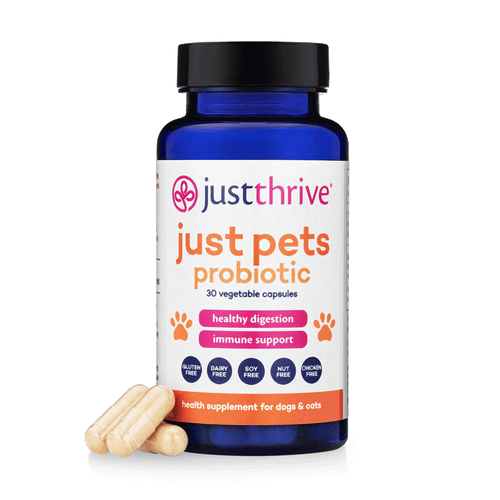
Just Thrive Pet Health Products
What Probiotics Are Best for Dogs?
Dogs need probiotics formulated for their own microbiome, not human ones. A dog-specific spore probiotic can help maintain a healthy balance of gut bacteria and support gut barrier function.
We share a lot with our dogs – walks, snuggles, sofas, and sometimes “people” food. But when it comes to probiotics, yours won’t do. So you’ll want to use probiotic supplements specifically formulated for dogs’ microbiomes.
Scientific studies show that giving proper probiotics to dogs can help maintain a healthy balance of gut bacteria and support optimal gut barrier function.
In fact, a specially formulated spore probiotic supplement for dogs demonstrated exciting results when it was clinically studied in dogs experiencing diarrhea and vomiting. Researchers tested a dog-focused supplement containing two probiotic strains: Bacillus subtilis and Pediococcus acidilactici. They gave the supplement to 11 dogs – some healthy, some with GI distress – for 30 days… with stunning results:
- GI issues were addressed
- Leaky gut markers dramatically fell
- Flatulence was reduced in healthy dogs
- No healthy dogs experienced adverse reactions
The right kind of pet probiotic has the potential to maintain healthy balance in the gut microbiome and support the strength of the gut barrier for your dog. And a clinically proven spore probiotic can work wonders in keeping your pup feeling their best.
Frequently Asked Questions About Leaky Gut in Dogs
What is leaky gut in dogs?
Leaky gut is when a dog's intestinal lining (the gut barrier) becomes damaged and more porous than normal. That allows toxins, undigested food particles, and pathogens to pass into the bloodstream, where they can spark a system-wide inflammatory response.
What are the signs of leaky gut in a dog?
Common signs include digestive problems, new food allergies, skin issues like hotspots and rashes, joint pain, wheezing, unusual fatigue, behavior changes, and sudden appetite or weight changes. The symptoms can shift over time and often seem to have no clear cause.
What causes leaky gut in dogs?
The gut barrier can be damaged by processed foods, antibiotics and medications such as NSAIDs and steroids, pesticides like glyphosate, flea and tick treatments, environmental toxins, gut infections, and dysbiosis (an imbalance of gut bacteria).
Can probiotics help a dog with leaky gut?
Probiotics formulated for dogs can help maintain a healthy balance of gut bacteria and support gut barrier function. In one clinical study, a dog-specific spore probiotic was associated with improvements in leaky gut markers and GI symptoms.
Can I give my dog my own probiotic?
No. Human probiotics are formulated for the human microbiome, so they are not the right fit for dogs. Choose a probiotic supplement made specifically for a dog's gut.
Keep Your Dog’s Gut Happy with Just Pets Probiotic
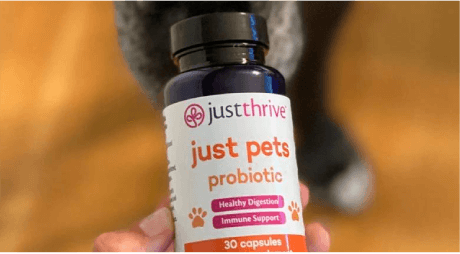
Just Pets Probiotic contains Bacillus subtilis and Pediococcus acidilactic, two strains of probiotics proven effective for supporting your dog’s gut.
Adding just one capsule to your dog’s food daily can help:
- Maintain optimal balance in the gut microbiome
- Promote a healthy digestive system
- Drive a healthy immune function
- Support a strong gut barrier
To help your dog put their best paw forward, treat them to Just Pets Probiotic today.


