



Most people don’t know this. But when you think about it, it definitely makes sense...
Your oral health and your gut health are directly connected. And that influence goes both ways.
Poor oral health can mess up your gut health. Poor gut health can undermine your gums and teeth.
You can’t completely fix one without fixing the other.
Luckily, there are things you can do to support both oral and gut health at the same time.
Quick Answer: Your mouth and your gut are directly connected through what scientists call the "gum-gut axis," and the influence goes both ways. Poor oral health can let pathogenic bacteria travel into the gut and disrupt its balance, while gut dysbiosis can weaken the immune system and affect the gums and teeth. The two largest microbiomes in the body, your oral and gut microbiomes, do best when beneficial bacteria outnumber pathogens. You can support both at once with good oral hygiene, a healthy diet, key nutrients like vitamins D and K2, and spore-based probiotics that help maintain microbiome balance.
How Are Your Mouth and Gut Connected?
Your mouth and gut are home to the two largest microbiomes in your body, and they are directly connected through the “gum-gut axis.” When either falls out of balance, it can negatively affect the other.
Both your mouth and your gut contain vast, diverse communities of bacteria. These microbiomes are the two largest in your body. And when they’re in positive balance, where beneficial bacteria greatly outnumber pathogens, they contribute to oral, gut, and overall health.[1]
These two microbiomes are directly connected and interact in many important ways through what scientists are calling the “gum-gut axis.”[2] And when either of them falls out of balance, a condition called dysbiosis, it affects the other negatively.[3]
With poor oral health, pathogenic bacteria get into the bloodstream through diseased gums. They also flow down the digestive tract and can colonize in the gut microbiome, triggering dysbiosis there.[4] That can bring on problematic gut issues or potentially worsen any that already exist.[5]
On the flip side, gut dysbiosis can negatively impact oral health. In times of gut dysbiosis, pathogenic bacteria can overload the immune system. Those pathogens also eat away at the protective mucosal gut barrier to cause leaky gut, allowing harmful bacteria to escape the gut and travel throughout the body… including to the oral microbiome. That overgrowth of pathogens can trigger inflammatory processes as the immune system tries to get them under control. And that reaction can trigger or worsen gum problems.
 Want to listen instead of read? CLICK HERE
Can an Unbalanced Gut Affect Your Oral Health?
Yes. When the gut is out of balance, it can interfere with immune responses and allow pathogenic bacteria to reach the oral microbiome, contributing to factors associated with unhealthy gums and a higher risk of tooth decay.
When your gut microbiome is out of balance and overgrown with harmful pathogens, it causes problems all over the body. Since up to 80% of your immune system is housed in your gut, dysbiosis can interfere with proper immune system responses.[6] Plus, leaky gut allows for translocation of pathogenic bacteria… which can end up in the oral microbiome. In these ways, gut dysbiosis can contribute to factors associated with unhealthy gums.
Research also shows that the presence of pathogenic bacteria in the gut increases the risk of tooth decay.[7] And weakened immune responses brought on by dysbiosis may contribute to bad breath and other oral health challenges.
Gut dysbiosis can also initiate a vicious cycle of continuing gut and oral microbial imbalances. And gum disease can keep that cycle going.
How Does Gum Health Affect Gut Health?
Problems with the gums are linked to whole-body issues, including a less balanced gut microbiome and digestive discomfort. Research suggests poor oral health may be associated with fewer gut bacteria that make beneficial short-chain fatty acids.
There’s a lot of research linking problems with the gums to whole-body issues.[8] That includes undermining a balanced gut microbiome and contributing to digestive discomfort.
Research suggests that oral health may be linked to differences in gut bacteria and their metabolic byproducts, including fewer bacteria that make beneficial short-chain fatty acids. These findings highlight the importance of supporting a healthy gut microbiome as part of overall wellness.[9]
And the great news is, you can support both your oral and gut health with targeted nutrients.

Which Nutrients Support Oral and Gut Health?
Two key nutrients support both: vitamin D, which encourages healthy enamel mineralization and a balanced microbiome, and vitamin K2, which directs calcium to teeth and bones and supports beneficial gut bacteria.
Good oral and gut health depends on a lot of support from you. Things like a healthy diet and good oral hygiene habits can keep them in top shape. And two key nutrients are crucial for proactive support.
Vitamin D helps maintain a strong enamel layer on teeth by encouraging healthy mineralization.[10] Research shows that Vitamin D is associated with periodontal and cellular health and a balanced oral microbiome.[11] It also plays a key role in gut health by helping maintain a diverse gut microbiome and a strong intestinal barrier.[12]
Vitamin K2 directs calcium into teeth and bones, helping support their strength. Higher levels of vitamin K2 are associated with healthier gums.[13] This essential nutrient also supports a well-balanced gut microbiome with increased levels of native beneficial bacteria.[14]
How Do Probiotics Support Oral and Gut Balance?
Probiotics support both microbiomes by claiming space to crowd out pathogens, producing compounds that discourage them, and helping maintain a strong gut barrier. Spore strains such as Bacillus subtilis HU58 and Bacillus clausii have been studied for supporting a diverse gut microbiome.
When it comes to keeping both oral and gut microbiomes in healthy balance, probiotics deliver strong support. Research shows that probiotics deliver specific benefits such as[15]:
- Modulating the composition of bacteria in the microbiome by claiming space to crowd out pathogens
- Producing compounds that dissuade pathogens
- Supporting healthy immune system function by producing beneficial compounds like short chain fatty acids
- Supporting a strong gut barrier that selectively allows only nutrients and other healthful substances through
Specific spore probiotic strains such as Bacillus subtilis HU58 and Bacillus clausii have been shown to support a diverse gut microbiome and healthy gut barrier function.[16]
Studies also suggest that taking probiotics helps can support oral health, including maintaining fresh breath and supporting the normal mineral environment around teeth.[17]
Adding high quality probiotics into your daily regimen helps support balanced gut and oral microbiomes, both key to maintaining overall health and wellness.
Frequently Asked Questions About the Gum-Gut Connection
What is the gum-gut axis?
The gum-gut axis is the direct, two-way connection between the oral microbiome and the gut microbiome, the two largest bacterial communities in the body. When one falls out of balance, it can affect the other, which is why oral and gut health are so closely linked.
Can poor oral health affect your gut?
Yes. With poor oral health, pathogenic bacteria can enter the bloodstream through diseased gums and flow down the digestive tract, where they may colonize the gut and contribute to imbalance.
Can gut problems affect your teeth and gums?
Research suggests they can. Gut dysbiosis can overload the immune system and contribute to factors associated with unhealthy gums, and the presence of certain pathogenic bacteria in the gut has been linked with a higher risk of tooth decay.
Which nutrients support both oral and gut health?
Vitamins D and K2 are two key nutrients for both. Vitamin D supports enamel mineralization and a balanced microbiome, while vitamin K2 helps direct calcium to teeth and bones and supports beneficial gut bacteria.
Do probiotics help oral and gut health?
Probiotics can support both microbiomes by crowding out pathogens, producing beneficial compounds, and helping maintain a strong gut barrier. Spore strains like Bacillus subtilis HU58 and Bacillus clausii have been studied for supporting a diverse gut microbiome.
Just Thrive Bone Health Products

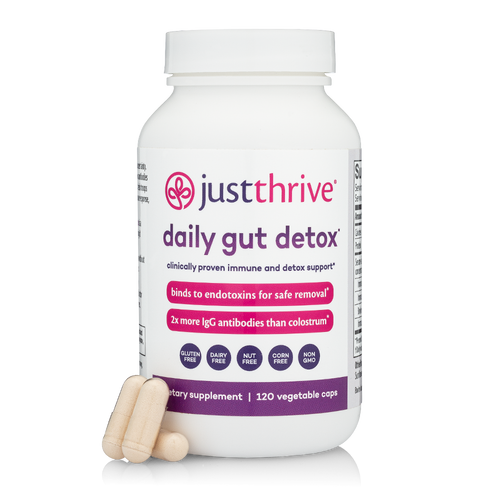
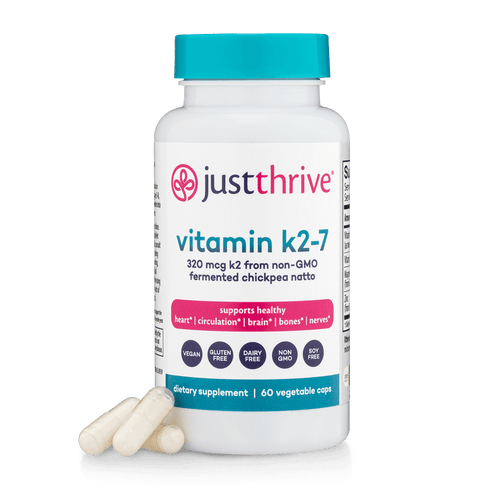
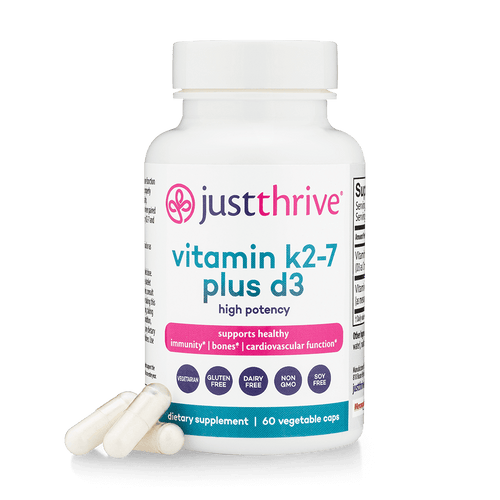
Support Gut and Oral Health Together with Just Thrive
Your oral health and gut health are tied together. Even though their microbiomes are separate, they have a two-way direct connection, affecting each other. And Just Thrive can help you support both ends of the gum-gut connection.
Just Thrive Probiotic is powered by clinically tested spore probiotics that deliver strong support to both your oral and gut microbiomes. It contains four proven spore strains:
- Bacillus indicus HU36™
- Bacillus subtilis HU58™
- Bacillus clausii
- Bacillus coagulans
Vitamin K2-7 Plus D3 contains high potency forms of both vitamins: 200 mcg of K2-7 and 5000 IU of D3. This essential nutrient duo supports a healthy mouth and a well-balanced gut.
>> Keep your mouth and gut healthy with Just Thrive Probiotic and Vitamin K2-7 Plus D3.
Not sure this supplement duo will work for you? While we’re confident that you’ll love the way you feel, if you’re not 100% happy with Just Thrive Probiotic and Vitamin K2-7 Plus D3, we’ve got your back.
At Just Thrive we offer you complete purchase protection, a 100% guarantee. If you’re not completely satisfied with your Just Thrive purchase for ANY reason, you can take advantage of our “Bottom of the Bottle” Guarantee:
Love your Just Thrive purchase, or request a full product refund at any time… Whether it’s 3 days, 3 weeks, or 3 months later… Even if the bottle is empty!
>> Try Just Thrive Probiotic and Vitamin K2-7 Plus D3 100% RISK-FREE today, and save 30% on your first month’s subscription with code SUB30.

Sources
- Kunath BJ, De Rudder C, Laczny CC, Letellier E, Wilmes P. The oral-gut microbiome axis in health and disease. Nat Rev Microbiol. 2024 Dec;22(12):791-805.
- Byrd KM, Gulati AS. The "Gum-Gut" Axis in Inflammatory Bowel Diseases: A Hypothesis-Driven Review of Associations and Advances. Front Immunol. 2021 Feb 19;12:620124.
- Pacheco-Yanes J, Reynolds E, Li J, Mariño E. Microbiome-targeted interventions for the control of oral-gut dysbiosis and chronic systemic inflammation. Trends Mol Med. 2023 Nov;29(11):912-925.
- Elzayat H, Mesto G, Al-Marzooq F. Unraveling the Impact of Gut and Oral Microbiome on Gut Health in Inflammatory Bowel Diseases. Nutrients. 2023 Jul 29;15(15):3377.
- Kitamoto S, Nagao-Kitamoto H, Hein R, Schmidt TM, Kamada N. The Bacterial Connection between the Oral Cavity and the Gut Diseases. J Dent Res. 2020 Aug;99(9):1021-1029.
- Wiertsema SP, van Bergenhenegouwen J, Garssen J, Knippels LMJ. The Interplay between the Gut Microbiome and the Immune System in the Context of Infectious Diseases throughout Life and the Role of Nutrition in Optimizing Treatment Strategies. Nutrients. 2021 Mar 9;13(3):886.
- Jiang Y, Jin H, Liang Q, Zhu X. Causal relationship between gut microbiota and dental caries: A Mendelian randomization analysis. Medicine (Baltimore). 2025 Feb 21;104(8):e41555.
- Wu Z, et al. Associations of periodontal disease and tooth loss with all-cause and cause-specific mortality in the Sister Study. J Clin Periodontol. 2021 Dec;48(12):1597-1604.
- Miyauchi, E., Yamazaki, K., Tsuboi, Y., Nakajima, T., Ono, S., Mizuno, K., … Yamazaki, K. (2025). Patients with periodontitis exhibit persistent dysbiosis of the gut microbiota and distinct serum metabolome. Journal of Oral Microbiology, 17(1).
- Al-Jubori SH, Al-Murad MA, Al-Mashhadane FA. Effect of Oral Vitamin D3 on Dental Caries: An In-Vivo and In-Vitro Study. Cureus. 2022 May 26;14(5):e25360.
- Anand N, Chandrasekaran SC, Rajput NS. Vitamin D and periodontal health: Current concepts. J Indian Soc Periodontol. 2013 May;17(3):302-8. doi: 10.4103/0972-124X.115645. PMID: 24049329; PMCID: PMC3768179.
- Wang J, et al. Contemporary Perspectives on the Role of Vitamin D in Enhancing Gut Health and Its Implications for Preventing and Managing Intestinal Diseases. Nutrients. 2024 Jul 20;16(14):2352.
- Olszewska-Czyz I, Firkova E. A Case Control Study Evaluating the Relationship between Vitamin K2 Serum Level and Periodontitis. Healthcare (Basel). 2023 Nov 10;11(22):2937.
- Chatterjee K, Mazumder PM, Sarkar SR, Saha R, Chatterjee A, Sarkar B, Banerjee S. Neuroprotective effect of Vitamin K2 against gut dysbiosis associated cognitive decline. Physiol Behav. 2023 Oct 1;269:114252.
- Di Stefano M, Santonocito S, Polizzi A, Mauceri R, Troiano G, Lo Giudice A, Romano A, Mascitti M, Isola G. A Reciprocal Link between Oral, Gut Microbiota during Periodontitis: The Potential Role of Probiotics in Reducing Dysbiosis-Induced Inflammation. Int J Mol Sci. 2023 Jan 6;24(2):1084.
- McFarlin BK, Deemer SE, Bridgeman EA. Oral Spore-Based Probiotic Supplementation Alters Post-Prandial Expression of mRNA Associated with Gastrointestinal Health. Biomedicines. 2024 Oct 18;12(10):2386.
- Beattie RE. Probiotics for oral health: a critical evaluation of bacterial strains. Front Microbiol. 2024 Jun 24;15:1430810.