



How one little-known nutrient can smooth fine lines and keep your complexion beautiful.
Have you ever spent money on creams and lotions to keep your face looking fresh… only to be let down by the appearance of more wrinkles and tired, “old-looking” skin?
We all want our skin to look youthful, but not everyone is willing to go to extremes to make it happen. After all, plastic surgery is expensive and potentially dangerous, and Botox is quite literally a toxin that gets injected near your brain.
Still, looking your best makes you feel more confident and in charge of your life... So wouldn’t it be wonderful if there was a way to minimize wrinkles and maximize your beautiful skin without blowing your bank account?… A way that would keep you safe from harmful side effects… and even improve your overall health?
As it turns out, the answer to achieving a youthful and vibrant complexion may lie in a powerful, but little-known nutrient that can help your skin look and feel younger from the inside out.
Quick Answer: The little-known nutrient behind healthy, youthful-looking skin is vitamin K2. Smooth, firm skin depends on two proteins, collagen and elastin, which can harden through a process called calcification when calcium ends up in soft tissue instead of bones and teeth. Vitamin K2 helps direct calcium where it belongs, which supports collagen and elastin and helps skin stay supple. K2 also supports bone, heart, blood sugar, and brain health. Because it is hard to get enough from food, many people choose a K2-7 (MK-7) supplement, the most absorbable form.
Which two proteins keep your skin looking young?
Healthy skin depends on two proteins: collagen, which keeps skin strong, smooth, and hydrated, and elastin, which keeps it flexible and supple. With age these proteins can lose function and even harden, which leads to wrinkles and sagging.
Vibrant, healthy skin depends on two important proteins: collagen and elastin.[1]
Collagen keeps your skin strong, smooth, and firm. It also increases your skin’s hydration, for that youthful, dewy glow.
Elastin provides flexibility to your skin, keeping it supple and elastic. So when your skin gets pinched or wrinkled, elastin smooths it back out.
Collagen and elastin work together to help you put your best face forward every day. But as you age, those proteins lose some of their function. Worse, they can become calcified, or hardened.[2] And when that happens, your skin can’t be smooth, strong, or elastic. Instead, your skin starts to age prematurely, and wrinkles start to take up permanent residence.
Unless, of course, you get to the source of the calcification problem, too much calcium going where it doesn’t belong.

How does vitamin K2 help keep your skin healthy?
Vitamin K2 activates proteins that direct calcium into your bones and teeth and away from soft tissue like skin and blood vessels. By helping calcium reach the right place, K2 helps protect collagen and elastin from hardening.
Your body relies on hundreds of proteins and enzymes to keep your cells, tissues, and organs functioning properly. And the lion’s share of those proteins can’t perform without an oft-overlooked power nutrient known as vitamin K2.
Vitamin K2’s main job is to activate the most important proteins and enzymes that keep your body running smoothly.[3]
And one of its most critical jobs is directing calcium into your bones and teeth… and away from soft tissue like blood vessels and skin.[4] Without K2 telling it where to go, calcium ends up in those soft tissues and hardens them, a process called calcification. That can lead to wrinkles, sagging skin, and other dangerous health problems.
But K2’s benefits don’t end with helping you sidestep calcification…
 Want to listen instead of read? CLICK HERE
What are the benefits of vitamin K2?
Beyond supporting youthful skin, vitamin K2 helps preserve bone density, manage blood sugar, support heart function, and aid memory and cognition. Research also links adequate K2 intake to a longer, healthier life.
For a little-known vitamin, K2 offers an impressive list of critical health benefits.[5] Along with keeping your skin young, smooth, and gorgeous, vitamin K2 helps:
- Preserve bone density and address bone loss[6]
- Manage blood sugar[7]
- Encourage peak heart function[8]
- Improve memory and cognition[9]
- Regulate vitamin D[10]
- Maintain healthy body mass[11]
Plus research shows that getting plenty of vitamin K2 can help you live a long, healthy life.[12]

Where can you get vitamin K2?
You can get vitamin K2 from certain foods or from a supplement, with a recommended daily intake around 320 mcg. Because few foods are high in K2 and some are an acquired taste, supplements are a common and reliable option.
Vitamin K2 can be taken naturally or as a dietary supplement, with a recommended daily intake of 320 mcg. Although that’s a fairly low amount, there’s no danger of having an excess of vitamin K2, because your body will quickly break down and excrete any amount that it doesn’t need.
Food Sources
These are the most potent dietary sources of K2 (based on 100-gram servings unless otherwise indicated).
- Natto (fermented soybeans): 108 micrograms
- Eel: 63 micrograms
- Muenster cheese: 100 micrograms
- Camembert cheese: 68 micrograms
- Edam and aged Gouda cheese: 63 micrograms
- Cheddar cheese: 24 micrograms
- Organ meat, such as beef liver: 11 micrograms
- Chicken: 10 micrograms
- Butter: 2.1 micrograms per tablespoon
- Sauerkraut: 2.75 micrograms per half-cup
- Egg yolks: between 67 and 192 micrograms per yolk (depending on the hen’s diet)
K2 Supplements
The list of foods that contain enough K2 isn’t very long, and some of these foods are an acquired taste not common to the standard Western diet. The most commonly eaten food, cheese, is high in fat and not recommended in high enough amounts to function as your only source of vitamin K2. And, if you need or prefer a diet without animal products, natto and sauerkraut would be your only options.
Because of these limitations, vitamin K2 is often recommended through supplementation.
Additionally, when there’s a deficiency (and it’s estimated that 97% of Westerners are K2 deficient), supplements are an easy and effective way to get vitamin K2 levels back to where they need to be to promote your overall health. However, there are a few disclaimers about taking supplements:
- Only buy from reputable companies that put all of the necessary nutritional information on their labels.
- Concentration levels can vary, so choose your supplements carefully and be sure that you are getting the right dosage (320 mcg is optimal).
- Look for Pharmaceutical Grade products; these are guaranteed to be at minimum 99% pure.
- When it comes to K2 supplements, stability is a big issue. Many K2 supplements deteriorate quickly on the shelf. Look for products formulated with MenaquinGold™, which ensures maximum stability.
One additional note:
Vitamin K2 comes in many different forms, ranging from K2-4 through K2-13.[13] The most natural, absorbable, and effective form is vitamin MK-7 (aka K2-7). That’s the one you want to prevent elastin and collagen from getting calcified… so your skin can look young and healthy every day.
| Getting your K2 | Food sources | K2-7 supplement |
|---|---|---|
| Variety of options | Few foods are high in K2 (natto, certain cheeses, organ meats) | A single daily dose covers your needs |
| Hitting the ~320 mcg target | Hard to reach consistently from diet alone | Formulated to deliver the recommended amount |
| Taste and diet fit | Some sources are an acquired taste or animal-based | Convenient regardless of diet |
| Form and stability | Varies by food and preparation | Look for the absorbable MK-7 (K2-7) form with stable sourcing |
Frequently Asked Questions About Vitamin K2 and Skin
How does vitamin K2 help your skin?
Vitamin K2 helps direct calcium into bones and teeth and away from soft tissue like skin. This helps protect collagen and elastin from calcifying, which supports smoother, more supple skin.
What is the difference between K2-4 and K2-7?
Vitamin K2 comes in several forms, from K2-4 through K2-13. K2-7 (MK-7) is considered the most natural, absorbable, and effective form, which is why it is the one most often recommended.
Can you get enough vitamin K2 from food?
It is difficult for many people. Few foods are rich in K2, and some, like natto, are an acquired taste, so supplements are a common way to reach the recommended intake.
How much vitamin K2 should you take?
The commonly cited optimal intake is around 320 mcg per day. The body breaks down and excretes what it does not need, and you should follow product labels and your healthcare provider’s guidance.
Does vitamin K2 do more than support skin?
Yes. K2 also supports bone density, heart function, blood sugar management, and cognition, making it a versatile nutrient for overall health.
Just Thrive Skin Health Products

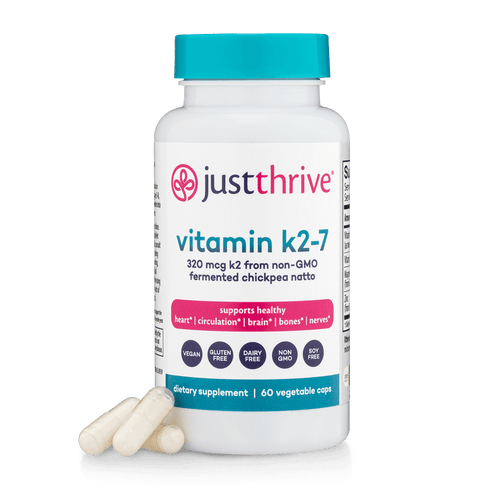

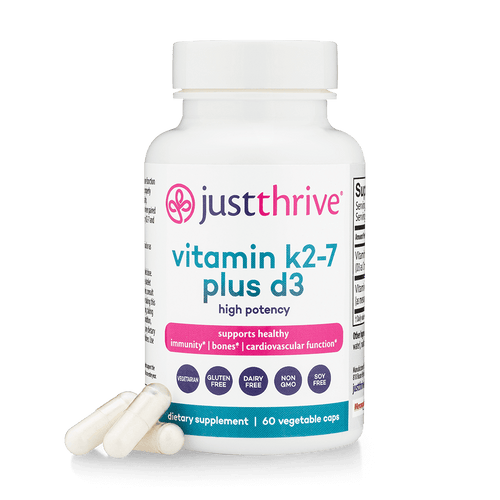
Beautify Your Skin with Just Thrive Vitamin K2-7
Looking your best is an important part of feeling your best. Your skin is the first thing people see, and healthy skin is key to feeling confident and attractive.
But according to studies, as much as 97% of people in the Western world are Vitamin K2 deficient. As we’ve learned, Vitamin K2 is essential for beautiful, young-looking skin, which is why it’s important to make sure you’re getting enough of it.
Just Thrive Vitamin K2-7 is the only K2-7 supplement on the market that has the expert-recommended amount (320 mcg) of all-natural, pharmaceutical grade K2 produced with MenaquinGold™ to guarantee 100% stability. Its proprietary manufacturing process ensures the highest quality, most effective Vitamin K2-7 available, so you can trust that you’re getting the best for your skin.
Don’t take any risks with your skin’s health. Trust Just Thrive Vitamin K2-7 to deliver the skin support you need so you can put your best face forward.
>> Unlock the secret to beautiful, healthy skin with Just Thrive Vitamin K2-7.
And did you know?
Just Thrive Vitamin K2-7 is covered by our Bottom of the Bottle, 100% money back guarantee.
So you can try Just Thrive Vitamin K2-7 risk-free to make sure it works for you… like it has for so many others.
But if for any reason you don’t notice a difference, simply ask for a full product refund. Any time. Even if it’s 3 months or 3 years later… and even if the bottle is empty!

Sources
- Uitto J. The role of elastin and collagen in cutaneous aging: intrinsic aging versus photoexposure. J Drugs Dermatol. 2008 Feb;7(2 Suppl):s12-6. PMID: 18404866.
- Gade PS, Robertson AM, Chuang CY. Multiphoton Imaging of Collagen, Elastin, and Calcification in Intact Soft-Tissue Samples. Curr Protoc Cytom. 2019 Jan;87(1):e51. doi: 10.1002/cpcy.51. Epub 2018 Oct 31.
- Jadhav N, Ajgaonkar S, Saha P, Gurav P, Pandey A, Basudkar V, Gada Y, Panda S, Jadhav S, Mehta D, Nair S. Molecular Pathways and Roles for Vitamin K2-7 as a Health-Beneficial Nutraceutical: Challenges and Opportunities. Front Pharmacol. 2022 Jun 14;13:896920. doi: 10.3389/fphar.2022.896920. PMID: 35774605; PMCID: PMC9237441.
- El Asmar MS, Naoum JJ, Arbid EJ. Vitamin k dependent proteins and the role of vitamin k2 in the modulation of vascular calcification: a review. Oman Med J. 2014 May;29(3):172-7. doi: 10.5001/omj.2014.44. PMID: 24936265; PMCID: PMC4052396.
- Jadhav N, Ajgaonkar S, Saha P, Gurav P, Pandey A, Basudkar V, Gada Y, Panda S, Jadhav S, Mehta D, Nair S. Molecular Pathways and Roles for Vitamin K2-7 as a Health-Beneficial Nutraceutical: Challenges and Opportunities. Front Pharmacol. 2022 Jun 14;13:896920. doi: 10.3389/fphar.2022.896920. PMID: 35774605; PMCID: PMC9237441.
- Rønn SH, Harsløf T, Pedersen SB, Langdahl BL. Vitamin K2 (menaquinone-7) prevents age-related deterioration of trabecular bone microarchitecture at the tibia in postmenopausal women. Eur J Endocrinol. 2016 Dec;175(6):541-549. doi: 10.1530/EJE-16-0498. Epub 2016 Sep 13. PMID: 27625301.
- Aguayo-Ruiz JI, García-Cobián TA, Pascoe-González S, Sánchez-Enríquez S, Llamas-Covarrubias IM, García-Iglesias T, López-Quintero A, Llamas-Covarrubias MA, Trujillo-Quiroz J, Rivera-Leon EA. Effect of supplementation with vitamins D3 and K2 on undercarboxylated osteocalcin and insulin serum levels in patients with type 2 diabetes mellitus: a randomized, double-blind, clinical trial. Diabetol Metab Syndr. 2020 Aug 18;12:73. doi: 10.1186/s13098-020-00580-w. PMID: 32831908; PMCID: PMC7436967.
- McFarlin BK, Henning AL, Venable AS. Oral Consumption of Vitamin K2 for 8 Weeks Associated With Increased Maximal Cardiac Output During Exercise. Altern Ther Health Med. 2017 Jul;23(4):26-32. PMID: 28646812.
- Alisi L, Cao R, De Angelis C, Cafolla A, Caramia F, Cartocci G, Librando A, Fiorelli M. The Relationships Between Vitamin K and Cognition: A Review of Current Evidence. Front Neurol. 2019 Mar 19;10:239. doi: 10.3389/fneur.2019.00239. PMID: 30949117; PMCID: PMC6436180.
- van Ballegooijen AJ, Pilz S, Tomaschitz A, Grübler MR, Verheyen N. The Synergistic Interplay between Vitamins D and K for Bone and Cardiovascular Health: A Narrative Review. Int J Endocrinol. 2017;2017:7454376. doi: 10.1155/2017/7454376. Epub 2017 Sep 12. PMID: 29138634; PMCID: PMC5613455.
- Knapen MH, Schurgers LJ, Shearer MJ, Newman P, Theuwissen E, Vermeer C. Association of vitamin K status with adiponectin and body composition in healthy subjects: uncarboxylated osteocalcin is not associated with fat mass and body weight. Br J Nutr. 2012 Sep 28;108(6):1017-24. doi: 10.1017/S000711451100626X. Epub 2011 Dec 5. PMID: 22136751.
- Juanola-Falgarona M, Salas-Salvadó J, Martínez-González MÁ, Corella D, Estruch R, Ros E, Fitó M, Arós F, Gómez-Gracia E, Fiol M, Lapetra J, Basora J, Lamuela-Raventós RM, Serra-Majem L, Pintó X, Muñoz MÁ, Ruiz-Gutiérrez V, Fernández-Ballart J, Bulló M. Dietary intake of vitamin K is inversely associated with mortality risk. J Nutr. 2014 May;144(5):743-50. doi: 10.3945/jn.113.187740. Epub 2014 Mar 19. Erratum in: J Nutr. 2016 Mar;146(3):653. PMID: 24647393.
- https://ods.od.nih.gov/factsheets/VitaminK-HealthProfessional/


